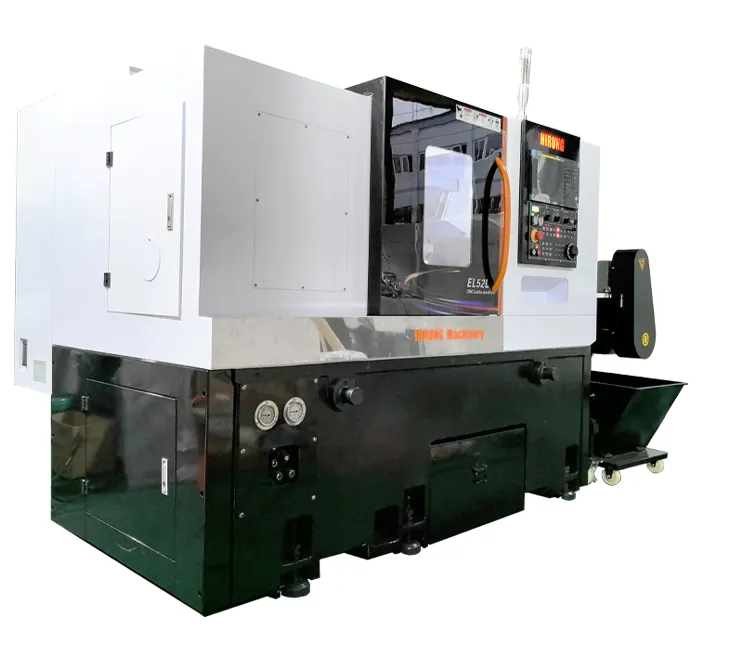
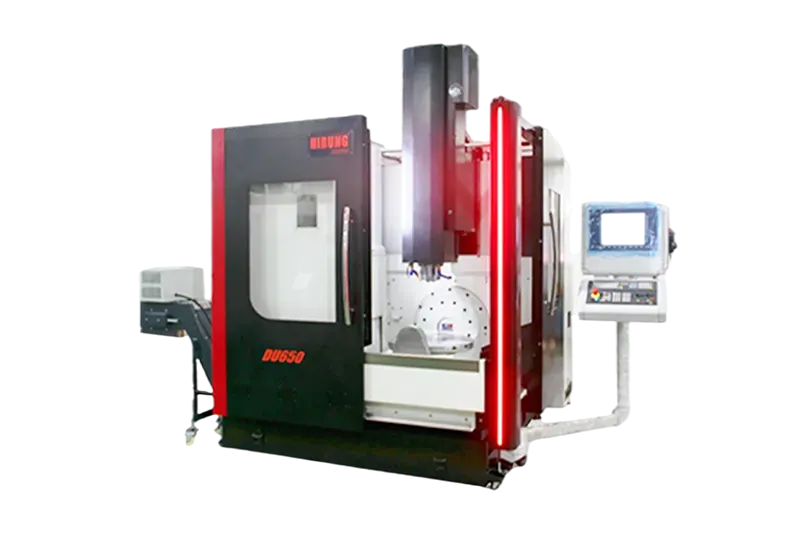
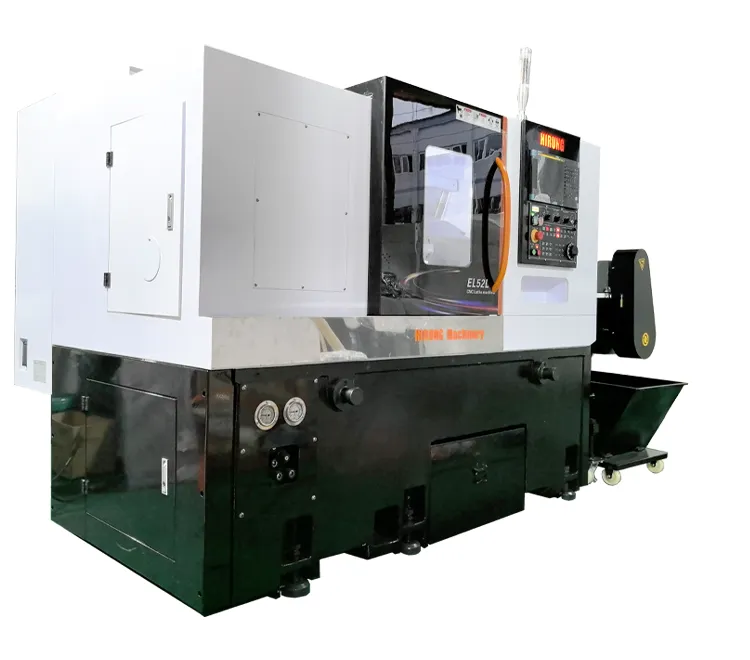
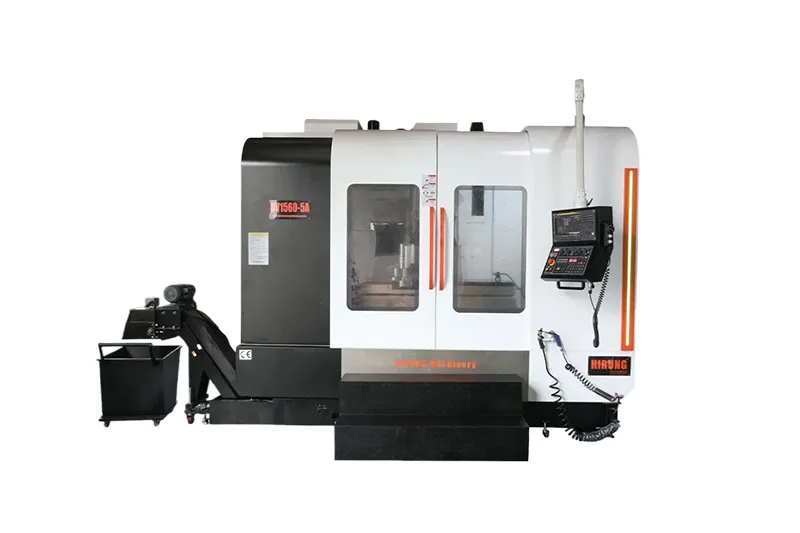
CNC vertical machining is a precision subtractive manufacturing process where a vertically oriented spindle holds and rotates a cutting tool to remove material from a stationary workpiece mounted on a worktable below. This method, performed by a Vertical Machining Center (VMC), is renowned for its accuracy, versatility, and efficiency in creating complex shapes, slots, holes, and details on a part’s surface. At Hirung, with over 20 years of specialized experience in the research, development, and production of high-end CNC machine tools, we leverage this technology to deliver exceptional quality and performance, making it a cornerstone of modern manufacturing across countless industries.

What is a Vertical Machining Center (VMC)?
A Vertical Machining Center, commonly abbreviated as VMC, is the machine tool that performs CNC vertical machining. Think of it as a highly sophisticated and automated version of a traditional milling machine. The defining characteristic is its vertical spindle orientation. The spindle, which is the heart of the machine, holds the cutting tool (like an end mill, drill, or tap) and moves up and down along the Z-axis. The worktable, which securely holds the workpiece, moves horizontally along the X and Y axes. This coordinated, computer-controlled movement allows the VMC to execute precise machining operations based on programmed instructions.
These machines are built for rigidity and precision. The entire structure, including the base, column, and spindle head, is designed to minimize vibration and ensure dimensional accuracy, even during aggressive cutting operations. VMCs are typically enclosed to contain cutting fluids and chips, ensuring a safe and clean working environment. As a leading manufacturer, Hirung’s VMC series, such as the VMC850, is engineered with high-grade cast iron and advanced control systems to guarantee stability and long-term reliability for our partners.
How Does CNC Vertical Machining Work? The Core Process
The magic of CNC vertical machining lies in its automated and programmatic workflow, which transforms a digital design into a physical part with incredible accuracy. The process is a seamless integration of digital design, machine programming, and physical execution.
The Role of the Vertically Oriented Spindle
The vertical spindle is the primary actor in this process. Because it approaches the workpiece from above, gravity works in its favor, providing a stable and consistent cutting force. The spindle can move vertically (Z-axis), while the table moves the workpiece left-to-right (X-axis) and front-to-back (Y-axis). The combination of these three axes of movement allows the cutting tool to reach any point on the top surface of the workpiece. This configuration is particularly effective for parts where most of the machining work is done on a single face, such as in mold making, creating pockets, or drilling precise hole patterns.
From CAD Design to Finished Part: The Workflow
The journey from concept to reality follows a clear, technology-driven path:
- CAD (Computer-Aided Design): Engineers and designers first create a 2D or 3D digital model of the final part using CAD software. This model contains all the necessary geometric data and dimensions.
- CAM (Computer-Aided Manufacturing): The CAD file is then imported into CAM software. Here, a programmer generates the toolpaths—the exact route the cutting tool will follow. This stage also involves selecting the right tools, setting cutting speeds, feed rates, and depth of cuts.
- G-code Generation: The CAM software translates the toolpaths and machining parameters into a machine-readable language called G-code (and M-code). This code consists of a series of alphanumeric commands that instruct the VMC on every movement and function, from spindle speed to coolant activation.
- Machine Setup & Execution: An operator securely fastens the raw material (the workpiece) onto the VMC’s worktable. They then load the necessary cutting tools into the automatic tool changer and upload the G-code program to the machine’s CNC controller. After performing safety checks and setting the part zero (datum), the operator initiates the cycle. The VMC then executes the G-code program automatically, precisely machining the part to the specified design.
Key Components of a Vertical Machining Center
Understanding the main components of a VMC is key to appreciating its capabilities. Each part plays a critical role in the machine’s overall performance and precision.
- CNC Controller: The “brain” of the machine. This is the computer interface where the G-code is loaded and processed. It interprets the code and sends electrical signals to the motors that drive the movement of the spindle and table, controlling every aspect of the operation with micron-level precision.
- Spindle: The core rotating component that holds the tool holder and cutting tool. Its speed (measured in RPM), power, and rigidity are critical factors that determine the machine’s ability to cut different materials and achieve desired surface finishes.
- Worktable: The flat, sturdy surface where the workpiece is mounted using clamps, vises, or custom fixtures. Its movement along the X and Y axes is essential for positioning the part correctly under the tool.
- Automatic Tool Changer (ATC): An automated carousel or chain that stores a variety of cutting tools. When the G-code calls for a tool change, the ATC quickly and automatically swaps the tool in the spindle, enabling complex jobs with multiple operations to run without manual intervention. This dramatically improves efficiency and reduces cycle times.
- Column and Base: The structural foundation of the machine. Usually made from heavy-duty cast iron to dampen vibrations, the base provides stability, while the column supports the spindle head and guides its vertical movement.
Vertical vs. Horizontal Machining: What’s the Difference?
A common question is how vertical machining compares to its counterpart, horizontal machining. The primary difference is the spindle orientation, which leads to distinct advantages and ideal use cases for each. Choosing between a VMC and a Horizontal Machining Center (HMC) depends entirely on the application’s specific requirements.
| Feature | Vertical Machining Center (VMC) | Horizontal Machining Center (HMC) |
|---|---|---|
| Spindle Orientation | Vertical (Z-axis is up and down) | Horizontal (Z-axis is in and out) |
| Gravity & Chip Evacuation | Chips can accumulate on top of the part, sometimes requiring coolant flushes or air blasts to clear. | Excellent chip evacuation. Gravity helps chips fall away from the part and into the chip conveyor. |
| Workpiece Visibility | Excellent. The operator can easily see the cutting process, making setup and monitoring simpler. | Visibility is often obstructed by the workpiece and tombstone fixture. |
| Workpiece Size & Weight | Best suited for smaller, lighter parts. Very large or heavy parts can be difficult to load and stress the table. | Ideal for large, heavy, and cubic parts. Often integrated with pallet changers for high-volume production. |
| Cost & Footprint | Generally less expensive and has a smaller footprint. More accessible for smaller shops. | Typically more expensive, larger, and more complex, representing a significant capital investment. |
| Ideal Applications | Single-sided operations, mold/die making, prototyping, smaller production runs. (e.g., plates, brackets). | Multi-sided machining in a single setup (using a tombstone), high-volume production, large components (e.g., engine blocks, gearboxes). |
Why Choose a Vertical Machining Center? Key Advantages
VMCs are the most common type of CNC milling machine in the world for several compelling reasons. Their design offers a unique blend of performance, accessibility, and value that makes them indispensable for a wide range of manufacturers.
Cost-Effectiveness and Accessibility
Compared to their horizontal counterparts, VMCs have a simpler design and construction, which translates to a lower initial purchase price. This makes them a more accessible entry point into precision CNC machining for startups, small-to-medium-sized businesses, and job shops. The lower investment barrier allows more companies to bring high-precision manufacturing capabilities in-house.
Simplicity and Ease of Use
The setup and programming for a VMC are often more straightforward than for an HMC. Because the workpiece is mounted flat on the table and the tool comes from above, visualizing the toolpaths and setting the part zero is intuitive. This simplicity can lead to shorter training times for operators and quicker turnaround times for new jobs.
Enhanced Visibility of the Machining Process
One of the most practical benefits of a VMC is the clear line of sight to the machining area. Operators can easily watch the cutting tool engage with the workpiece, allowing them to monitor the process for any potential issues, check the surface finish in real-time, and make adjustments on the fly. This is especially valuable during prototyping and first-article inspection.
Space Efficiency
VMCs typically have a more compact, vertical design, occupying less floor space than the often sprawling footprint of an HMC with its associated pallet systems. For workshops where every square foot counts, the space-saving nature of a VMC is a significant advantage.
Are There Limitations to Vertical Machining?
While highly versatile, VMCs are not the perfect solution for every machining task. It’s important to understand their limitations to make an informed decision. The most significant challenge is chip evacuation. Because the workpiece is flat, chips and cutting fluid can pool on the surface, potentially leading to re-cutting of chips, which can degrade surface finish and cause premature tool wear. This often requires high-pressure through-spindle coolant or programmed air blasts to mitigate. Additionally, VMCs are less efficient for machining multiple sides of a complex, cubic part in a single setup, which would require re-fixturing the part for each side.
Common Applications and Industries Served by VMCs
The versatility of CNC vertical machining makes it a foundational technology in nearly every sector of manufacturing. Its ability to produce high-precision components efficiently makes it invaluable.
- Aerospace: Manufacturing of structural components, brackets, and interior fittings that require high precision and complex geometries.
- Automotive: Production of engine components, transmission parts, suspension elements, and molds for plastic or cast parts.
- Medical: Creating custom surgical instruments, orthopedic implants (like knee or hip replacements), and components for medical devices from materials like titanium and stainless steel.
- Mold and Die: A primary application for VMCs is the creation of injection molds and stamping dies, where complex 3D surface contouring is essential.
- Electronics: Machining of heat sinks, enclosures, and chassis for electronic devices.
- Prototyping and Job Shops: VMCs are perfect for creating one-off prototypes and handling small-to-medium-sized production runs due to their quick setup and flexibility.
Exploring Different Types of VMCs: From 3 to 5-Axis
Not all VMCs are the same. They are primarily categorized by the number of axes of movement they can control, which directly impacts the complexity of the parts they can produce.
Standard 3-Axis VMCs
This is the most common type of VMC. It operates on the three linear axes: X (left-right), Y (front-back), and Z (up-down). A 3-axis VMC is perfect for parts that can be machined from a single direction, such as plates, manifolds, and parts with pockets, slots, and drilled holes. They are the workhorses of the industry, known for their reliability and simplicity.
4-Axis and 5-Axis VMCs: Expanding Capabilities
To machine more complex geometries, additional rotary axes are introduced.
- 4-Axis VMCs add a rotary axis (the A-axis) to the worktable. This allows the workpiece to be rotated, enabling the machine to access four sides of a part without needing to manually re-clamp it.
- 5-Axis VMCs are the pinnacle of machining capability. They feature three linear axes (X, Y, Z) and two rotary axes (typically A and C axes, or a B and C trunnion table). This allows the cutting tool to approach the workpiece from an infinite number of angles in a single setup. 5-axis machining is essential for highly complex parts like turbine blades, impellers, and intricate medical implants, drastically reducing setup time and improving accuracy by eliminating re-fixturing errors.
Choosing the Right VMC for Your Needs with Hirung
Understanding what CNC vertical machining is and how it works is the first step. The next is selecting the right machine to empower your production. At Hirung, we are more than just a manufacturer; we are your trusted CNC machine tool partner. With over two decades of industry-leading experience and a commitment to quality backed by ISO9001 and CE certifications, we understand that the right machine is a catalyst for growth.
Whether you need the robust reliability of a 3-axis VMC like our VMC850 for versatile job shop work or the advanced capabilities of a 5-axis machine for complex components, our team of experts is here to guide you. We analyze your specific applications, production goals, and budget to recommend a solution that delivers maximum value and performance. We build partnerships grounded in trust, quality, and exceptional service.
Ready to elevate your manufacturing capabilities with a high-performance Vertical Machining Center? Contact our experts at Hirung today to discuss your project and discover how our technology can drive your success.