The different types of CNC work primarily include subtractive processes like CNC milling, CNC turning (lathing), CNC drilling, and CNC grinding. These advanced manufacturing operations utilize computer-controlled machines to precisely remove material from a workpiece, shaping it into a highly accurate, custom-designed part. Beyond these core methods, the world of CNC also extends to specialized work such as routing, plasma cutting, laser cutting, and Electrical Discharge Machining (EDM). Understanding which process is right for a specific application is the key to achieving optimal results in quality, efficiency, and cost-effectiveness.

In today’s fast-paced industrial landscape, Computer Numerical Control (CNC) technology is the backbone of modern manufacturing. From aerospace components to medical implants, the precision and repeatability offered by CNC machining are unparalleled. It has transformed the way we produce parts, moving from labor-intensive manual processes to automated, software-driven perfection. As a leading manufacturer and exporter of high-quality CNC machine tools, we at Hirung have a deep, hands-on understanding of these processes. This guide will walk you through the various types of CNC work, drawing from our expertise to help you understand their functions, applications, and unique advantages.
First, What Exactly is CNC Machining?
Before diving into the different types of work, it’s crucial to understand the core concept. CNC stands for Computer Numerical Control. In essence, it is an automated manufacturing process where pre-programmed computer software dictates the movement of factory tools and machinery. The process takes a digital design, created using Computer-Aided Design (CAD) software, and translates it into a specific set of instructions, known as G-code. This G-code tells the CNC machine exactly where to move, how fast to move, and when to activate its cutting tool.
This automation marks a significant leap from traditional, manual machining, which relies on the skill and steady hand of a human operator. The primary benefits of CNC machining are its incredible precision, consistency, and efficiency. A CNC machine can flawlessly reproduce the same part thousands of times with tolerances as fine as a few microns. This capability is essential for industries like automotive, aerospace, and defense, where every component must meet exacting standards. At Hirung, our machines are built on this principle of unwavering precision, powered by world-class control systems from FANUC and Siemens.
The Core Categories of CNC Work: A Breakdown
Most common CNC work falls under the umbrella of subtractive manufacturing. This means we start with a solid block of material (a “workpiece” or “blank”) and strategically cut away material to reveal the final desired shape. The way this material is removed defines the type of CNC work.
Subtractive Machining: The Foundation of CNC
Imagine a sculptor starting with a block of marble and chipping away until a statue emerges—that is the essence of subtractive manufacturing. CNC machines do this with incredible speed and precision on materials ranging from aluminum and steel to titanium and specialized plastics. The main types of subtractive CNC work—milling, turning, drilling, and grinding—are the workhorses of the industry, each suited for creating different types of geometries.
CNC Milling: Shaping with Multi-Axis Precision
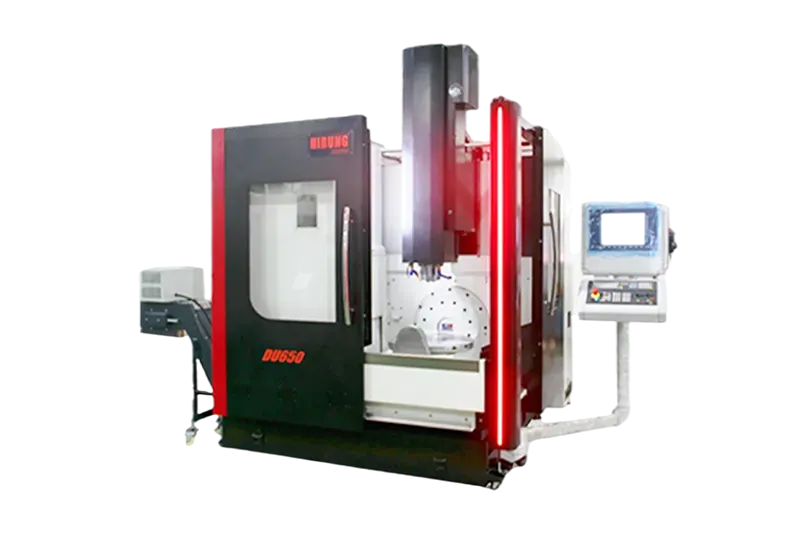
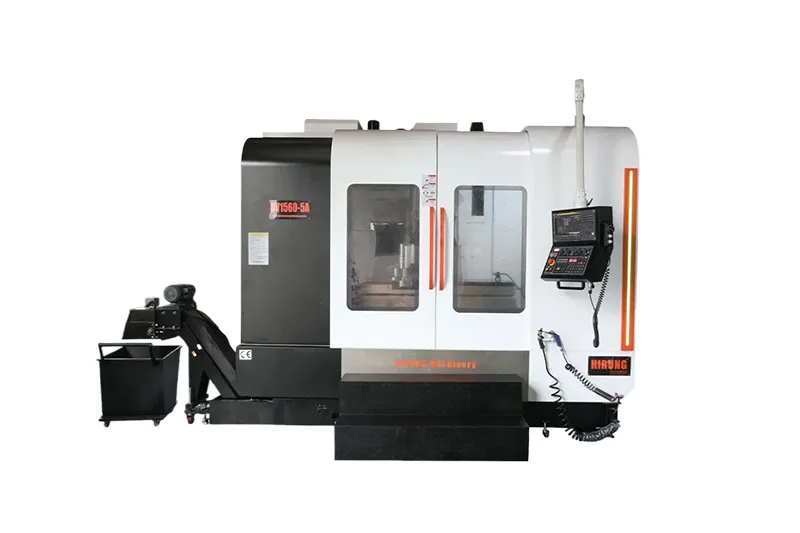
What is it? CNC milling is a process that uses rotating multi-point cutting tools to remove material from the workpiece. In a typical milling setup, the workpiece is held stationary on a bed, and the cutting tool, housed in a rotating spindle, moves along multiple axes to create the desired features, such as slots, holes, pockets, and complex surface contours.
How does it work? The versatility of CNC milling comes from the number of axes it can operate on.
- 3-Axis Milling: The tool moves along the X, Y, and Z axes (left-right, forward-back, up-down). This is ideal for parts with simpler, prismatic geometries.
- 4-Axis Milling: This adds a rotational axis (the A-axis), allowing the workpiece to be turned so it can be machined on different sides without manual refixturing.
- 5-Axis Milling: The pinnacle of milling technology, 5-axis machines add a second rotational axis (the B-axis). This allows for the creation of extremely complex shapes and organic curves, as the cutting tool can approach the workpiece from virtually any angle. This is critical for manufacturing turbine blades, complex molds, and aerospace structural components.
Applications and Machines: Milling is used to create a vast range of parts, from engine blocks and custom enclosures to intricate molds. The machines used are called machining centers. Hirung specializes in manufacturing both Vertical Machining Centers (VMCs), where the spindle is vertically oriented, and Horizontal Machining Centers (HMCs), which are often better for complex, multi-sided parts and high-volume production.
CNC Turning: Crafting High-Precision Cylindrical Parts
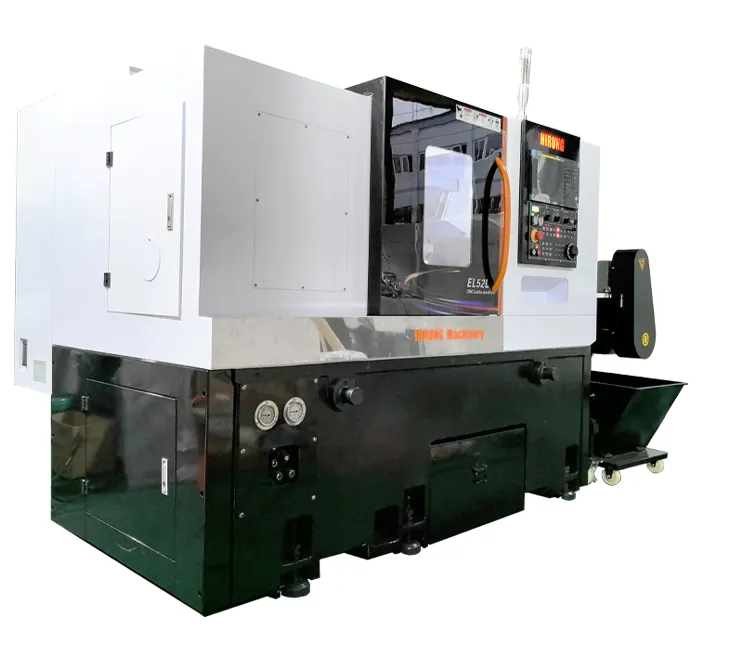
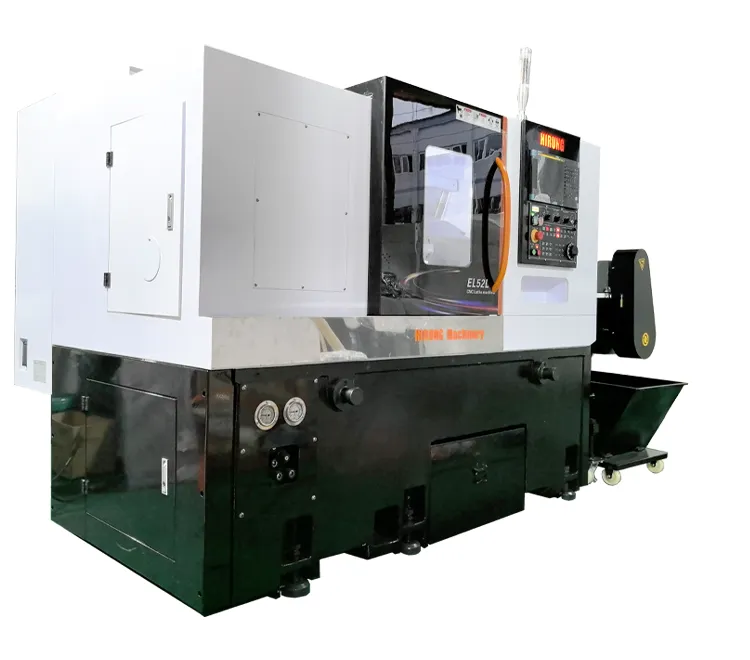
What is it? In contrast to milling, CNC turning involves rotating the workpiece at high speed while a stationary, single-point cutting tool moves along its surface to remove material. This process is used to create parts with cylindrical, conical, or helical features.
How does it work? The workpiece is held in a chuck and spun by a spindle. The cutting tool is mounted on a turret, which is guided by the CNC program to perform various operations like facing (creating a flat face), parting (cutting the part off), grooving, and thread cutting. Modern turning centers, often called CNC lathes, can also incorporate “live tooling,” where rotating tools can be used to mill or drill features on the part, combining turning and milling into one seamless operation.
Applications and Machines: Turning is the go-to process for producing any component that is rotational in nature. This includes shafts, bolts, screws, flanges, and custom fittings. Hirung’s line of Slant Bed CNC Lathes are designed for high precision and stability, making them perfect for industries that demand tight tolerances on their rotational parts.
CNC Drilling: More Than Just Making Holes
What is it? While seemingly simple, CNC drilling is a fundamental and precise operation. It uses a rotating drill bit to create, size, or finish a hole in the workpiece. While there are dedicated CNC drilling machines, this operation is most often performed on CNC milling machines or turning centers.
How does it work? The CNC controller precisely positions the workpiece (or the tool) and controls the depth and feed rate of the drill bit. But CNC hole-making goes beyond basic drilling. Associated processes include:
- Boring: Using a single-point tool to enlarge an existing hole to a precise diameter.
- Reaming: Using a specialized rotary tool to lightly enlarge a hole, providing a very smooth internal finish and extremely tight tolerance.
- Tapping: Cutting internal threads into a hole to accommodate a screw or bolt.
CNC Grinding: Achieving Superior Surface Finishes
What is it? CNC grinding is a finishing process that uses a rotating abrasive wheel to remove minute amounts of material from a workpiece. Its purpose is not to create a shape from scratch, but to refine an existing shape to achieve an exceptionally fine surface finish and extremely tight dimensional tolerances.
How does it work? The grinding wheel, made of countless abrasive grains, acts as a multi-point cutting tool. As it spins against the workpiece, it shears away microscopic chips of material. CNC grinders can perform cylindrical grinding (for shafts), surface grinding (for flat surfaces), and complex profile grinding. The process is valued for its ability to machine very hard materials, such as hardened steel, that are difficult to cut with traditional milling or turning tools.
Applications: Grinding is essential for producing high-performance components like ball bearings, transmission shafts, camshafts, and any part where friction and wear must be minimized.
Specialized and Advanced CNC Processes
While the core four make up the bulk of CNC work, technology continues to evolve. Several other CNC-controlled processes are vital for specific materials and applications.
CNC Routing: The Go-To for Softer Materials
Functionally similar to milling, CNC routing is optimized for cutting softer materials like wood, plastics, foam, and composites. CNC routers typically operate at much higher spindle speeds than milling machines and are built on large, flatbed gantries to accommodate large sheets of material. This process is a cornerstone of the sign-making, woodworking, and furniture industries.
Other Related CNC-Driven Processes
These processes don’t always use traditional cutting tools but rely on CNC for their precision:
- Laser Cutting: A focused laser beam melts, burns, or vaporizes material. It is extremely precise and ideal for cutting intricate patterns in sheet metal or other materials.
- Plasma Cutting: An accelerated jet of hot plasma is used to cut through electrically conductive materials like steel and aluminum. It’s much faster than milling but less precise.
- Electrical Discharge Machining (EDM): Uses electrical sparks to erode material. It’s perfect for creating complex shapes in extremely hard metals or for features that are impossible to create with a traditional cutting tool.
A Quick-Reference Guide: Comparing CNC Work Types
To help visualize the differences, here is a simple comparison of the main subtractive processes:
| Process | Tool Action | Workpiece Action | Best For | Common Machines |
|---|---|---|---|---|
| CNC Milling | Rotating multi-point tool moves along multiple axes | Stationary (but can be rotated in 4/5-axis) | Complex shapes, slots, pockets, flat surfaces | Vertical/Horizontal Machining Center |
| CNC Turning | Stationary (or live) single-point tool moves along workpiece | Rotates at high speed | Cylindrical, conical, and helical parts (shafts, bolts) | CNC Lathe / Turning Center |
| CNC Drilling | Rotating drill bit moves into the workpiece | Stationary | Creating, sizing, or threading holes | Machining Center, Lathe, Drill Press |
| CNC Grinding | Rotating abrasive wheel removes micro-material | Can be stationary or rotating | Achieving ultra-fine surface finishes and tight tolerances | CNC Grinding Machine |
How Do You Choose the Right Type of CNC Work for Your Project?
Selecting the correct CNC process is a critical decision that impacts quality, lead time, and cost. From our experience at Hirung helping clients across dozens of industries, the choice typically boils down to four key factors:
- Part Geometry: This is the most important consideration. Is the part primarily cylindrical? If so, turning is the most efficient process. Is it prismatic with pockets, holes, and complex surfaces? Milling is the clear choice. For parts with extremely complex, organic curves, 5-axis milling is likely necessary.
- Material Properties: The hardness and machinability of the workpiece material matter. Extremely hard materials may require grinding or EDM after initial machining, while softer materials like wood or plastic are best suited for routing.
- Tolerance and Surface Finish: What level of precision is required? If a standard machined finish is acceptable, milling and turning are sufficient. If the part requires a mirror-like finish or tolerances in the single-micron range, a secondary grinding operation will be essential.
- Production Volume and Cost: For one-off prototypes, the process choice may be flexible. For high-volume production, however, optimizing the process for speed and efficiency is key. This might involve using a multi-turret lathe or a horizontal machining center with a pallet changer to minimize setup time and maximize output.
Partner with the CNC Experts at Hirung
Understanding the different types of CNC work is the first step toward optimizing your manufacturing operations. Each process—from the robust power of milling and the rotational precision of turning to the finishing touch of grinding—plays a unique and vital role. The success of any project depends not only on choosing the right process but on using high-quality, reliable, and precise machinery to execute it.
At Hirung, we don’t just sell machines; we provide manufacturing solutions. With a legacy of R&D and a commitment to quality, our range of CNC Lathes, Vertical Machining Centers, and Horizontal Machining Centers are engineered to deliver the performance and reliability your business demands. Whether you are producing parts for the automotive, aerospace, or energy sector, our team of experts is ready to help you select the ideal machine tools for your specific needs.
Ready to elevate your production capabilities? Contact our engineering team today to discuss your project, or explore our complete lineup of high-precision CNC machines to find the perfect fit for your workshop.