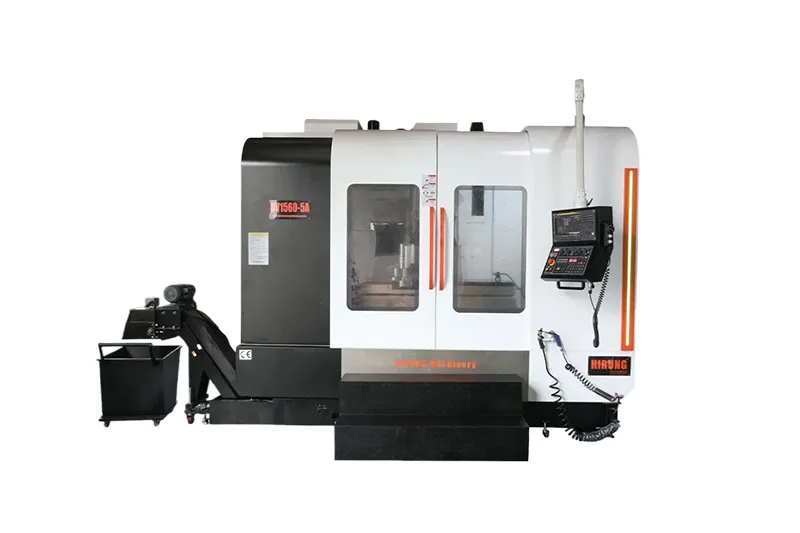
In the competitive landscape of modern manufacturing, the quality and efficiency of mold production are paramount. The next-generation tool for this demanding task is the high-speed, high-rigidity Vertical Machining Center (VMC). These machines are specifically engineered to deliver the exceptional precision, superior surface finish, and reduced cycle times that mold makers require. A HIRUNG VMC, with its robust construction and advanced technological integration, represents the pinnacle of this design philosophy, directly addressing the complex challenges of die and mold machining.
What Makes a VMC Ideal for Mold Making?
Mold and die manufacturing presents a unique set of challenges. It demands the ability to machine hardened steels and exotic alloys with extreme accuracy, often involving complex 3D contours, deep cavities, and intricate details. The final product must have an impeccable surface finish to ensure the quality of the molded parts, minimizing or eliminating the need for manual polishing. A standard Vertical Machining Center may struggle to meet these demands, leading to inaccuracies, poor finishes, and extended production times.
An ideal VMC for mold making must therefore possess a specific combination of attributes. High rigidity is essential to absorb cutting forces and prevent vibration, which is a primary cause of tool chatter and dimensional errors. Simultaneously, high-speed capability, particularly in the spindle and axis movements, is critical for utilizing modern cutting tools effectively, enabling fine, precise cuts that produce mirror-like surfaces and drastically reduce machining time. The synergy between these two core characteristics defines a machine’s suitability for high-stakes mold applications.
The Bedrock of Precision: Why High Rigidity is Non-Negotiable
Rigidity is the fundamental quality from which all precision is born. In mold machining, where tolerances are measured in microns, any deflection or vibration in the machine structure translates directly into imperfections on the workpiece. A rigid machine frame ensures that the cutting tool’s path is precisely what the CNC program dictates, even under the heavy loads of roughing or the high-frequency movements of finishing. This stability is the key to achieving consistent accuracy, extending tool life by preventing chatter, and creating a flawless surface.
Structural Integrity with Meehanite Casting
The choice of material for the machine base and column is the first step in building a rigid structure. HIRUNG VMCs are constructed using high-grade Meehanite cast iron. Unlike standard castings, the Meehanite process ensures a uniform, dense, and fine-grained microstructure, which provides superior vibration damping and high compressive strength. This material choice minimizes structural deformation under load and effectively absorbs vibrations generated during the cutting process, creating a stable foundation for high-precision machining.
Wide-Span Base and Column Design
Beyond material, the geometric design of the structure is critical. HIRUNG employs a wide-span base and a robust, box-type column structure. This engineering approach maximizes the machine’s stability by creating a larger, more stable footprint. The wide spacing of the linear guideways on the base distributes forces over a broader area, resisting the twisting and bending moments that can occur during aggressive cutting. This enhanced structural integrity ensures that the geometric accuracy of the machine is maintained throughout the entire machining envelope, which is vital when working on large and complex molds.
Unleashing Productivity: The Role of High-Speed Spindles
While rigidity provides the stable platform, the high-speed spindle is the engine that drives productivity and quality in modern mold making. High RPMs allow for higher feed rates with smaller-diameter tools, which is the cornerstone of High-Speed Machining (HSM) techniques. This approach enables faster material removal, especially during finishing passes, and significantly reduces the overall cycle time for a mold.
Achieving Superior Surface Finishes
How does a high-speed spindle improve surface finish? By operating at high RPMs, the chipload per tooth can be kept small and consistent. This results in finer, cleaner cuts that leave a smoother surface, often referred to as a “mirror finish.” This capability can dramatically reduce or even eliminate the time-consuming and labor-intensive manual polishing process that follows machining. For mold makers, this translates directly into faster delivery times and lower labor costs. The spindle’s precision bearings and balancing are critical, as any runout at high speeds would negate these benefits.
Direct-Drive Technology for Efficiency
Many advanced VMCs, including select HIRUNG models, utilize direct-drive spindle technology. In this design, the motor is coupled directly to the spindle, eliminating belts or gears. This configuration offers several key advantages for mold machining. It reduces vibration and heat generation, improves acceleration and deceleration for faster tapping and tool changes, and provides greater thermal stability. The result is a more efficient, reliable, and precise spindle system capable of sustained high-performance operation.
How Does Machine Design Impact Machining Stability?
Machining stability is the holistic result of every component working in harmony. It goes beyond a single feature and represents the overall dynamic performance of the machine. The design of a Vertical Machining Center directly influences its ability to perform stable, chatter-free cutting across a wide range of operating parameters. This involves a careful balancing act between static rigidity (the machine’s stiffness at rest) and dynamic rigidity (its behavior during cutting).
Factors like the mass and distribution of the machine’s components, the design of the spindle headstock, and the way the axes are supported all play a crucial role. For example, a well-designed headstock minimizes overhang to keep the tool as close to the rigid support structure as possible. The internal ribbing within the cast iron structures is also meticulously engineered using Finite Element Analysis (FEA) to counteract specific vibrational modes. This deep level of engineering ensures that HIRUNG machines remain stable and predictable, allowing operators to push cutting parameters with confidence.
Precision in Motion: Analyzing Guideway and Drive Systems
If the machine frame is the skeleton, the guideways and drive systems are the muscles and nerves that execute precise movements. The accuracy and responsiveness of these systems are critical for translating the CNC’s commands into flawless tool motion. In mold making, where complex 3D contours require constant, minute changes in direction, the performance of these components is under constant scrutiny.
The Function of C3 Class Ball Screws
HIRUNG VMCs utilize high-precision C3 class ball screws. These components are responsible for converting the rotary motion of the servo motors into linear motion of the machine axes. The “C3” classification denotes a high level of accuracy, ensuring minimal backlash and lead error. The ball screws are often pre-tensioned, which eliminates play in the system and increases their axial stiffness. This prevents the axes from “bouncing” during rapid direction changes, a common issue in contouring, and ensures that the tool tip is always exactly where it is commanded to be.
High-Precision Linear Guideways
High-quality roller-type linear guideways provide the low-friction, high-load-capacity pathways on which the machine’s moving components travel. Compared to older box-way designs, modern linear guideways offer lower friction, enabling higher rapid traverse rates and better acceleration. Their design provides excellent straightness and parallelism, ensuring that movement in one axis does not induce error in another. This allows for fast, responsive, and accurate positioning, which is essential for the high-speed, multi-axis contouring that defines modern mold machining.
The Brains of the Operation: Advanced CNC Control for Complex Molds
A powerful mechanical structure is only as good as the control system directing it. Modern mold programs are often massive, with millions of lines of code defining complex toolpaths. The CNC control must be able to process this data at high speed without “starving” the machine of information. Advanced controls from partners like Fanuc, Siemens, or Mitsubishi, which are integrated into HIRUNG machines, provide the necessary processing power.
Features like high-speed look-ahead, nano-interpolation, and sophisticated acceleration/deceleration algorithms are vital. Look-ahead allows the control to read many blocks of code in advance, anticipating changes in direction and optimizing the machine’s velocity and acceleration to navigate corners smoothly without pausing or leaving tool marks. This ensures a consistent cutting speed and a superior surface finish, turning complex geometry into a smooth, flowing machining process.
Managing the Heat: The Importance of Thermal Stability
Machining generates heat—from the spindle, the servo motors, and the cutting process itself. This heat can cause components to expand, leading to thermal-induced inaccuracies that can ruin a precision mold. A next-generation VMC must actively manage this thermal growth. This is achieved through a combination of smart design and dedicated cooling systems.
HIRUNG machines address this challenge with features like spindle oil coolers, which circulate chilled fluid to maintain a constant temperature in the spindle bearings and motor housing. Some advanced systems may also incorporate cooled ball screws. This active thermal management ensures that the machine’s accuracy remains consistent from the beginning of a long machining cycle to the end. By preventing thermal drift, the machine can hold tight tolerances over many hours of continuous operation, a common requirement for finishing large molds.
What Advanced Features in HIRUNG VMCs Target Mold Machining Challenges?
Beyond the core principles of speed and rigidity, HIRUNG integrates specific features designed to tackle the day-to-day problems of a mold shop. An efficient chip management system, for example, is crucial. Molds often require deep pocketing, and the inability to effectively evacuate chips can lead to tool breakage and a poor surface finish. HIRUNG’s design often includes high-volume coolant systems and steep internal inclines to flush chips away from the cutting zone and out of the machine.
Additionally, the fast and reliable Automatic Tool Changer (ATC) minimizes non-cutting time. Mold machining often requires a large number of different tools for roughing, semi-finishing, finishing, and detailing. A quick and dependable ATC ensures that the transition between these operations is seamless, maximizing the machine’s uptime and overall productivity. These practical, application-focused features demonstrate a deep understanding of the mold maker’s workflow.
Tangible Benefits: Translating Design into Business Value
The sophisticated engineering behind a high-speed, high-rigidity VMC translates directly into measurable benefits for a business. The combination of design elements discussed delivers a powerful return on investment through improved efficiency, quality, and capability.
| Feature | Technical Advantage | Business Benefit |
| High-Rigidity Meehanite Frame | Absorbs vibration and resists deflection under load. | Higher accuracy, longer tool life, ability to machine harder materials. |
| High-Speed Direct-Drive Spindle | Enables high feed rates and fine cuts with minimal heat/vibration. | Reduced cycle times, superior surface finish, less manual polishing. |
| Precision C3 Ball Screws & Guideways | Ensures backlash-free, responsive, and accurate axis movement. | Exceptional contouring accuracy, improved repeatability. |
| Advanced CNC Control | Fast block processing and look-ahead for smooth toolpaths. | Flawless execution of complex 3D programs, reduced risk of errors. |
Future-Proofing Your Mold Shop with Next-Generation Technology
Investing in a machine tool is a long-term strategic decision. The demands on mold makers for tighter tolerances, more complex geometries, and faster turnarounds will only increase. Choosing a machine that is merely adequate for today’s jobs means falling behind tomorrow. By contrast, investing in a VMC built on a foundation of high rigidity and high-speed capability is an investment in future competitiveness.
The engineering philosophy behind HIRUNG VMCs—marrying a massively rigid structure with fast, precise motion systems and intelligent control—provides a platform that is not only capable of meeting today’s challenges but is also ready for the advanced tooling and machining strategies of the future. It empowers mold shops to take on more complex work, deliver higher quality products, and operate with greater efficiency, securing their position at the forefront of the industry.