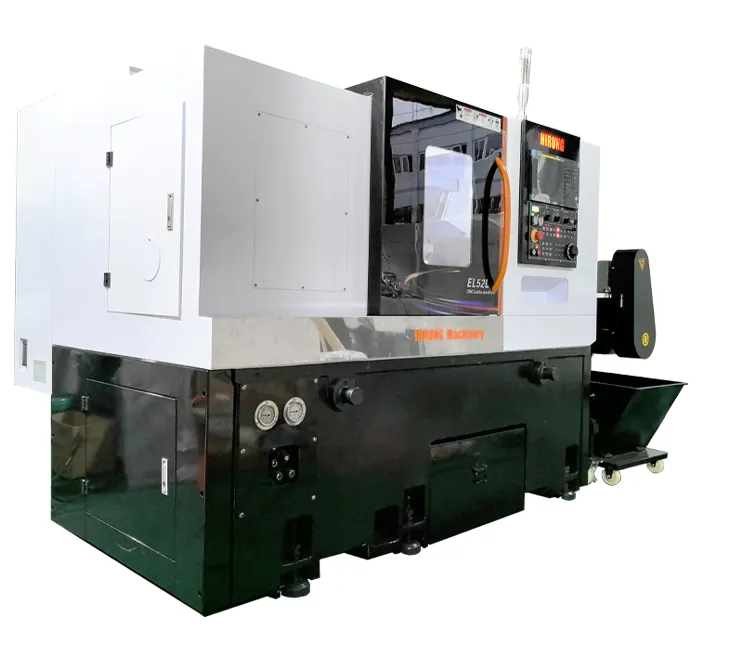
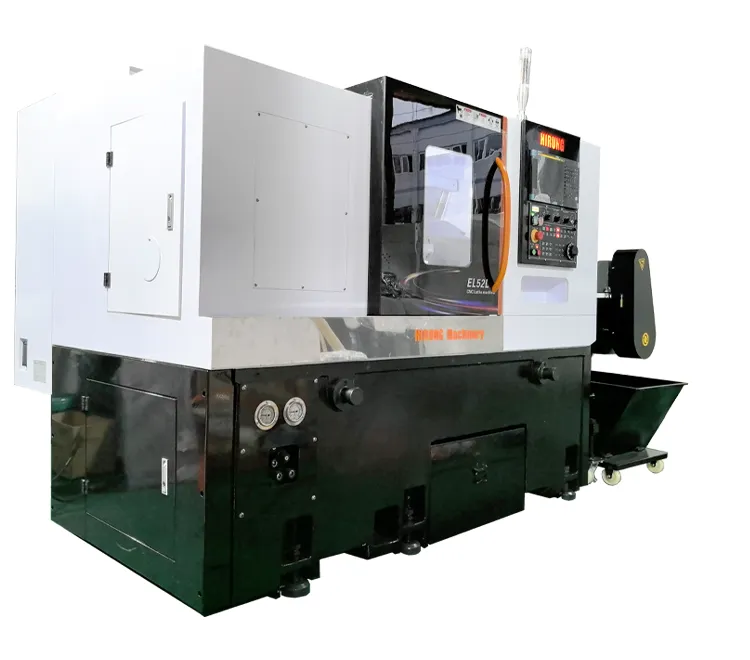
A CNC lathe machine and a CNC turning center are both used for machining rotating metal parts, but they are not always the same in capability. A CNC lathe mainly performs turning operations such as facing, external turning, boring, grooving, and threading. A CNC turning center is generally a more advanced turning machine that may include automatic tool changing, turret tooling, live tooling, C-axis control, Y-axis machining, sub-spindle options, and higher automation for complex production.
The main difference between a CNC lathe machine and a CNC turning center is that a CNC lathe focuses on standard turning operations, while a CNC turning center is designed for higher productivity, more complex processes, and greater automation.
For buyers who manufacture shafts, sleeves, bushings, rings, flanges, threaded parts, hydraulic components, automotive parts, and precision metal components, understanding this difference is important. Choosing the wrong machine can increase setup time, limit machining capability, reduce production efficiency, or create unnecessary investment cost.
This guide explains the practical difference between CNC lathe machines and CNC turning centers from a B2B purchasing perspective. It covers machine structure, machining functions, tooling configuration, application suitability, cost considerations, and selection recommendations.
If you are evaluating CNC turning equipment for industrial metal parts production, you can also review the CNC Lathe Machine EL Series as a reference for common turning applications.
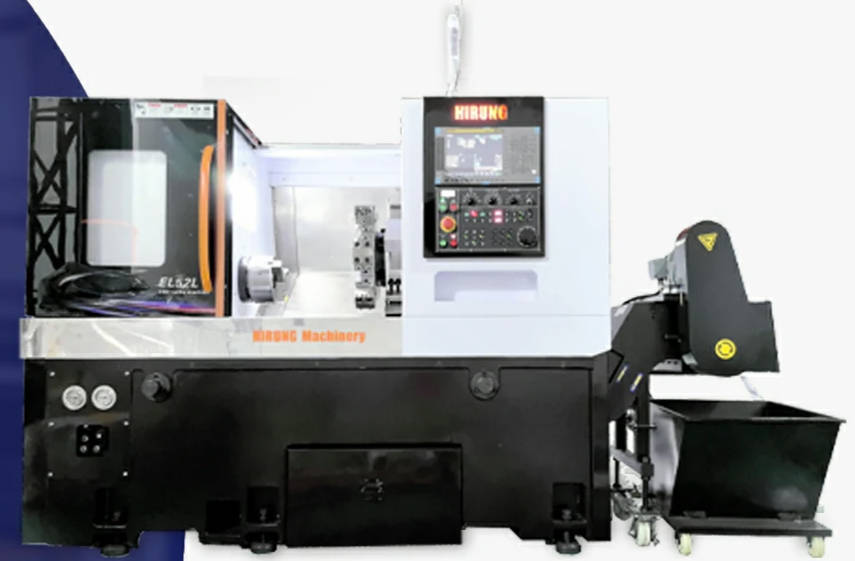
What Is a CNC Lathe Machine?
A CNC lathe machine is a computer-controlled machine tool used to cut a rotating workpiece. The workpiece is held by a chuck, collet, or fixture and rotates around the spindle. Cutting tools move along programmed axes to remove material and form the required shape.
Typical CNC lathe operations include:
| Operation | Purpose |
|---|---|
| Facing | Machining the end surface of a part |
| External turning | Reducing or shaping the outside diameter |
| Internal boring | Enlarging or finishing internal holes |
| Threading | Producing internal or external threads |
| Grooving | Cutting grooves or relief features |
| Parting | Cutting off a finished part from bar stock |
| Drilling | Creating axial holes through the centerline |
| Chamfering | Removing sharp edges or creating angled edges |
A CNC lathe machine is commonly used for parts with rotational symmetry. It is suitable for workpieces where most features can be machined by rotating the part and moving stationary cutting tools along the X and Z axes.
Common CNC lathe applications include:
| Industry | Typical Parts |
|---|---|
| Automotive manufacturing | Shafts, hubs, sleeves, bushings, brake components |
| Machinery manufacturing | Flanges, rollers, couplings, threaded parts |
| Hydraulic and pneumatic systems | Fittings, valve components, piston rods |
| General metalworking | Pins, rings, connectors, custom turned parts |
| Electrical equipment | Metal sleeves, housings, contact parts |
| Industrial equipment | Pump parts, pipe fittings, rotating components |
A CNC lathe machine is a practical choice when the part mainly requires turning, facing, boring, threading, and other operations along the rotational axis.
What Is a CNC Turning Center?
A CNC turning center is generally a more advanced type of CNC turning machine designed for higher productivity and more complex machining tasks. In many cases, a turning center includes an enclosed structure, automatic turret, chip conveyor, hydraulic chuck, tailstock or sub-spindle options, live tooling, and additional axis control.
The exact definition can vary by manufacturer and market. Some suppliers use “CNC lathe” and “turning center” interchangeably for certain models. However, in practical machine tool selection, a CNC turning center usually indicates a machine with stronger production capability and more integrated functions.
A CNC turning center may support:
- Standard turning
- High-speed turning
- Drilling and tapping
- Live tool milling
- C-axis positioning
- Y-axis off-center machining
- Sub-spindle back machining
- Bar feeding
- Automated loading and unloading
- Multi-process machining in one setup
A CNC turning center can often complete turning, drilling, milling, tapping, and secondary operations in one machine setup, reducing part handling and improving production efficiency.
This makes turning centers useful for parts that require more than simple external and internal turning.
CNC Lathe Machine vs CNC Turning Center: Quick Comparison
The table below summarizes the main differences between a CNC lathe machine and a CNC turning center.
| Comparison Item | CNC Lathe Machine | CNC Turning Center |
|---|---|---|
| Main function | Standard turning operations | Turning plus advanced multi-process machining |
| Typical axes | Usually X and Z axes | X/Z, C-axis, Y-axis, sub-spindle options in many models |
| Tooling system | Basic turret, tool post, or gang tools | Turret, live tooling, powered tools, multiple stations |
| Part complexity | Simple to medium turned parts | Medium to complex turned-milled parts |
| Automation level | Basic to moderate | Moderate to high |
| Setup efficiency | Suitable for simpler parts | Better for reducing multiple setups |
| Milling capability | Limited or unavailable in basic models | Available with live tooling in many configurations |
| Back-side machining | Usually requires second setup | Possible with sub-spindle in advanced models |
| Investment cost | Usually lower | Usually higher |
| Best use | General turning and cost-effective production | Complex parts, higher productivity, integrated processes |
For buyers, the key question is not which machine is “better” in general. The real question is which machine fits your workpiece, process route, tolerance, production volume, and budget.
Key Difference 1: Machining Capability
A CNC lathe is mainly designed for turning operations. It is effective when the part features are concentric with the spindle centerline. For example, shafts, sleeves, bushings, and flanges can often be machined efficiently on a CNC lathe.
A CNC turning center offers broader machining capability. With live tooling, C-axis, and sometimes Y-axis functions, it can machine non-concentric features such as drilled side holes, milled flats, keyways, grooves, slots, and off-center holes.
| Part Feature | CNC Lathe Machine | CNC Turning Center |
|---|---|---|
| External turning | Suitable | Suitable |
| Internal boring | Suitable | Suitable |
| Threading | Suitable | Suitable |
| Axial drilling | Suitable | Suitable |
| Side drilling | Usually limited | Suitable with live tooling |
| Milling flats | Usually not suitable | Suitable with live tooling |
| Off-center holes | Usually not suitable | Suitable with C/Y-axis |
| Back-side machining | Requires second setup | Possible with sub-spindle |
| Complex multi-process parts | Limited | More suitable |
If your parts only need standard turning, a CNC lathe may be sufficient. If your parts require turning, milling, drilling, tapping, and secondary operations, a turning center may reduce process complexity.
Key Difference 2: Machine Structure and Bed Design
CNC lathe machines and turning centers may use flat bed, slant bed, or more integrated production structures. Basic CNC lathes may have simpler configurations, while turning centers are often designed with enclosed work areas, efficient chip removal, automatic lubrication, and production-oriented layouts.
Flat bed CNC lathes are commonly used for general turning, larger workpieces, and flexible machining. Slant bed designs are often used for production turning because they support better chip evacuation, compact machine layout, and easier automation integration.
| Machine Structure | Advantages | Suitable Applications |
|---|---|---|
| Flat bed CNC lathe | Good accessibility, flexible setup, suitable for longer or heavier workpieces | General turning, shafts, repair work, low to medium volume |
| Slant bed CNC lathe | Better chip removal, compact layout, efficient production | Batch production, precision turning, automated machining |
| Turning center structure | Higher integration, turret tooling, automation options | Complex parts, high-mix production, multi-process machining |
When comparing CNC lathe machine vs CNC turning center, buyers should not evaluate only the machine name. It is more useful to compare the real configuration: bed structure, guideway type, spindle system, turret, axes, chuck, tailstock, chip conveyor, and control system.
Key Difference 3: Tooling System and Turret Configuration
The tooling system strongly affects production efficiency. A basic CNC lathe may use a tool post, gang tool system, or standard turret. A CNC turning center usually uses a multi-station turret and may support live tools.
| Tooling Configuration | Typical Use |
|---|---|
| Tool post | Simple turning, low-complexity work |
| Gang tool system | Small parts, fast tool change, high-speed production |
| 4-station turret | Basic turning operations |
| 8-station turret | General metal parts production |
| 10/12-station turret | Multi-process turned parts |
| Live tooling turret | Milling, drilling, tapping, and off-center machining |
| Dual turret | Higher productivity and simultaneous operations in advanced setups |
If your part requires many tools, such as rough turning, finish turning, boring, grooving, threading, drilling, chamfering, and parting, a larger turret can reduce manual tool changes and improve process consistency.
If your part also requires milling or cross-hole drilling, live tooling may be necessary. In that case, a CNC turning center can provide more value than a basic CNC lathe.
Key Difference 4: Axis Control and Part Complexity
A standard CNC lathe commonly works with X-axis and Z-axis movement. This is enough for many turning applications. A CNC turning center may include additional axis control, which expands machining capability.
| Axis / Function | What It Does | Why It Matters |
|---|---|---|
| X-axis | Controls tool movement across diameter | Essential for turning diameter |
| Z-axis | Controls tool movement along part length | Essential for lengthwise turning |
| C-axis | Controls spindle positioning | Enables precise angular positioning |
| Y-axis | Allows off-center tool movement | Supports off-center drilling and milling |
| Sub-spindle | Holds part for back-side machining | Reduces second setup |
| Live tooling | Rotating tools on turret | Enables milling and drilling operations |
If your part needs off-center holes, milled surfaces, or back-side machining, a CNC turning center with live tooling, C-axis, Y-axis, or sub-spindle may be more efficient than a standard CNC lathe.
However, more axes and functions also mean higher machine cost, more programming complexity, and higher operator skill requirements. Buyers should select these features based on actual part requirements rather than assuming more functions are always better.
Key Difference 5: Production Efficiency and Setup Time
A CNC lathe can be very efficient for simple and medium-complexity turned parts. If the part can be finished in one turning setup, a CNC lathe may provide excellent cost performance.
A CNC turning center becomes more valuable when the part would otherwise require multiple machines or multiple setups. For example, a part may need turning on a lathe, then drilling on another machine, then milling a flat on a machining center. A turning center with live tooling can often combine these processes.
| Production Scenario | Recommended Machine Type |
|---|---|
| Simple shaft turning | CNC lathe machine |
| Bushing or sleeve production | CNC lathe machine |
| Flange turning with basic holes | CNC lathe or turning center, depending on process |
| Turned part with side holes | CNC turning center |
| Part requiring milling flats | CNC turning center with live tooling |
| High-volume bar parts | CNC lathe with bar feeder or turning center |
| Complex parts requiring both front and back machining | CNC turning center with sub-spindle |
Reducing setups can improve consistency because the part is not repeatedly removed, re-clamped, and re-indicated. This can be important for parts requiring tighter positional accuracy between turned and milled features.
Key Difference 6: Cost and Return on Investment
In many cases, a CNC turning center requires a higher initial investment than a basic CNC lathe machine. This is because turning centers may include more advanced turrets, additional axes, live tooling, sub-spindle systems, automation, and more complex controls.
However, the lowest purchase price does not always create the lowest production cost. A turning center may reduce labor, setup time, secondary processing, part handling, and work-in-process inventory.
| Cost Factor | CNC Lathe Machine | CNC Turning Center |
|---|---|---|
| Initial machine cost | Usually lower | Usually higher |
| Tooling cost | Lower to moderate | Moderate to higher |
| Programming complexity | Lower | Higher |
| Operator training | Easier for standard turning | Requires more advanced skills |
| Setup reduction | Limited for complex parts | Stronger advantage |
| Secondary operation cost | May be higher if extra machines are needed | Can be lower if processes are combined |
| Long-term ROI | Good for standard parts | Good for complex or high-volume parts |
For procurement teams, the decision should be based on total production cost, not machine price alone. If a turning center eliminates one or two secondary operations, the higher investment may be justified. If your parts are simple, a CNC lathe may offer a more cost-effective solution.
When Should You Choose a CNC Lathe Machine?
A CNC lathe machine is usually suitable when your production mainly involves standard turning operations and does not require extensive milling or off-center machining.
Choose a CNC lathe machine when:
- Your parts are mostly shafts, sleeves, bushings, pins, rings, or flanges.
- The machining process mainly includes turning, boring, grooving, and threading.
- You do not need side milling or off-center drilling.
- Your production requires cost-effective turning capacity.
- You need flexible machining for different part types.
- Your budget does not justify advanced turning center functions.
- Your operators mainly work with standard turning programs.
A CNC lathe can also be suitable for many batch production applications when configured with a suitable chuck, turret, tailstock, bar feeder, or chip conveyor.
For buyers focused on reliable turning capacity, the EL Series CNC lathe machine can be used as a reference for evaluating model configuration and turning applications.
When Should You Choose a CNC Turning Center?
A CNC turning center is usually more suitable when your parts require multiple processes, complex features, or higher automation.
Choose a CNC turning center when:
- Your parts require turning plus milling or drilling.
- You need to machine side holes, slots, flats, or off-center features.
- You want to reduce secondary setups.
- You need C-axis, Y-axis, live tooling, or sub-spindle functions.
- Your production volume justifies higher automation.
- You need better process integration for complex components.
- You want to improve consistency by finishing more features in one setup.
A CNC turning center is especially useful for complex precision components, hydraulic fittings, connectors, automotive parts, aerospace-related components, and parts that require both turning and milled features.
Common Mistakes When Comparing CNC Lathes and Turning Centers
Mistake 1: Assuming All CNC Lathes Are the Same
The term CNC lathe can describe many machine types, from basic two-axis machines to advanced slant bed models. Always compare specifications and configuration.
Mistake 2: Buying a Turning Center Without Needing Its Functions
Live tooling, Y-axis, and sub-spindle options add cost and complexity. If your parts do not require these functions, a properly selected CNC lathe may be more practical.
Mistake 3: Choosing Based Only on Machine Price
Initial machine price is only one part of the decision. Setup time, labor cost, secondary operations, scrap rate, maintenance, and downtime also affect total cost.
Mistake 4: Ignoring Tooling and Programming Requirements
A turning center may require more advanced tooling, CAM programming, and operator training. Make sure your team can use the machine effectively.
Mistake 5: Not Sharing Part Drawings with the Supplier
Machine selection should be based on real workpieces. Without drawings, material information, tolerance requirements, and production volume, a supplier can only give a general recommendation
How to Choose Between a CNC Lathe Machine and a CNC Turning Center
Before making a decision, evaluate your parts and production process step by step.
| Selection Question | If Yes, Consider |
|---|---|
| Are most parts simple rotational components? | CNC lathe machine |
| Do parts require mainly turning and threading? | CNC lathe machine |
| Do parts require side drilling or milling? | CNC turning center |
| Do you need to reduce multiple setups? | CNC turning center |
| Is production volume high enough for automation? | CNC turning center or automated CNC lathe |
| Are long shafts your main products? | CNC lathe with tailstock/steady rest |
| Are small bar-fed parts your main products? | CNC lathe or turning center with bar feeder |
| Do you need back-side machining? | Turning center with sub-spindle |
| Is budget limited and part complexity low? | CNC lathe machine |
| Is part complexity high and labor cost significant? | CNC turning center |
The practical recommendation is simple: choose a CNC lathe when your work is mainly turning; choose a CNC turning center when process integration, live tooling, automation, and setup reduction create measurable production value.
How to Evaluate a Supplier for CNC Turning Equipment
Whether you choose a CNC lathe machine or a CNC turning center, supplier capability matters. A reliable supplier should help match the machine to your parts, not only send a quotation.
Before contacting suppliers, prepare:
- Part drawings
- Material type
- Maximum diameter and length
- Tolerance requirements
- Surface finish requirements
- Expected production volume
- Current process route
- Tooling and fixture requirements
- Automation expectations
- Budget range
When evaluating a supplier, ask:
- Can they explain the difference between available CNC lathe models?
- Can they recommend a machine based on your workpiece?
- Do they understand turning, boring, threading, grooving, and live tooling applications?
- Can they provide clear machine specifications?
- Do they offer installation, training, and after-sales support?
- Are spare parts and technical assistance available?
- Can they support future upgrades or automation needs?
If you are comparing CNC turning solutions for metal parts production, you can review the CNC Lathe Machine EL Series and match its configuration with your part size, machining process, and production goals.
Practical Buyer Checklist
Use this checklist before deciding between a CNC lathe machine and a CNC turning center.
| Checklist Item | Confirmed? |
|---|---|
| Maximum workpiece diameter is defined | Yes / No |
| Maximum workpiece length is defined | Yes / No |
| Main materials are confirmed | Yes / No |
| Turning, boring, threading, and grooving needs are listed | Yes / No |
| Side drilling or milling requirements are confirmed | Yes / No |
| Need for live tooling is reviewed | Yes / No |
| Need for C-axis or Y-axis is reviewed | Yes / No |
| Need for sub-spindle is reviewed | Yes / No |
| Production volume is estimated | Yes / No |
| Secondary operation cost is calculated | Yes / No |
| Tooling requirements are estimated | Yes / No |
| Operator skill level is considered | Yes / No |
| Supplier service capability is checked | Yes / No |
This checklist can help you avoid overbuying unnecessary functions or underbuying a machine that cannot support your production.
FAQ
1. What is the difference between a CNC lathe machine and a CNC turning center?
A CNC lathe machine mainly performs standard turning operations such as facing, turning, boring, grooving, and threading. A CNC turning center usually offers more advanced functions such as turret tooling, live tooling, C-axis, Y-axis, sub-spindle, and higher automation.
2. Is a CNC turning center the same as a CNC lathe?
In some markets, the terms may overlap, but they are not always the same. A CNC turning center is generally considered a more advanced CNC lathe designed for complex parts, process integration, and higher productivity.
3. When should I choose a CNC lathe instead of a turning center?
Choose a CNC lathe when your parts mainly require standard turning, threading, boring, or grooving. It is often more cost-effective for shafts, sleeves, bushings, rings, flanges, and other rotational parts with limited secondary machining needs.
4. When do I need a CNC turning center with live tooling?
You may need a CNC turning center with live tooling when your parts require milling flats, drilling side holes, tapping off-center features, machining slots, or completing multiple operations in one setup.
5. Is a CNC turning center more expensive than a CNC lathe machine?
In many applications, a CNC turning center has a higher initial cost because it may include live tooling, extra axes, sub-spindle options, automation, and more advanced controls. However, it may reduce setup time and secondary operation costs for complex parts.
6. Which machine is better for shaft machining, CNC lathe or turning center?
For standard shaft machining, a CNC lathe with suitable turning length, spindle power, tailstock, and steady rest may be sufficient. If the shaft also requires milled features, side holes, or complex secondary operations, a CNC turning center may be more efficient.
7. How do I choose between a CNC lathe machine vs CNC turning center for production?
Start by analyzing your part drawings, material, tolerance, machining process, and production volume. If most operations are standard turning, choose a CNC lathe. If multiple setups, milling, drilling, or automation are required, consider a CNC turning center.
Conclusion
The difference between a CNC lathe machine and a CNC turning center comes down to capability, complexity, automation, and production efficiency. A CNC lathe is suitable for standard turning operations and cost-effective metal parts production. A CNC turning center is more suitable for complex components that require turning, milling, drilling, tapping, live tooling, C-axis, Y-axis, or sub-spindle operations.
For buyers, the right choice depends on the actual workpiece. If your parts are mainly shafts, sleeves, bushings, flanges, and standard rotational components, a CNC lathe may be the practical solution. If your parts require multiple processes and fewer setups, a CNC turning center may provide higher long-term production value.
To evaluate a suitable turning machine for your workshop, compare your part requirements with the CNC Lathe Machine EL Series and consider machine structure, spindle capacity, tooling configuration, accuracy, and supplier support before making a purchase decision.