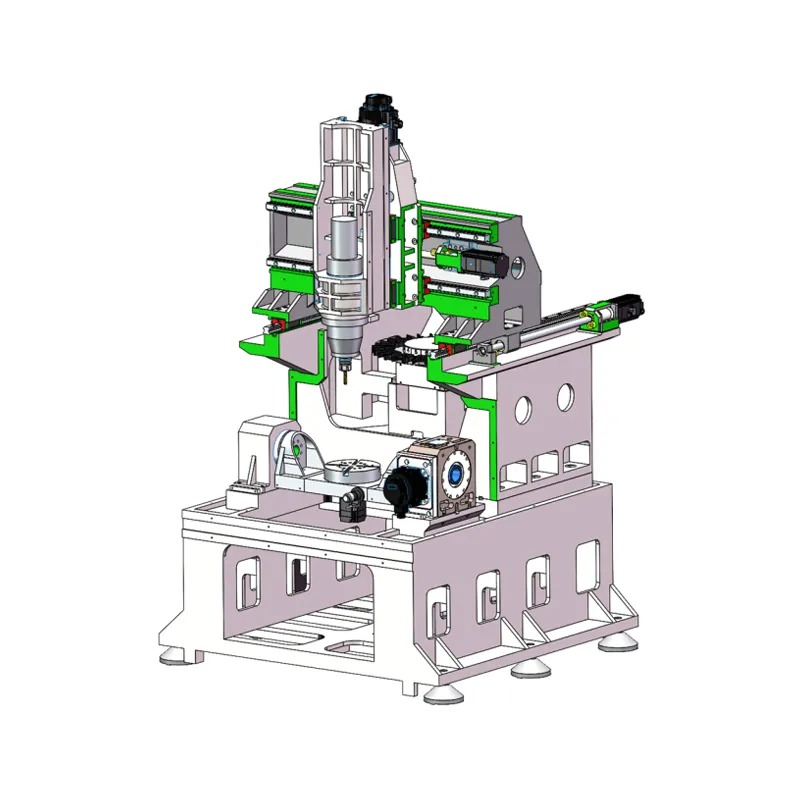
When choosing a Vertical Machining Center (VMC) for heavy-duty cutting, a box-way construction is generally the superior choice due to its unparalleled rigidity and vibration damping capabilities. Box ways excel at handling aggressive roughing, interrupted cuts, and machining tough materials like titanium and hardened steels. In contrast, linear guide VMCs are champions of speed and precision, making them ideal for high-speed machining, fine finishing, and applications where cycle time is a critical factor, typically with softer materials like aluminum. The decision ultimately hinges on a crucial trade-off between raw power and high-speed agility.

Table of Contents
- What Are Machine Ways and Why Do They Matter?
- A Deep Dive into Box-Way Construction
- A Deep Dive into Linear Guide Construction
- Head-to-Head Comparison: Box Way vs. Linear Guide
- When Should You Choose a Box-Way VMC?
- When Should You Choose a Linear Guide VMC?
- The Best of Both Worlds? Understanding Hybrid Systems
- The Final Verdict: Matching the Machine to Your Mission
What Are Machine Ways and Why Do They Matter?
In the world of CNC machining, the “ways” are the foundational guideways upon which a machine’s moving components—the table (X-axis), saddle (Y-axis), and headstock (Z-axis)—travel. Think of them as the railroad tracks for the entire machine. The design and construction of these ways directly dictate the machine’s most fundamental performance characteristics, including its rigidity, speed, accuracy, and overall durability. An incorrect choice in way construction can lead to chatter, poor surface finishes, excessive tool wear, and a fundamental mismatch between the machine’s capabilities and your shop’s primary applications. Therefore, understanding the difference between the two dominant technologies, box ways and linear guides, is paramount for any serious manufacturing operation.
A Deep Dive into Box-Way Construction
Box ways, also known as dovetail ways or hardened ways, represent the traditional, time-tested approach to machine tool construction. They are integral, ground surfaces on the machine’s primary castings, typically made of high-grade cast iron. The moving component glides directly on these surfaces, separated by a thin film of lubricating oil and often featuring a low-friction polymer lining like Turcite-B. This design creates a massive surface area of contact between the moving and stationary parts of the machine.
How Are Box Ways Made? The Art of Hand Scraping
The manufacturing of box ways is a labor-intensive process that blends precision engineering with true craftsmanship. After the cast iron components are milled and ground to tight tolerances, the final geometry is achieved through a meticulous process called hand scraping. A skilled technician uses a special tool to scrape away microscopic high spots on the surface, creating a distinct pattern of small pockets. These pockets serve to retain oil, ensuring consistent lubrication and preventing a phenomenon known as “stick-slip” where static friction causes jerky initial movements. This painstaking process is what gives a box-way machine its signature damping characteristics and long-term stability, but it also contributes significantly to its higher manufacturing cost.
The Core Advantages of Box-Way VMCs
The primary benefit of a box-way design is its exceptional rigidity and vibration damping. The large contact area between the moving components effectively acts like a shock absorber, absorbing and dissipating the vibrational energy generated during heavy and interrupted cuts. This “damping effect” is crucial for:
- Heavy Roughing: Taking deep axial and radial cuts in tough materials without inducing chatter.
- Interrupted Cuts: Machining across features like keyways, cross-holes, or uneven castings where the tool is constantly entering and exiting the material.
- Hard Material Machining: Effectively cutting hardened steels, titanium, Inconel, and other superalloys that generate immense cutting forces.
- Improved Tool Life & Surface Finish: By minimizing vibration, box ways reduce tool wear and help achieve smoother surface finishes, especially under heavy load.
The Inherent Disadvantages of Box Ways
The strength of box ways—their large contact area—is also the source of their main weakness: high friction. This sliding friction limits the machine’s top speed and acceleration. Box-way machines typically have slower rapid traverse rates (the speed at which the machine moves when not cutting) compared to their linear guide counterparts. This can lead to longer cycle times on parts that involve a lot of repositioning and less actual cutting. Furthermore, they require a diligent maintenance schedule to ensure the lubrication system is functioning perfectly and the gibs (adjustable wear strips) are correctly tightened to maintain accuracy.
A Deep Dive into Linear Guide Construction
Linear guides, also known as linear motion (LM) guideways or profile rail guides, are a more modern approach to machine tool motion. They consist of two main components: a precision-ground steel rail that is bolted to the machine casting, and a bearing block (or carriage) that is bolted to the moving component. Inside the bearing block are circuits of recirculating ball bearings or rollers that travel along matched grooves in the rail. This design replaces sliding friction with much lower rolling friction.
How Do Linear Guides Work? The Science of Rolling Friction
The principle behind linear guides is straightforward: it’s easier to roll something than to slide it. The hardened steel ball bearings or rollers create a very small point or line of contact between the rail and the block. As the block moves, the bearings recirculate through a pathway inside the block, providing smooth, continuous motion. Because the friction is significantly lower than in a box-way system, the machine’s motors can achieve much higher rates of acceleration and deceleration. This allows for incredibly fast rapid traverse rates and feed rates, which is the defining characteristic of linear guide machines.
The Core Advantages of Linear Guide VMCs
The standout advantage of linear guides is speed. Their low-friction nature allows for rapid traverse rates that can be two to three times faster than a comparable box-way machine. This drastically reduces out-of-cut time and can lead to significantly shorter cycle times, boosting productivity and profitability, especially in high-volume production.
Other key benefits include:
- High Positional Accuracy: With no stick-slip effect, linear guides offer excellent precision and repeatability, especially for high-speed finishing operations and intricate 3D contouring.
- Lower Power Consumption: The low friction requires less force from the servo motors to move the axes, resulting in more efficient operation.
- Reduced Maintenance: Bearing blocks are typically sealed and lubricated for life or have simple automated grease systems, requiring less day-to-day operator intervention than box ways.
The Inherent Disadvantages of Linear Guides
The small contact area that enables the high speed of linear guides also makes them less effective at damping vibration. The point or line contact of the bearings can transmit cutting forces and vibrations directly into the machine structure rather than absorbing them. This makes them less suitable for heavy, chatter-prone cutting. While modern linear guides are incredibly robust, a severe crash can damage the bearings or the rail, often requiring a more costly and complex replacement of the entire guide assembly compared to re-scraping a box way.
Head-to-Head Comparison: Box Way vs. Linear Guide
To make the choice clearer, let’s directly compare the two systems across the most important performance metrics for a VMC. This table serves as a quick reference guide to help you weigh the trade-offs.
| Feature | Box-Way Construction | Linear Guide Construction |
|---|---|---|
| Rigidity & Damping | Excellent. Superior ability to absorb vibration from heavy and interrupted cuts. | Good to Very Good. Less damping capacity due to smaller contact area. Can be prone to chatter under heavy loads. |
| Speed & Acceleration | Fair. Limited by high sliding friction. Slower rapid traverse and feed rates. | Excellent. Low rolling friction allows for extremely high rapid traverse and acceleration rates. |
| Load Capacity | Excellent. Large surface area distributes load very effectively. Ideal for heavy workpieces and cutting forces. | Very Good. High static and dynamic load ratings, but concentrated on small bearing points. |
| Accuracy | Very Good. High thermal stability. Can suffer from “stick-slip” at very low feed rates if not perfectly maintained. | Excellent. No stick-slip, providing superior contouring accuracy at high speeds. Can be more sensitive to thermal growth. |
| Maintenance | Higher. Requires diligent lubrication checks and periodic gib adjustments. Can be re-scraped to restore accuracy after wear. | Lower. Often uses sealed, self-lubricating bearing blocks. Damage from a crash usually requires full component replacement. |
| Best Application | Heavy-duty roughing, interrupted cuts, hard materials (steel, titanium), large molds, and die work. | High-speed machining, finishing passes, high-volume production, soft materials (aluminum), and complex 3D surfacing. |
When Should You Choose a Box-Way VMC?
You should strongly favor a VMC with box-way construction if your primary work involves heavy-duty applications. A box-way machine is your workhorse, designed to hog out material with power and stability. If your shop’s business is built on machining large steel fabrications, tough aerospace alloys like Inconel, or creating deep cavities in P20 mold steel, the damping capability of box ways is not just a feature—it’s a necessity. It’s the difference between a smooth, quiet cut and a loud, chattering process that destroys tools and produces out-of-spec parts. The slower rapid rates are an acceptable trade-off for the ability to take heavier, more confident cuts, which can ultimately remove material faster in these specific scenarios.
When Should You Choose a Linear Guide VMC?
A VMC with linear guides is the right choice when speed, agility, and cycle time are your most important metrics. If you are a job shop running high volumes of aluminum parts, a medical device manufacturer needing pristine surface finishes on small components, or an electronics enclosure producer, the speed of a linear guide machine is a massive competitive advantage. The ability to zip between features at high rapid rates and maintain tight tolerances during high-speed contouring translates directly to more parts per hour and higher profitability. For these applications, the machine will likely never be pushed into the heavy-duty cutting regime where a box way’s damping would be required, making the linear guide system the logical and more efficient choice.
The Best of Both Worlds? Understanding Hybrid Systems
Recognizing the distinct benefits of each system, some machine tool builders offer hybrid designs. A common configuration is to use robust box ways for the Z-axis (headstock), which bears the brunt of the vertical cutting forces and the weight of the spindle, while employing faster linear guides for the X and Y axes (table and saddle). This approach attempts to provide excellent cutting stability where it’s needed most, while still offering fast table positioning to reduce cycle times. These hybrid machines can be an excellent compromise, providing a versatile platform for shops that handle a wide variety of work, from moderate roughing to high-speed finishing.
The Final Verdict: Matching the Machine to Your Mission
In the debate of Box Way vs. Linear Guide, there is no single “winner.” The best choice is entirely dependent on your specific application and business goals. Don’t choose based on brand preference or outdated assumptions. Instead, perform a thorough analysis of the work you do now and the work you plan to do in the future.
For heavy-duty cutting, aggressive material removal, and machining difficult alloys, the superior rigidity and vibration damping of a box-way VMC make it the clear and correct choice. It provides the power and stability needed to tackle the toughest jobs with confidence.
For high-volume production, high-speed finishing, and applications where cycle time is king, the speed, acceleration, and precision of a linear guide VMC are unmatched. It is the engine of productivity for modern, fast-paced manufacturing.
By carefully evaluating your needs against the core strengths of each design, you can select a VMC construction that will serve as a reliable and profitable foundation for your shop for years to come.
box way vs linear guide, vmc construction, heavy-duty cutting, cnc machine ways, vertical machining center, box way vmc, linear guide vmc, what is a box way, cnc machine rigidity, vibration damping, hand scraping cnc, linear guide pros and cons, which vmc is best for steel, machine tool guideways