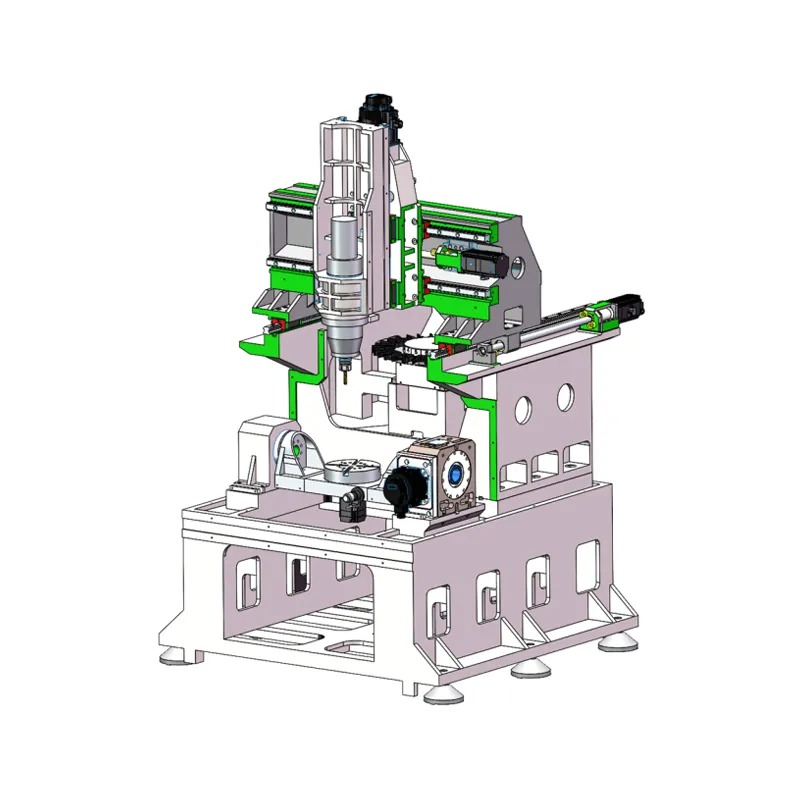
Yes, you can absolutely mount a CNC machine vertically, and this configuration is professionally known as a Vertical Machining Center (VMC). These machines are purpose-built for vertical operation and are a mainstay in modern manufacturing. However, the more nuanced question is whether you can take a standard desktop or gantry-style CNC, designed for horizontal use, and simply turn it on its side. While theoretically possible for DIY projects, this conversion introduces significant engineering challenges related to gravity, structural integrity, chip removal, and lubrication that can compromise accuracy and machine longevity. For professional results, a machine engineered from the ground up for vertical stress, like those manufactured by Hirung, is the definitive solution.

Understanding the Core Question: What Does a “Vertical CNC” Mean?
When discussing a “vertical CNC,” it’s crucial to distinguish between two very different concepts. The term itself can refer to a professional-grade machine designed for this orientation or a hobbyist modification. Understanding this distinction is the first step in evaluating if a vertical setup is right for your needs.
The Professional Standard: The Vertical Machining Center (VMC)
In the world of professional manufacturing, the answer to “Can you mount a CNC vertically?” is a resounding yes, embodied by the Vertical Machining Center (VMC). These machines, like the high-performance V-series offered by Hirung, feature a vertically oriented spindle. The tool moves up and down along the Z-axis, while the worktable moves along the X and Y axes below. Every component—from the heavy cast iron frame to the ball screws and lubrication system—is meticulously engineered to work with gravity, ensuring maximum rigidity, precision, and tool life. The entire design prioritizes accuracy and efficiency in a vertical configuration.
The DIY Approach: Modifying a Horizontal CNC for Vertical Use
The second interpretation involves taking a gantry-style CNC router, typically used flat, and mounting it upright against a wall. This is often attempted by hobbyists or small shops to save floor space. While an ingenious idea for space optimization, this approach means you are now fighting against the machine’s original design intent. The frame, gantry, and drive systems are suddenly subjected to gravitational forces and stresses they were never meant to handle, which can lead to a host of performance issues.
Why Consider a Vertical CNC Orientation? The Key Advantages
Despite the challenges of a DIY conversion, there are compelling reasons why vertical orientation is a dominant design in the industry and an attractive goal for hobbyists. The benefits revolve around space, ergonomics, and physics.
The Ultimate Space-Saver: Optimizing Your Workshop Footprint
The most significant advantage of a vertical CNC setup is the dramatic reduction in floor space. A machine that might occupy a 4’x8′ area on the floor can be mounted on a wall, consuming only a fraction of the workshop’s footprint. For businesses operating in high-cost real estate or hobbyists with limited garage space, this can be a game-changing factor, freeing up valuable room for other equipment, assembly tables, or material storage.
Ergonomics and Accessibility: Simplifying Workpiece Handling
Working with large, heavy, or awkward workpieces like full sheets of plywood or metal plates can be significantly easier on a vertical machine. Instead of lifting a heavy sheet onto a flatbed, you can often slide it into place from the side and clamp it vertically. This reduces physical strain and can simplify the loading and unloading process, especially for single-operator workshops.
A Helping Hand from Gravity: Coolant and Chip Evacuation
In a properly designed vertical system, gravity becomes an ally. Coolant applied to the cutting tool naturally flows down and across the workpiece, effectively lubricating and cooling the cutting zone before collecting in a basin at the bottom. Similarly, chips and swarf fall away from the cut path, preventing recutting (which dulls tools) and making cleanup more straightforward. This is a core design feature of professional VMCs.
The Engineering Hurdles: Critical Challenges of Vertical CNC Mounting
If you’re considering converting a horizontal machine, you’re not just changing its orientation; you’re fundamentally altering its mechanical dynamics. Overcoming these challenges is the difference between a functional machine and a frustrating, inaccurate one.
The Unseen Force: How Gravity Impacts Accuracy and Backlash
In a horizontal setup, gravity’s primary effect is to hold the gantry and workpiece down. When turned vertically, gravity constantly pulls the entire gantry (Y-axis) and spindle (Z-axis) downwards. This creates several problems:
- Increased Backlash: The downward pull can create slack in the Z-axis and Y-axis ball screws or lead screws. When the motor changes direction (e.g., moving up after moving down), this slack must be taken up before the tool actually moves, introducing significant inaccuracy. Professional VMCs use pre-loaded, high-precision ball screws to eliminate this backlash.
- Gantry Sag and Racking: The gantry, now a cantilevered weight, can sag or “rack,” pulling it out of square with the machine frame. This results in cuts that are not perfectly perpendicular.
The Battle Against Chips: Why Evacuation is More Complex
While gravity helps chips fall down, where they fall becomes a new problem. In a converted setup, chips will accumulate on the lower frame, Y-axis linear rails, and ball screw mechanisms. This buildup can cause jams, immense wear on mechanical components, and can even become a fire hazard with materials like wood. VMCs are designed with sloped sheet metal enclosures and powerful coolant washdown systems that flush chips into a conveyor or collection bin—a feature absent in standard desktop routers.
Lubrication Woes: Ensuring Proper Oil and Grease Distribution
CNC machines rely on carefully managed lubrication for their linear guides and ball screws. Systems designed to work horizontally may fail completely when turned vertically. Grease can be pulled down by gravity, leaving upper guide portions dry, while oil from an automatic lubrication system might not flow correctly to all required points. This starvation of lubricant leads to premature wear, increased friction, and eventual catastrophic failure of core components.
Structural Rigidity and Frame Stress: Is Your Machine Built for It?
The frame of a desktop CNC is designed to handle cutting forces primarily in the horizontal plane. When mounted vertically, the static weight of the gantry and spindle introduces new, constant stress points on the frame and mounting points. Over time, this can lead to frame distortion, a loss of calibration, and reduced overall rigidity. A less rigid machine will experience more vibration and chatter during cuts, resulting in poor surface finish and reduced accuracy.
Motor Torque and Counterbalancing Requirements
The stepper or servo motors on the Z-axis and Y-axis now have to work much harder. They must not only overcome cutting forces but also constantly fight gravity just to hold the gantry and spindle in position. This can lead to overheating motors or lost steps (in the case of open-loop steppers), which ruins a job instantly. To compensate, many vertical systems require a counterbalance system—a series of weights, pulleys, or gas struts—to offset the weight of the Z-axis assembly, which adds another layer of mechanical complexity.
Key Modifications for Converting a Horizontal CNC to a Vertical Setup
Disclaimer: The following modifications are for informational purposes. Converting a machine voids warranties and requires a high level of mechanical and electrical expertise. For any application requiring reliability and precision, Hirung strongly recommends a purpose-built VMC.
If you proceed with a conversion, several areas must be addressed. Each modification is a complex project in its own right.
| Component | Consideration in Vertical Orientation | Potential Solution / Modification |
|---|---|---|
| Frame | New static and dynamic stress points. Needs extreme rigidity to prevent flex. | Reinforce the frame with steel brackets or gussets. Ensure the wall mount is secure and perfectly plumb. |
| Z-Axis & Y-Axis | Gravity-induced backlash and motor strain. | Install a counterbalance system (weights or gas struts). Upgrade to stronger motors or higher-ratio gearboxes. Consider upgrading to anti-backlash ball screws. |
| Lubrication | Oil/grease will not distribute correctly. | Convert to a manual lubrication schedule, ensuring all parts are greased frequently. May require re-engineering the system with new grease points. |
| Chip Management | Chips will accumulate on lower rails and drive systems. | Fabricate and install protective covers (bellows) for all linear rails and ball screws. Design and add a sloped chip tray and collection system at the base. |
| Wiring | Cables may sag or snag in new ways. | Re-route all wiring, ensuring no cables can get caught in moving parts. Check cable chain (drag chain) behavior in the new orientation. |
The Hirung Solution: Why a Purpose-Built VMC is the Superior Choice
While a DIY vertical CNC is an interesting mechanical puzzle, for businesses and serious hobbyists, the path to precision and reliability is a purpose-built machine. This is where the engineering-first approach of a company like Hirung provides unparalleled value. A Hirung VMC is not a converted machine; it is a holistic system designed for vertical excellence.
Designed for Gravity: Pre-loaded Ball Screws and Rigid Construction
Hirung Vertical Machining Centers are built on a foundation of high-grade, stress-relieved cast iron. This massive construction provides the structural rigidity necessary to absorb cutting forces and the static weight of the spindle without a hint of flex. Critically, our machines utilize high-precision, pre-loaded ball screws on all axes. This design actively eliminates backlash, ensuring that the downward pull of gravity on the Z-axis has zero impact on positional accuracy. What is a major engineering problem for a DIY conversion is a solved issue from day one in a Hirung VMC.
Integrated Chip and Coolant Management Systems
A key differentiator of a professional VMC is its fully enclosed workspace. The interior is designed with steeply sloped surfaces that use gravity to its advantage. High-pressure coolant flushes chips away from the workpiece and tool, where they are guided into a chip auger or conveyor for easy removal. This integrated system keeps the work area clean, extends tool life, and ensures a smooth, uninterrupted machining process—a level of efficiency that is nearly impossible to replicate in a makeshift conversion.
Uncompromised Precision and Repeatability
Every component in a Hirung VMC, from the powerful spindle and servo motors to the laser-calibrated linear guideways, is selected and integrated to deliver exceptional precision and repeatability. Because the entire machine is designed as one cohesive vertical system, we can guarantee performance specifications that are essential for industries like aerospace, automotive, and medical manufacturing. This is the confidence that comes from buying an engineered solution, not experimenting with a modification.
Conclusion: Is a Vertical CNC Right for You?
So, can you mount a CNC vertically? The answer depends entirely on your goals.
For the hobbyist tinkerer with severe space constraints and a passion for mechanical challenges, converting a desktop CNC can be a rewarding, educational project. It requires significant modification, a deep understanding of mechanical forces, and a willingness to accept potential trade-offs in accuracy.
However, for any professional application, small business, or serious maker where time is money and accuracy is non-negotiable, the answer is clear. The challenges of gravity, chip control, and structural stress are too great to leave to chance. Investing in a purpose-built Vertical Machining Center (VMC) from a reputable manufacturer like Hirung is the only way to guarantee the reliability, precision, and efficiency required for high-quality production. You’re not just buying a machine; you’re buying a pre-engineered solution to all the problems that a vertical orientation presents.
Frequently Asked Questions (FAQ)
- What is the main difference between a horizontal and vertical CNC?
- The primary difference is the spindle orientation. A Vertical Machining Center (VMC) has a vertical spindle and is best for work on flat, plate-like parts or jobs that require access to one side of the workpiece. A Horizontal Machining Center (HMC) has a horizontal spindle and often uses a tombstone fixture to machine multiple sides of a part in one setup, making it highly efficient for production runs.
- Does a vertical CNC have less accuracy?
- No, a purpose-built Vertical Machining Center (VMC) is not inherently less accurate. They are engineered with features like pre-loaded ball screws and rigid frames to counteract gravity and maintain high precision. However, a converted horizontal CNC mounted vertically will almost certainly be less accurate due to uncompensated gravitational effects and frame flex.
- Is a VMC better than an HMC?
- Neither is “better”; they are suited for different tasks. VMCs are generally less expensive, easier to program for simple jobs, and take up less floor space. HMCs excel at high-volume production and multi-sided machining, offering better chip evacuation and efficiency for complex parts.
- Can you use a 3018 CNC vertically?
- While you could physically mount a small desktop CNC like a 3018 vertically, it is not recommended for serious use. These machines lack the frame rigidity, motor power, and proper drive systems (often using lead screws without anti-backlash nuts) to perform accurately against the force of gravity. It would suffer from severe backlash and flex issues.