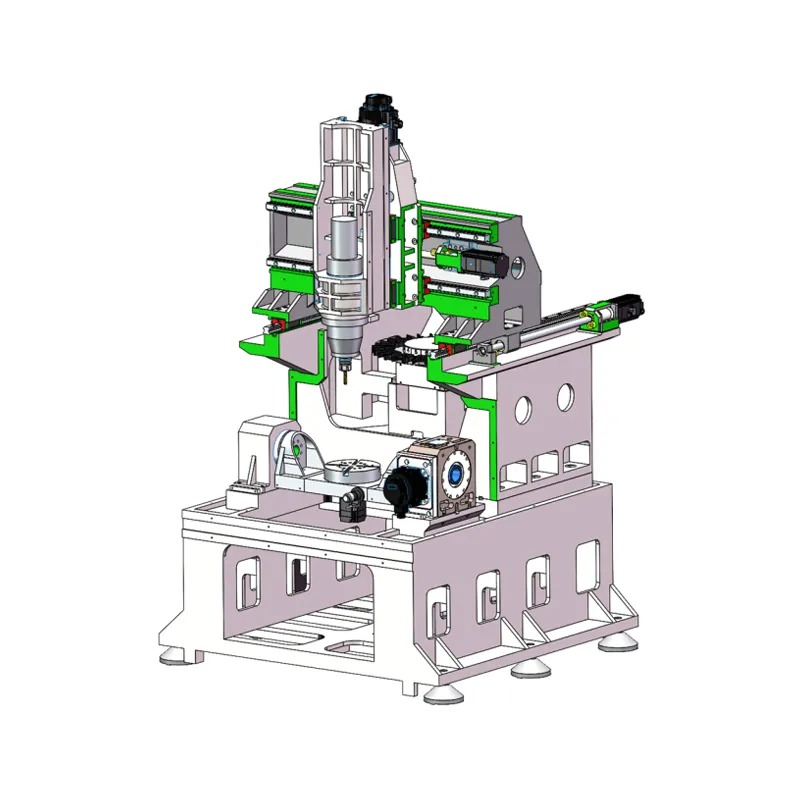
Choosing the right CNC machine is a critical decision that directly impacts a workshop’s capability, efficiency, and profitability. The primary difference between a vertical machining center (VMC) and a gantry machining center lies in their fundamental design and, consequently, their ideal application. VMCs are built with a vertical spindle mounted on a “C-frame” structure, making them perfect for small to medium-sized, high-precision parts. In contrast, gantry machining centers feature a bridge-like structure that straddles the workpiece, enabling them to machine exceptionally large and heavy components with consistent stability across a vast work area. This guide will delve into the nuances of each machine, helping you determine which is the optimal choice for your specific manufacturing needs.
Table of Contents
- Understanding the Fundamentals: What Defines These Machining Centers?
- Head-to-Head Comparison: VMC vs. Gantry Mill
- Deep Dive into the Deciding Factors: Which Machine is Right for Your Application?
- Real-World Scenarios: Where VMCs and Gantries Shine
- The Future and Hybrid Solutions: Are the Lines Blurring?
- Conclusion: Making the Right Choice for Your Manufacturing Needs
Understanding the Fundamentals: What Defines These Machining Centers?
Before comparing them, it’s essential to understand the core architecture of both vertical and gantry machining centers. Their names refer not just to the spindle orientation but to the entire structural philosophy that dictates their strengths and limitations.
What is a Vertical Machining Center (VMC)?

A Vertical Machining Center (VMC) is arguably the most common type of CNC milling machine found in workshops worldwide. Its defining characteristic is a vertically oriented spindle that holds the cutting tool. The machine is built on a “C-frame” design, where the spindle head moves up and down along the Z-axis, while the worktable moves in the X and Y axes beneath it. This configuration is highly efficient and provides excellent access to the top surface of the workpiece.
VMCs are renowned for their versatility and relative affordability. They are the workhorses of general machine shops, mold and die makers, and prototyping facilities. Because the cutting forces are directed straight down into the machine bed and table, they offer substantial rigidity for their size. Gravity also assists with chip evacuation, as chips naturally fall away from the cutting zone, though deep pockets can still present challenges.
What is a Gantry Machining Center?

A Gantry Machining Center, often called a gantry mill or bridge mill, is designed for a completely different scale of work. Its defining feature is a massive, overhead bridge (the gantry) that straddles the worktable. This gantry, supported by columns on both sides, moves along the X-axis on parallel guideways. The spindle head traverses this bridge for the Y-axis motion and moves vertically for the Z-axis. The workpiece itself typically remains stationary on a large table or floor plate.
This design overcomes the inherent size limitations of the C-frame. By supporting the spindle assembly from both ends, the gantry structure provides immense rigidity and consistent accuracy across extremely large travel distances—often spanning many meters. This makes them the only practical solution for machining massive components like aircraft wings, large automotive molds, and structural elements for the shipbuilding and energy sectors.
Head-to-Head Comparison: VMC vs. Gantry Mill
To clarify the choice between these two powerful machines, a direct comparison of their key attributes is invaluable. The following table highlights the fundamental differences that will guide your decision-making process.
| Feature | Vertical Machining Center (VMC) | Gantry Machining Center |
|---|---|---|
| Workpiece Size & Weight | Ideal for small to medium-sized parts. Limited by table size and Z-axis height. | Designed for large to exceptionally large and heavy components. |
| Machine Structure | C-Frame, with an open front for easy access. | Overhead Bridge / Gantry Frame, providing symmetrical support. |
| Footprint | Relatively compact and space-efficient. | Requires a very large floor space and often a special foundation. |
| Accuracy & Rigidity | Extremely high rigidity and accuracy for its work envelope. | Superior stability and sustained accuracy over very large travel distances. |
| Cost (Initial Investment) | Lower to moderate. A common entry point for many shops. | Significantly higher. A major capital investment. |
| Typical Applications | Mold & Die, Prototyping, Medical, General Jobbing, Small Parts Production. | Aerospace, Shipbuilding, Large Molds, Energy Sector, Heavy Equipment. |
| Chip Management | Gravity-assisted, but can be difficult in deep pockets. | More complex; often requires integrated chip conveyor systems. |
| Versatility | Highly versatile for a wide range of common jobs. The “Swiss Army knife” of mills. | Specialized for large-scale work; less practical for small, quick jobs. |
Deep Dive into the Deciding Factors: Which Machine is Right for Your Application?
The table provides a high-level overview, but a true investment decision requires a deeper analysis of several key factors. Your choice will ultimately depend on a careful evaluation of your parts, processes, and business goals.
Workpiece Geometry and Size: The Primary Consideration
This is the most straightforward and important differentiator. If your typical jobs involve parts that measure in centimeters or a few meters and weigh up to a couple of tons, a VMC is almost always the correct and most cost-effective choice. The work envelope of a VMC is perfectly suited for a vast majority of machined components, from small electronic housings to medium-sized engine blocks and injection molds.
However, once your workpiece dimensions exceed the largest VMC’s table travel or its weight capacity, a gantry machine becomes the only viable option. Think about machining a 20-meter aircraft wing spar, a massive mold for a car’s body panel, or a turbine housing for a power plant. These parts are physically impossible to mount and machine on a VMC. The gantry’s design, with its stationary workpiece and overhead moving structure, is purpose-built for this scale.
Why Does Structural Rigidity Matter?
Rigidity is the machine’s ability to resist deflection under cutting forces, and it is paramount for accuracy and surface finish. While both machine types are designed to be rigid, their structural differences become apparent at scale. A VMC’s C-frame is exceptionally rigid for its intended work envelope. The direct downward force path into the column and base provides excellent stability for heavy cutting on small-to-medium parts.
The gantry’s advantage emerges over long distances. In a very large C-frame machine, the headstock extends far from the column, creating a cantilever effect that can be susceptible to deflection and thermal expansion. The gantry’s dual-supported bridge design eliminates this cantilever effect. By distributing forces symmetrically through two columns, it maintains consistent rigidity and accuracy whether the spindle is in the center of the table or at the far edge of its travel. This is *critical* for maintaining tight tolerances on very large parts.
Evaluating Accuracy and Tolerance Requirements
Both high-end VMCs and gantry machines can achieve remarkable accuracy. The real question is, “accuracy over what distance?” A modern VMC equipped with linear scales, thermal compensation, and a chilled spindle can easily hold micron-level tolerances on parts that fit within its work area. It is the perfect tool for precise mold work and complex, small components.
A gantry machine’s mission is to maintain that precision over a much larger area. When machining a large aerospace component, it’s not enough for the machine to be accurate in one spot; it must maintain its positional and geometric accuracy across many meters of travel. The gantry’s stable, thermally symmetric design, combined with advanced features like laser calibration and volumetric error compensation, is what allows it to machine large, single-piece structures to exacting tolerances that would be impossible otherwise.
The Total Cost of Ownership: Beyond the Sticker Price
The initial purchase price is a major factor. VMCs have a significantly lower barrier to entry, with a wide range of models available to suit different budgets. Their installation, maintenance, and tooling costs are also generally lower, making them a financially sound investment for most shops.
A gantry machining center represents a monumental capital investment, often costing millions of dollars. But the sticker price is just the beginning. The total cost of ownership includes a specially engineered foundation to ensure stability, a significantly higher energy consumption, more complex maintenance procedures, and a larger rigging and installation budget. The return on this investment (ROI) comes from securing high-value contracts for large-part manufacturing that simply cannot be done on smaller machines. The decision is less about saving money and more about enabling a specific, high-margin business capability.
Shop Floor Logistics: Footprint and Installation
The physical impact on your facility cannot be overstated. A VMC has a compact, self-contained footprint. It can typically be installed in a matter of days in a standard machine shop with a solid concrete floor. This ease of integration makes it simple to add capacity or replace older equipment.
Installing a gantry machine is a major construction project. It requires a vast amount of dedicated floor space, often with ceiling heights to match. The foundation must be exceptionally deep and isolated from the rest of the building’s floor to prevent vibrations and ensure long-term stability. The installation process itself can take weeks or even months, requiring careful planning and coordination between the manufacturer and foundation contractors. You are not just buying a machine; you are building a dedicated manufacturing environment around it.
Real-World Scenarios: Where VMCs and Gantries Shine
Understanding the typical industries and applications for each machine can help solidify your choice. The machine’s design is a direct response to the demands of these sectors.
Typical Vertical Machining Center Applications
- Mold & Die Industry: VMCs, especially 5-axis models, excel at creating the complex, 3D contours of small-to-medium-sized injection molds, stamping dies, and forging dies with high precision and excellent surface finishes.
- Job Shops & Prototyping: The versatility and quick setup time of a VMC make it the cornerstone of any job shop. They can efficiently switch between a high mix of different parts, from one-off prototypes to small production runs.
- Medical Device Manufacturing: The high accuracy and reliability of VMCs are critical for machining small, intricate components like surgical instruments and orthopedic implants from materials like titanium and stainless steel.
Dominant Gantry Machining Center Applications
- Aerospace & Defense: This is the gantry’s flagship industry. They are used for machining large monolithic airframe components, such as wing ribs, spars, and fuselage sections, from single billets of aluminum or titanium to reduce weight and increase strength.
- Energy & Shipbuilding: Gantries are essential for producing large-scale components like turbine blades, huge diesel engine blocks, and structural elements for ships and submarines where both size and precision are non-negotiable.
- Large-Scale Mold Making: For industries like automotive, gantry machines are used to create the massive molds required for stamping body panels (hoods, doors, fenders) and forming large plastic components like dashboards and bumpers.
The Future and Hybrid Solutions: Are the Lines Blurring?
While the core distinction remains, technology is causing some overlap. VMC manufacturers are building larger machines with increased travel and rigidity, encroaching on the smaller end of the gantry market. These “large-frame VMCs” offer a bridge solution for shops that need more capacity without a full gantry investment.
Simultaneously, smaller, more affordable gantry-style CNC routers are popular for machining lighter materials like wood, plastics, and aluminum sheet. While they share the gantry structure, they lack the mass and rigidity of a true gantry machining center for heavy metal cutting. Furthermore, automation is a key trend for both. VMCs are frequently paired with automatic pallet changers (APCs) for “lights-out” production of smaller parts, while large gantries may utilize robotic systems for tool management and inspection on massive workpieces.
Conclusion: Making the Right Choice for Your Manufacturing Needs
The choice between a vertical machining center and a gantry machining center is not a matter of which is “better,” but which is the *right tool for the job*. The decision hinges on an honest assessment of your primary application.
Choose a Vertical Machining Center (VMC) if your business revolves around flexibility, cost-effectiveness, and the production of small-to-medium-sized parts. It is the versatile, reliable, and accessible workhorse for the vast majority of machining tasks.
Invest in a Gantry Machining Center when your mission is to conquer scale. If your contracts demand the machining of massive, heavy, and high-value components for industries like aerospace or energy, the gantry’s supreme stability, expansive work envelope, and unwavering aVMC vs Gantry: Which is best for your parts? Compare size, rigidity, cost, accuracy & real applications to make the right CNC choice in 2025.ccuracy are not just an advantage—they are a necessity.
By carefully analyzing your workpiece requirements, budget, and facility constraints, you can confidently select the machining center that will not only meet your current needs but also serve as a cornerstone for your future growth.
Vertical Machining Center, Gantry Machining Center, VMC vs Gantry, CNC Machining, VMC, Gantry Mill, CNC Machine Comparison, what is the difference between a vmc and a gantry machine, when to use a gantry machining center, best cnc for large parts, vertical machining center applications, choosing a cnc machine, structural rigidity cnc, gantry cnc machine price