In the competitive world of modern manufacturing, efficiency isn’t just an advantage; it’s a necessity. Every second saved and every micron of precision gained translates directly to a stronger bottom line. This relentless pursuit of optimization has led to incredible innovations in machining technology. One of the most impactful of these is the CNC Duplex Milling Machine.
At HIRUNG, we don’t just build machines; we engineer solutions that empower our clients to lead their industries. We’ve seen firsthand how adopting the right technology can revolutionize a workshop. Today, we want to pull back the curtain and explain the mechanics, principles, and profound benefits of duplex milling. This guide will walk you through exactly how these powerful machines operate and why they might be the key to unlocking your company’s next level of productivity.
What Exactly Differentiates a CNC Duplex Milling Machine?
Before diving into the “how,” let’s clarify the “what.” A standard CNC milling machine, often called a simplex mill, uses a single cutting spindle to remove material from a workpiece. The process is sequential; if you need to machine two opposite sides of a part, you must complete the first side, stop the machine, unclamp the workpiece, flip it, re-clamp it perfectly, and then machine the second side. This multi-step process is time-consuming and introduces opportunities for error.
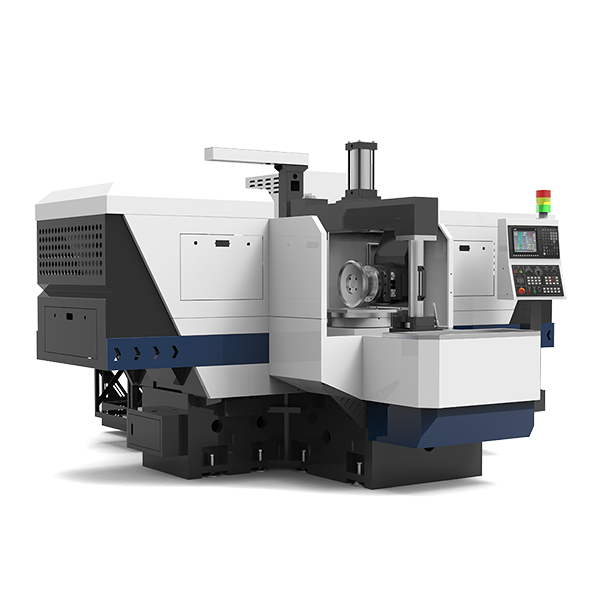
A CNC Duplex Milling Machine fundamentally changes this workflow. As the name “duplex” implies, it features two opposing milling spindles that work on the workpiece at the same time. These two spindles, or milling heads, are mounted opposite each other, allowing them to machine two parallel faces of a part in a single setup. This parallel processing capability is the defining characteristic and the source of its immense efficiency gains.
What is the Core Working Principle of a Duplex Mill?
The magic of duplex milling lies in its synchronized, parallel action. While the specific operations can be complex, the fundamental working principle can be broken down into a clear, logical sequence. Here’s how a typical job runs on a HIRUNG duplex milling machine:
- Step 1: Workpiece Clamping: The raw workpiece is securely fixed onto the machine’s worktable or a specialized fixture. Unlike simplex milling, there’s no need to worry about a second setup. The part is clamped once, which is crucial for maintaining relational accuracy between the two machined faces.
- Step 2: Programming and Setup: The operator or programmer inputs the job parameters into the CNC (Computer Numerical Control) system. This includes the final desired width of the part, the depth of cut for each side, the feed rate (how fast the part moves past the cutters), and the spindle speed (how fast the cutting tools rotate). The machine’s control system precisely positions the two opposing milling heads to match these specifications.
- Step 3: Simultaneous Machining: This is where the core advantage materializes. The worktable moves the clamped part between the two rotating cutting tools. Both spindles engage the material simultaneously, removing material from opposite faces in one smooth pass. The forces exerted by the cutters are largely balanced, contributing to greater stability and precision during the cut.
- Step 4: Completion and Unloading: Once the pass is complete, the part has two perfectly parallel, finished faces, machined to the exact specified dimension. The finished workpiece is then unclamped and unloaded, and the machine is immediately ready for the next part. The entire cycle time is drastically reduced compared to traditional methods.
Which Essential Components Define a Duplex Milling Machine?
A machine’s performance is the sum of its parts. At HIRUNG, we build our machines on a foundation of quality, using robust, high-grade components to ensure reliability and precision for years. The key components that enable the duplex milling process include:
- Machine Bed and Base: This is the foundation of the entire machine. It must be incredibly rigid and heavy to absorb vibrations and maintain stability during aggressive cutting. We use high-quality cast iron, stress-relieved and precision-machined for a solid, unshakeable base.
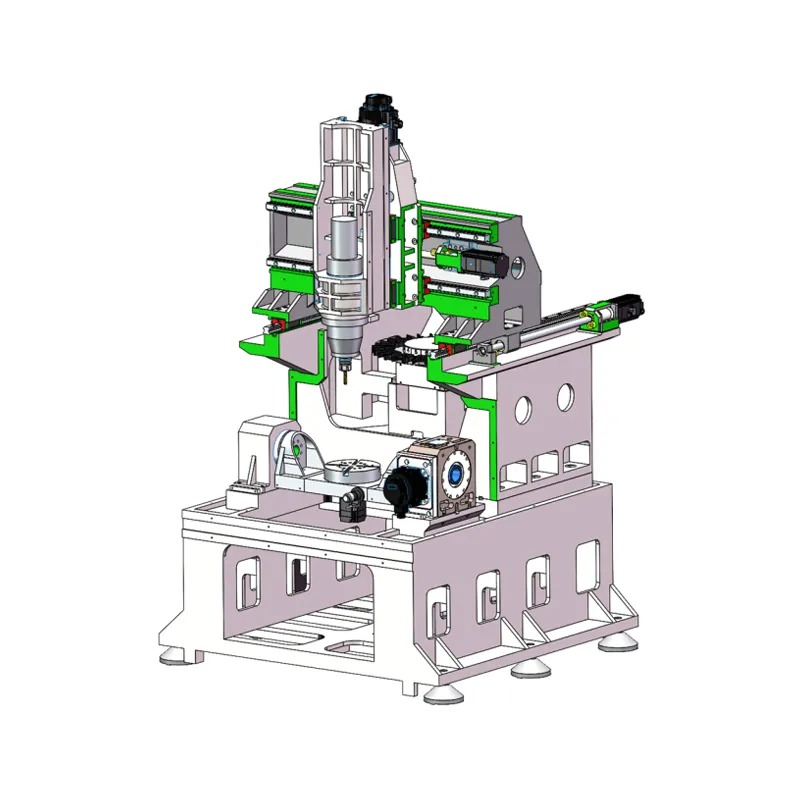
- Dual Milling Heads: The heart of the machine. Each head contains a high-torque spindle that holds the cutting tool. These heads are mounted on rigid columns and can be precisely adjusted in or out to set the final width of the part. Their robust construction is vital for chatter-free machining.
- Worktable and Fixturing System: The worktable securely holds the workpiece and moves it through the cutting zone. The smoothness and accuracy of its movement, guided by precision linear guideways and ballscrews, directly impact the surface finish and dimensional accuracy of the final product.
- CNC Control System: The brain of the operation. A sophisticated CNC controller (like those from FANUC or Siemens) synchronizes the movement of the worktable and the operation of the spindles. It allows for precise control over every variable, ensuring repeatability and complex machining capabilities.
Why is Duplex Milling a Decisive Advantage in Production?
The theoretical principle is impressive, but the real-world benefits are what drive manufacturers to invest in this technology. The advantages over conventional milling are not just incremental; they are transformative for high-volume production of square or rectangular parts.
| Advantage | Duplex Milling Machine | Conventional (Simplex) Milling |
|---|---|---|
| Productivity & Throughput | Extremely high. Machining two sides at once nearly halves the cycle time per part. | Lower. Requires two separate operations and setups to machine two sides. |
| Accuracy & Parallelism | Superior. Machining in a single setup eliminates positioning errors from refixturing, ensuring excellent parallelism. | Good, but operator-dependent. Prone to errors when flipping and reclamping the workpiece. |
| Labor & Setup Costs | Reduced. One setup operation instead of two saves significant operator time and reduces labor cost per part. | Higher. More manual intervention is required for the second setup, increasing labor time and cost. |
| Floor Space Efficiency | Optimized. One duplex mill can often do the work of two simplex mills, saving valuable factory floor space. | Less efficient. May require multiple machines or more complex setups to achieve the same throughput. |
| Ideal Application | High-volume production of parts requiring two parallel faces, such as mold bases, blocks, and plates. | Versatile for general-purpose milling, but less efficient for 2-sided parallel work. |
In Which Industries Do Duplex Milling Machines Excel?
The efficiency of duplex milling makes it an indispensable tool in any industry that requires the high-volume production of precision-milled blocks. Its ability to quickly prepare “2-4-6 blocks” (parts squared on all sides) makes it a foundational machine in many production lines.
Key industries include:
- Die & Mold Manufacturing: For creating mold bases, plates, and blocks with perfect parallelism and accuracy.
- Automotive: For producing engine blocks, transmission components, and other high-volume parts.
- Hydraulics & Pneumatics: For manufacturing manifold blocks and valve bodies.
- Heavy Machinery: For creating structural components, machine bases, and large-scale parts.
- General Contract Machining: For any shop that performs high-volume squaring operations as a primary or secondary process.
How Can You Select the Ideal Duplex Milling Machine?
Choosing the right machine is a critical investment. As your partners in manufacturing, we at HIRUNG advise considering several key factors to ensure you get a machine that perfectly matches your needs.
- Workpiece Size and Weight: What are the typical dimensions and weight of the parts you will be machining? This will determine the required table size, travel distance (X, Y, Z axes), and load capacity of the machine.
- Material and Removal Rate: Are you cutting aluminum, steel, or exotic alloys? The required spindle power, torque, and overall machine rigidity will depend heavily on the materials you work with and how aggressively you need to cut them.
- Precision and Tolerance Requirements: What level of accuracy and parallelism does your final product demand? Higher precision requirements necessitate machines with better components, such as high-grade linear guideways, ballscrews, and advanced CNC controllers.
- Support and Service: A machine is only as good as the support behind it. Look for a partner, like HIRUNG, that offers comprehensive pre-sales consultation, installation, training, and responsive after-sales service to minimize downtime and maximize your return on investment.
By understanding how these powerful machines work, you can see the clear, quantifiable value they bring. The principle of simultaneous, single-setup machining is a simple concept with a profound impact on efficiency, accuracy, and cost-effectiveness. If you are looking to elevate your production capabilities, exploring a CNC Duplex Milling solution is not just an option—it’s a strategic necessity.
Ready to see how a HIRUNG Duplex Milling Machine can transform your production line? Contact our engineering team today for a personalized consultation.