CNC vertical machining center accuracy can be improved by controlling machine rigidity, spindle stability, tool runout, fixture positioning, thermal deformation, cutting parameters, workpiece clamping, coolant performance, and regular maintenance. In practical machining, accuracy is not determined by the machine alone. It is the result of machine structure, process planning, tooling, material behavior, operator skill, and inspection control working together.
For manufacturers producing precision metal parts, molds, automotive components, electronic housings, machinery parts, or custom industrial components, machining accuracy directly affects assembly fit, surface quality, part consistency, scrap rate, and delivery reliability. A high-quality CNC vertical machining center provides the foundation for stable machining, but the final accuracy still depends on how the machine is selected, used, maintained, and matched with the right process.
This guide explains the key factors that affect CNC vertical machining center accuracy and provides practical methods to improve VMC accuracy in daily production.
What Does CNC Vertical Machining Center Accuracy Mean?
CNC vertical machining center accuracy refers to how closely the machined part matches the required drawing dimensions, geometry, position, and surface finish. In a VMC, accuracy is usually affected by machine positioning, repeatability, spindle performance, axis movement, cutting force, tool condition, fixture stability, and thermal changes.
In real production, accuracy may include several different aspects:
| Accuracy Type | What It Means | Example in Machining |
|---|---|---|
| Dimensional accuracy | Whether the final size matches the drawing | A pocket width, hole diameter, or slot depth |
| Position accuracy | Whether features are located correctly | Hole spacing, bolt pattern, datum-to-feature distance |
| Repeatability | Whether the machine produces consistent results repeatedly | Same part dimensions across a batch |
| Geometric accuracy | Whether shapes and angles are correct | Flatness, perpendicularity, parallelism |
| Surface accuracy | Whether the surface meets quality requirements | Milling finish, tool marks, roughness level |
| Thermal stability | Whether accuracy changes as the machine heats up | Size drift during long production runs |
For precision machining, repeatable accuracy is often more important than one-time accuracy, because manufacturers need stable results across many parts, not only one successful sample.
Why Machining Accuracy Matters for B2B Manufacturers
For B2B industrial parts, machining accuracy is not only a technical issue. It directly affects production cost, customer trust, and long-term cooperation.
Poor machining accuracy may lead to:
- Assembly problems
- Rework and scrap
- Delayed delivery
- Higher tool consumption
- Unstable surface finish
- Customer complaints
- Reduced machine utilization
- Extra inspection workload
For example, a slightly inaccurate hole position may cause assembly misalignment. A poor flatness result may affect sealing or mounting. A rough surface may reduce product appearance or functional performance. In high-volume production, even a small error can become a major cost issue when repeated across many parts.
That is why manufacturers looking for machining accuracy improvement should evaluate both the CNC machine and the entire machining process.
Main Factors That Affect VMC Accuracy
A vertical machining center can only deliver stable accuracy when all key factors are controlled. The most important factors include machine structure, spindle condition, tool system, fixture design, cutting parameters, thermal management, and inspection methods.
1. Machine Rigidity
Machine rigidity is one of the most important foundations of VMC accuracy. A rigid machine structure helps resist cutting force, reduce vibration, and maintain stable tool movement.
When rigidity is insufficient, common problems include:
- Chatter marks
- Poor surface finish
- Tool deflection
- Dimensional variation
- Inaccurate hole position
- Shorter tool life
- Unstable heavy cutting performance
A rigid vertical machining center usually depends on a strong base, stable column structure, high-quality casting, reliable guideways, and good spindle support. For demanding applications, machine buyers should evaluate the machine structure carefully instead of only comparing travel size or spindle speed.
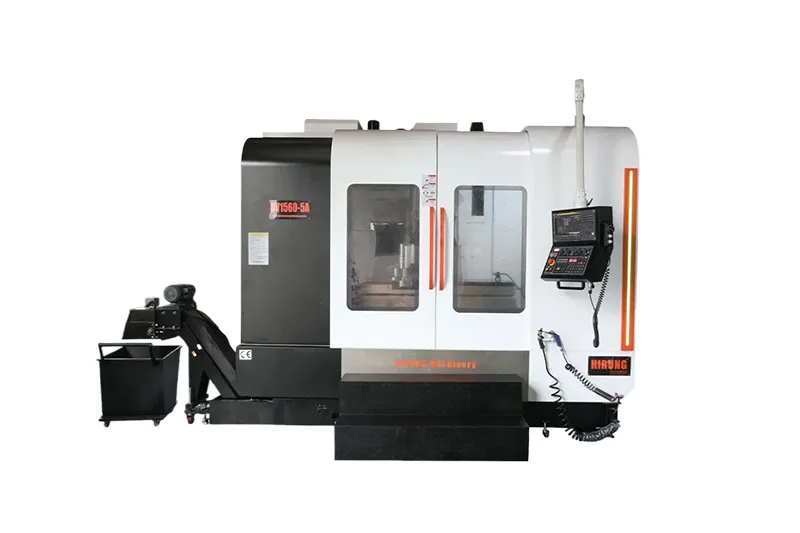
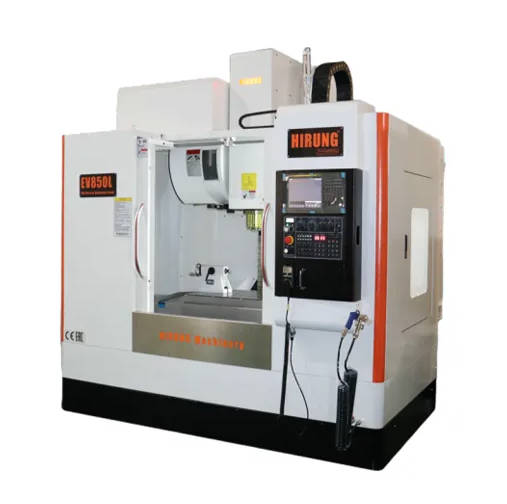
The HIRUNG EV Series vertical machining center is designed for industrial machining applications where rigidity, durability, and accuracy stability are important. For buyers processing steel, cast iron, aluminum, molds, or precision components, the machine body and axis structure should be part of the accuracy evaluation.
2. Spindle Stability and Tool Runout
The spindle directly controls tool rotation, so spindle stability has a strong influence on machining accuracy. Even a small amount of spindle runout can create poor hole accuracy, inconsistent surface finish, uneven tool wear, and dimensional errors.
Tool runout can come from:
- Spindle bearing wear
- Poor tool holder quality
- Dirty taper surfaces
- Incorrect tool clamping
- Long tool overhang
- Worn collets or adapters
- Incorrect cutting parameters
To improve CNC machining accuracy, the spindle, tool holder, cutting tool, and clamping interface must be treated as one complete precision system.
Practical methods include cleaning the spindle taper regularly, using suitable tool holders, reducing unnecessary tool overhang, checking tool runout, and replacing worn clamping components before they affect part quality.
3. Guideways and Axis Movement
The movement of the X, Y, and Z axes determines how accurately the tool follows the programmed path. Axis accuracy is influenced by guideway design, ball screw quality, servo tuning, lubrication, backlash control, and machine wear.
If axis movement is unstable, parts may show:
- Positional errors
- Uneven interpolation marks
- Inconsistent pocket dimensions
- Poor circularity
- Step marks between toolpaths
- Different results between roughing and finishing
High-rigidity linear guideways or suitable guideway structures can help support stable movement under cutting loads. However, the machine still needs proper leveling, lubrication, and preventive maintenance to maintain accuracy over time.
4. Fixture Design and Workpiece Clamping
Many machining accuracy problems are not caused by the CNC machine itself. They come from poor fixture design or unstable workpiece clamping.
A good fixture should position the workpiece consistently, resist cutting force, avoid deformation, and allow chips to escape. If a part is clamped too weakly, it may move during cutting. If it is clamped too strongly, it may deform and rebound after machining.
Common fixture-related errors include:
| Fixture Problem | Possible Accuracy Issue |
|---|---|
| Weak clamping | Part movement, vibration, inconsistent dimensions |
| Excessive clamping force | Workpiece deformation and size change after release |
| Poor datum selection | Incorrect feature position and poor repeatability |
| Chip buildup under part | Height error, poor flatness, unstable clamping |
| Fixture wear | Gradual batch-to-batch accuracy drift |
| Long unsupported workpiece area | Deflection during cutting |
For repeat production, fixture repeatability can be as important as machine repeatability.
5. Tool Selection and Tool Wear
Cutting tools directly contact the material, so tool condition has a major effect on machining accuracy. A worn tool may cut undersize or oversize, generate heat, leave poor surface finish, or increase cutting force.
Tool-related accuracy problems often appear as:
- Dimensional drift during batch production
- Burr formation
- Poor surface finish
- Oversized or undersized holes
- Tapered walls
- Poor corner quality
- Increased vibration
To improve accuracy, manufacturers should choose the right tool material, coating, flute design, diameter, and cutting geometry for the workpiece material. Tool life should be monitored, especially in production machining where accuracy must remain stable across many parts.
6. Cutting Parameters
Cutting parameters include spindle speed, feed rate, depth of cut, width of cut, toolpath strategy, and coolant application. Incorrect cutting parameters can reduce accuracy even when the machine itself is capable.
For example:
| Parameter Issue | Possible Result |
|---|---|
| Feed rate too high | Tool deflection, rough surface, dimensional error |
| Spindle speed too low | Poor cutting efficiency, vibration, built-up edge |
| Depth of cut too large | Heavy cutting force, chatter, part deformation |
| Poor toolpath strategy | Uneven load, visible tool marks, unstable finish |
| Insufficient finishing allowance | Roughing errors transferred to final surface |
| No spring pass when needed | Remaining deflection affects final dimension |
In many applications, roughing and finishing should be separated. Roughing removes material efficiently, while finishing uses lighter cutting conditions to control accuracy and surface quality.
7. Thermal Deformation
Heat is one of the most overlooked causes of CNC machining error. During operation, heat may come from the spindle, ball screws, motors, cutting zone, coolant, and surrounding environment. As machine components and workpieces expand, dimensions can shift.
Thermal effects are especially important in:
- Long machining cycles
- High-speed spindle operation
- Continuous batch production
- Tight tolerance machining
- Large workpieces
- Workshops with unstable temperature
Thermal control is essential for machining accuracy improvement because even a stable machine can produce dimensional drift when heat is not managed properly.
Common solutions include machine warm-up, stable workshop temperature, coolant control, spindle cooling, proper cutting parameters, and periodic inspection during long runs.
Practical Methods to Improve Machining Accuracy
Improving VMC accuracy requires a systematic approach. The following methods can help manufacturers reduce errors and improve process stability.
Method 1: Start with Proper Machine Installation and Leveling
A vertical machining center must be installed on a suitable foundation and leveled correctly. Poor installation can affect axis movement, machine geometry, vibration control, and long-term accuracy.
Before production, check:
- Foundation stability
- Machine leveling
- Power connection
- Air supply
- Coolant system
- Lubrication system
- Chip removal system
- Machine warm-up procedure
If the machine is moved or used for heavy cutting over time, rechecking the level may be necessary.
Method 2: Use a Stable Datum and Process Plan
Accuracy starts with process planning. A good machining process defines the correct datum, clamping sequence, roughing allowance, finishing allowance, tool order, and inspection points.
For precision parts, avoid changing datums unnecessarily. Every repositioning step introduces potential error. If multiple setups are required, use reliable locating features and inspection references.
Method 3: Separate Roughing and Finishing
Roughing creates cutting force, heat, and possible workpiece stress release. Finishing should be performed after the major material removal is complete.
A common approach is:
- Rough machining
- Semi-finishing if needed
- Allow stress or heat to stabilize when necessary
- Finish machining with lighter cutting parameters
- Inspect key dimensions
This approach helps reduce the impact of tool deflection and material movement.
Method 4: Control Tool Length and Tool Runout
Shorter tool overhang generally improves rigidity. Long tools are sometimes necessary for deep cavities, but they increase deflection risk.
To improve tool system accuracy:
- Use suitable tool holders
- Keep tool overhang as short as practical
- Clean spindle and holder tapers
- Measure runout when accuracy is critical
- Replace worn collets and holders
- Use balanced tools for high-speed machining
- Avoid using damaged tools for finishing
Method 5: Optimize Fixtures for Repeatability
For batch production, fixture consistency is critical. A good fixture should support fast loading and repeatable positioning while preventing deformation.
Fixture improvement methods include:
- Use clear locating datums
- Add support points where needed
- Avoid over-clamping thin parts
- Provide chip escape space
- Use hardened locating elements for long-term use
- Inspect fixture wear regularly
- Keep clamping surfaces clean
Method 6: Apply Suitable Coolant and Chip Removal
Coolant helps control heat, remove chips, and improve tool life. Chip buildup can damage surfaces, cause recutting, affect datum contact, and reduce accuracy.
For aluminum, efficient chip evacuation helps prevent chip welding and surface scratching. For cast iron, dust and fine chips require proper removal. For steel, chip shape and cutting heat should be controlled.
A vertical machining center with flexible chip removal options can help improve production stability. HIRUNG’s EV Series CNC vertical machining center provides configuration options for industrial machining needs, including chip management considerations for different production environments.
Method 7: Inspect Accuracy During Production
Inspection should not only happen after the batch is completed. For accuracy-sensitive parts, in-process inspection helps detect drift early.
Common inspection methods include:
- First article inspection
- Tool offset verification
- In-process measurement
- Periodic sampling
- Gauge inspection
- Coordinate measuring machine inspection when required
- Tool wear monitoring
Inspection frequency should depend on part tolerance, material stability, tool life, and batch size.
Accuracy Improvement Checklist for VMC Users
| Area | What to Check | Why It Matters |
|---|---|---|
| Machine installation | Leveling, foundation, vibration | Supports stable machine geometry |
| Spindle | Runout, taper cleanliness, bearing condition | Affects hole accuracy and surface finish |
| Tooling | Tool wear, holder quality, tool overhang | Controls deflection and consistency |
| Fixture | Datum, clamping force, support points | Prevents part movement and deformation |
| Cutting parameters | Feed, speed, depth of cut, toolpath | Reduces vibration and heat |
| Coolant | Flow, concentration, temperature | Controls heat and chip removal |
| Chip management | Conveyor, flushing, cleaning | Prevents recutting and datum contamination |
| Maintenance | Lubrication, backlash, axis check | Maintains long-term accuracy |
| Inspection | First article, sampling, offset correction | Detects errors before batch failure |
How to Choose a CNC Vertical Machining Center for Better Accuracy
When purchasing a CNC vertical machining center, buyers should avoid choosing only by price, table size, or spindle speed. Accuracy depends on the full machine design and how well the machine fits the intended parts.
Evaluate Machine Structure
Look for a rigid base, stable column, strong spindle support, reliable guideways, and a design suitable for your cutting load. If you machine steel or molds, rigidity becomes especially important. If you machine aluminum parts at higher speed, spindle stability and chip evacuation become more important.
Match the Machine to Your Workpiece
Prepare the following information before asking for a recommendation:
| Information | Why It Helps |
|---|---|
| Part drawings | Confirms size, tolerance, and machining features |
| Material | Determines spindle, tool, and coolant requirements |
| Maximum part size | Determines travel and table size |
| Workpiece weight | Determines load capacity |
| Tolerance requirements | Helps evaluate accuracy needs |
| Surface finish requirement | Affects spindle and cutting strategy |
| Batch size | Determines productivity and automation needs |
| Fixture plan | Confirms available working space |
Consider Long-Term Stability
A machine may produce one accurate sample, but long-term stability is more important for production. Ask about machine structure, guideway design, spindle configuration, lubrication, chip removal, maintenance access, and after-sales support.
The HIRUNG official website provides access to different CNC machine categories, which can help buyers compare whether a vertical machining center, CNC lathe, 5-axis machining center, or gantry machine is more suitable for their parts.
Common Mistakes That Reduce Machining Accuracy
Mistake 1: Assuming a New Machine Automatically Solves All Accuracy Problems
A good machine is important, but accuracy also depends on tooling, fixture design, cutting parameters, inspection, and maintenance. A high-quality VMC can still produce inaccurate parts if the process is poorly controlled.
Mistake 2: Using the Same Cutting Parameters for Roughing and Finishing
Roughing and finishing have different goals. Roughing focuses on material removal, while finishing focuses on accuracy and surface quality. Using aggressive parameters for finishing can cause tool deflection and poor surface finish.
Mistake 3: Ignoring Thermal Warm-Up
Starting precision machining before the machine reaches a stable operating condition may cause dimensional drift. Warm-up procedures are especially useful for tight tolerance work and long production cycles.
Mistake 4: Over-Clamping Thin or Flexible Parts
Excessive clamping force can deform the workpiece. After machining, the part may spring back and become out of tolerance. Thin-walled parts require careful support and controlled clamping.
Mistake 5: Delaying Tool Replacement
A worn tool may still cut, but it may no longer cut accurately. Tool wear should be managed before it creates scrap.
FAQ
1. How can I improve CNC vertical machining center accuracy?
You can improve CNC vertical machining center accuracy by checking machine leveling, controlling spindle runout, using rigid tooling, optimizing fixtures, separating roughing and finishing, applying suitable coolant, managing chip removal, and performing regular inspection and maintenance.
2. What affects VMC accuracy the most?
The main factors affecting VMC accuracy include machine rigidity, spindle stability, axis movement, tool runout, fixture positioning, cutting parameters, thermal deformation, workpiece material, and operator process control.
3. How do you reduce machining errors in CNC milling?
To reduce machining errors in CNC milling, use stable datum selection, proper clamping, correct toolpath strategy, suitable cutting parameters, short tool overhang, regular tool inspection, coolant control, and in-process measurement.
4. Why does machining accuracy change during long production runs?
Machining accuracy may change during long runs because of tool wear, heat buildup, coolant temperature changes, chip accumulation, fixture wear, spindle thermal growth, or machine component expansion.
5. Is machine rigidity important for CNC machining accuracy?
Yes. Machine rigidity helps reduce vibration, tool deflection, chatter, and dimensional variation. It is especially important for heavy cutting, mold machining, steel parts, cast iron components, and precision finishing.
6. How do I choose a VMC for high-accuracy machining?
Choose a VMC based on part size, material, tolerance, production volume, spindle configuration, guideway structure, machine rigidity, table load, tool magazine needs, chip removal, control system, and supplier support.
7. Can a CNC vertical machining center maintain accuracy for batch production?
A CNC vertical machining center can support batch production accuracy when the machine is rigid, properly maintained, correctly leveled, and matched with stable tooling, fixtures, cutting parameters, and inspection procedures.
Conclusion
Improving machining accuracy with a CNC vertical machining center requires more than adjusting one parameter. It requires a complete system: a rigid machine structure, stable spindle, accurate axis movement, suitable tooling, reliable fixtures, controlled cutting parameters, effective coolant, clean chip removal, and regular maintenance.
For manufacturers producing precision parts, molds, automotive components, electronic housings, or machinery parts, choosing the right VMC is the first step toward stable accuracy. A well-designed vertical machining center provides the foundation, while process control determines the final result.
If you are evaluating a VMC for precision machining, the HIRUNG EV Series can be considered for industrial applications that require machining stability, rigidity, and long-term usability. Prepare your part drawings, material information, tolerance requirements, and production goals before requesting a machine recommendation, so the equipment configuration can be matched more accurately to your machining needs.