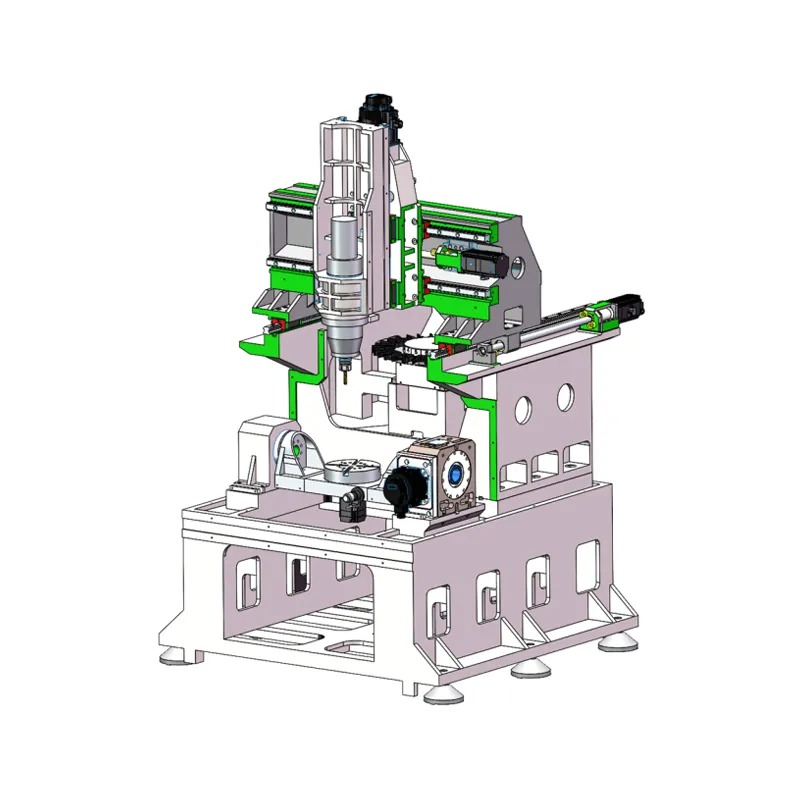
While vertical machining centers (VMCs) are celebrated for their versatility, precision, and cost-effectiveness, their primary disadvantages stem from their core design: a vertically oriented spindle. Key limitations include constraints on workpiece size and weight, significant challenges with chip and coolant evacuation due to gravity, lower productivity in high-volume production runs compared to their horizontal counterparts, and restricted access for machining multiple sides of a complex part in a single setup. Understanding these drawbacks is crucial for making an informed investment and ensuring the machine you choose is perfectly aligned with your production needs.

At Hirung, we manufacture a comprehensive range of CNC machines, including advanced VMCs. Our experience has shown us that while a VMC is the ideal solution for many applications, recognizing its inherent limitations is the first step toward true manufacturing efficiency. This article will provide an in-depth, expert look at the cons of a vertical machining center, helping you weigh them against its many benefits to select the right equipment for your workshop.
Why Do These Disadvantages Exist? Understanding the VMC’s Core Design
Before diving into the specific drawbacks, it’s essential to understand why they exist. The identity of a vertical machining center is defined by its vertically oriented spindle. The cutting tool moves up and down along the Z-axis, while the worktable moves left and right (X-axis) and forward and backward (Y-axis). This configuration is intuitive, easy to set up, and offers excellent visibility of the machining process. However, this very design is the root cause of its limitations. Gravity, which can be an asset in some machine designs, becomes an obstacle for VMCs, particularly concerning chip removal and workpiece stability for very large parts. The entire work envelope is built around this vertical axis, fundamentally influencing everything from part size to production speed.
The Key Disadvantages of VMCs in Detail
Let’s explore the most significant cons of a vertical mill that every shop owner, engineer, and machinist should consider.
Workpiece Size and Weight Constraints
One of the most apparent VMC limitations is the size and weight of the workpiece it can handle. The entire weight of the part and its fixture rests on the worktable, which is supported by the machine’s base and guideways. This imposes a strict limit on the maximum payload. Overloading the table can lead to diminished accuracy, premature wear on mechanical components, and even structural damage. Furthermore, the “daylight,” or the distance between the table surface and the end of the spindle at its highest Z-axis position, restricts the height of the workpiece. Machining tall parts can be challenging or impossible on a standard VMC, often requiring a machine with a larger work envelope, such as a gantry machining center.
The Constant Challenge of Chip Evacuation
Perhaps the most persistent operational issue with VMCs is poor chip evacuation. Because the tool cuts from above, chips fall directly onto the workpiece and into the pockets and cavities being machined. Gravity works against the process. These chips can accumulate rapidly, leading to several problems:
- Re-cutting Chips: The tool plows through already-cut chips, increasing the load on the spindle, generating excess heat, and accelerating tool wear. This can lead to tool breakage and is highly inefficient.
- Poor Surface Finish: Trapped chips can mar the surface of the part, compromising the required finish and potentially causing the part to be scrapped.
- Reduced Tool Life: The increased heat and abrasion from re-cutting chips significantly shortens the life of expensive cutting tools, increasing operational costs.
While high-pressure through-spindle coolant (TSC) systems and air blasts can help mitigate this, they don’t eliminate the fundamental problem. For materials that produce long, stringy chips like some aluminum alloys or stainless steels, this issue is even more pronounced. In contrast, on a horizontal machining center (HMC), gravity is an ally, as chips naturally fall away from the workpiece and into the chip conveyor below.
Productivity Bottlenecks in High-Volume Production
While a VMC is highly flexible for small-to-medium batch sizes and prototype work, it can become a bottleneck in high-volume, high-production environments. The primary reason is that the machine is idle during part loading, unloading, and setup. Spindle-on time, the period when the machine is actually making money, is often significantly lower than on other machine types. Horizontal machining centers, for example, frequently integrate automatic pallet changers (APCs). An operator can safely set up a new workpiece on one pallet while the machine is cutting on another. When the cycle is complete, the pallets swap in seconds, and the spindle is immediately back to work. This near-continuous operation gives HMCs a substantial productivity advantage for mass production.
Limited Machining Access for Complex Geometries
A standard 3-axis VMC can only machine the top surface and sides of a workpiece within the tool’s reach. To machine features on four or five sides of a cube-shaped part, the operator must stop the machine and manually re-fixture the part for each new orientation. This manual intervention introduces several issues:
- Increased Setup Time: Each re-fixturing adds significant non-productive time to the overall cycle.
- Loss of Accuracy: It is extremely difficult to perfectly re-locate a part. Each time it is moved, the risk of positional errors and tolerance stacking increases, potentially compromising the part’s final accuracy.
While these limitations can be overcome by adding a 4th or 5th-axis rotary table to a VMC, this adds cost and complexity and may reduce the available work envelope. A purpose-built HMC with a standard rotating B-axis or a full 5-axis machine is often a more integrated and rigid solution for complex, multi-sided parts.
Inefficient Coolant Management and Pooling
Similar to the chip evacuation problem, coolant management can be a drawback. In deep pocketing operations, coolant can fill the cavity like a swimming pool. This “flooding” can prevent fresh, cool lubricant from reaching the cutting edge, leading to thermal shock and reduced tool life. It also makes it harder for the coolant jet to effectively flush chips out of the cutting zone. The pooled coolant adds weight to the workpiece and can splash out of the machine, creating a messy and potentially hazardous work environment. Effective coolant delivery requires careful programming and specialized tooling, adding another layer of complexity to the process.
VMC vs. HMC: A Comparative Look at Key Limitations
To put these disadvantages into perspective, here is a direct comparison with a Horizontal Machining Center (HMC), which is often the alternative consideration for buyers.
| Feature / Challenge | Vertical Machining Center (VMC) | Horizontal Machining Center (HMC) |
|---|---|---|
| Chip Evacuation | Poor. Gravity causes chips to pile up on the workpiece, requiring air blasts or high-pressure coolant. | Excellent. Gravity assists in clearing chips, which fall directly into the conveyor. |
| Workpiece Size | Generally limited to smaller, lighter parts due to table load and Z-axis height. | Better suited for large, heavy workpieces due to robust pallet design and work envelope. |
| High-Volume Productivity | Lower. Machine is idle during part setup. Pallet changers are less common. | Higher. Dual pallet changers allow for near-continuous machining, maximizing spindle uptime. |
| Multi-Sided Machining | Requires multiple setups or an add-on rotary axis, risking accuracy loss. | Easily machines 4 sides in one setup using the standard B-axis rotary pallet. |
| Upfront Cost & Footprint | Generally lower cost and requires less floor space (An advantage for VMCs). | Significantly higher initial investment and a larger footprint. |
When is a VMC Still the Right Choice?
After reviewing these disadvantages, one might wonder why VMCs are the most common type of machining center in the world. The answer is simple: their advantages often outweigh their disadvantages for a vast number of applications. A VMC is the undisputed champion for:
- Cost-Sensitive Shops: VMCs have a significantly lower purchase price than HMCs of a similar size.
- Workshops with Limited Space: Their vertical design gives them a much smaller footprint.
- Low-to-Medium Volume Runs: For job shops handling diverse parts in small batches, the flexibility and quick setup of a VMC are ideal.
- Plate Work and 2.5D Machining: For parts that are relatively flat and require machining primarily on one face (e.g., molds, dies, plates), a VMC is perfectly suited.
- Ease of Use and Training: The open setup and clear visibility make VMCs easier for new operators to learn and program.
Conclusion: Making an Informed Decision for Your Operations
The decision to purchase a vertical machining center—or any CNC machine—should never be made without a full understanding of its capabilities and its limitations. The disadvantages of a VMC, namely its constraints on part size, challenges with chip and coolant control, and lower throughput in mass production, are not reasons to dismiss the machine. Rather, they are critical factors to weigh against your specific applications, production volume, part complexity, and budget.
By understanding what a VMC cannot do well, you can better appreciate what it excels at. For many machine shops, the VMC’s affordability, versatility, and ease of use make it the cornerstone of their operations. Our team at Hirung doesn’t just sell machines; we partner with you to find the optimal solution. If you are weighing the pros and cons of a VMC for your business, contact our experts today. We can help you analyze your needs and determine if a VMC like our VMC850 or VMC1160 is the perfect fit, or if your application would be better served by one of our horizontal or gantry machining centers.