A 5 axis CNC machining center buying guide should help manufacturers evaluate part complexity, machine structure, rotary axis configuration, spindle performance, rigidity, accuracy, table load, control system, tooling, automation options, service support, and return on investment before purchasing. Unlike a standard 3-axis machining center, a 5-axis CNC machine is a high-value investment that must be matched carefully with your parts, materials, tolerances, production volume, and operator capability.
For precision manufacturers, a 5-axis CNC machining center can reduce multiple setups, improve access to complex surfaces, shorten tool overhang, support higher geometric freedom, and improve consistency for multi-angle components. However, not every workshop needs a 5-axis machine. If most parts are simple plates, blocks, and basic pockets, a 3-axis or 4-axis machine may still be more economical. If your business produces aerospace components, medical parts, impellers, complex molds, automotive precision parts, or high-value multi-face components, a 5 axis CNC machining center can become a strategic production asset.
This guide explains how to choose a 5 axis CNC machine from a practical manufacturing perspective, covering structure types, specifications, accuracy, spindle selection, tooling, control systems, automation, supplier evaluation, and common purchasing mistakes.
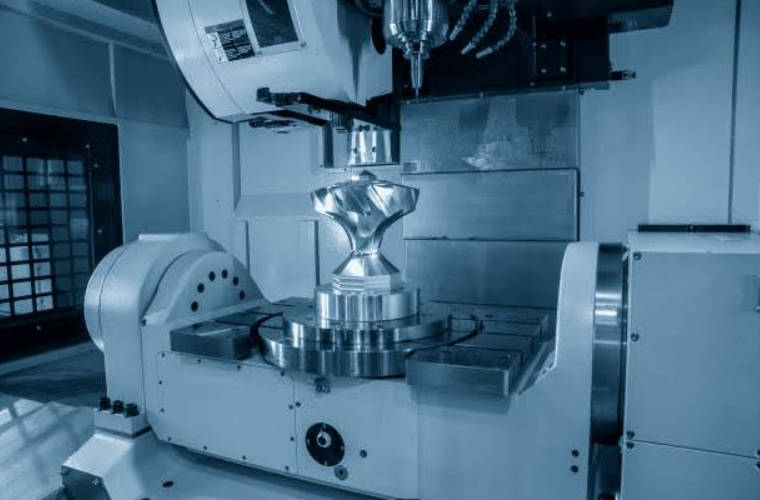
What Is a 5 Axis CNC Machining Center?
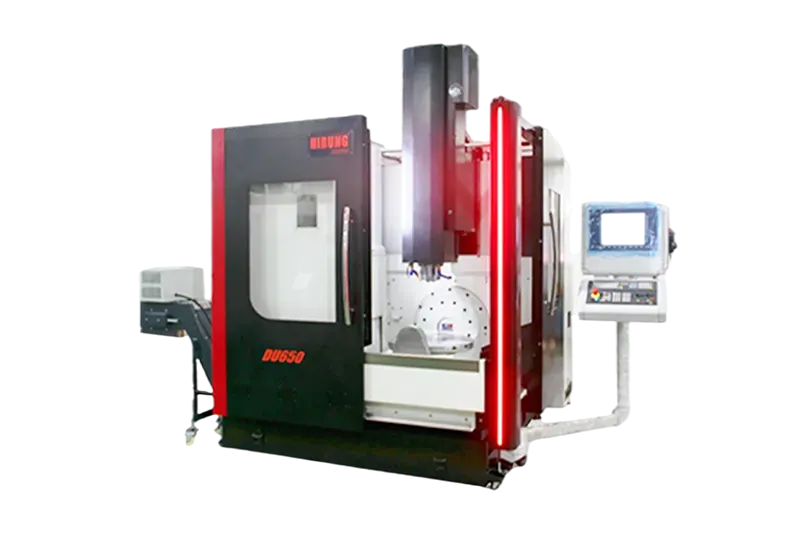
A 5 axis CNC machining center is a CNC machine tool that controls movement along three linear axes and two rotary axes. The three linear axes are usually X, Y, and Z. The two rotary axes are commonly A, B, or C axes, depending on the machine structure.
This additional rotary movement allows the cutting tool or workpiece to approach the part from multiple angles. As a result, the machine can process complex surfaces, angled holes, undercuts, deep cavities, curved profiles, and multi-face features with fewer setups.
A 5-axis machining center is most valuable when it reduces manual repositioning, improves complex-part accuracy, and enables geometry that is difficult or inefficient on 3-axis equipment.
There are two main machining modes:
| Machining Mode | Description | Typical Use |
| 3+2 axis machining | Rotary axes position the workpiece or tool at a fixed angle, then 3-axis machining is performed | Angled holes, multi-face parts, reduced setups |
| Simultaneous 5-axis machining | All five axes move together during cutting | Complex surfaces, impellers, blades, aerospace parts, medical parts |
For many precision manufacturers, 3+2 machining is already a major productivity upgrade. Simultaneous 5-axis machining is more advanced and requires stronger programming, machine calibration, and collision control.
Why Precision Manufacturers Invest in 5-Axis CNC Machines
A 5-axis machine is not purchased only to add more axes. It is purchased to solve manufacturing problems that are difficult to handle efficiently with conventional machines.
Common reasons include:
- Too many setups on 3-axis machines
- Accumulated positioning errors between setups
- Difficult access to angled or hidden features
- Long tool overhang in deep cavities
- Complex freeform surfaces
- High-value parts with strict tolerance requirements
- Need to reduce lead time
- Need to expand into higher-value industries
- Need to improve consistency for complex components
For example, a complex aerospace bracket may require machining from several angles. On a 3-axis machine, this may require multiple fixtures and repeated part positioning. Each setup adds labor time and error risk. A 5-axis machine can often complete more features in one clamping, improving process consistency.
For medical components or complex mold cavities, the ability to maintain a better tool angle can help improve surface quality and reduce the need for secondary finishing in many applications.
Step 1: Start with Your Part Geometry
The most important rule in 5 axis machine selection is simple: start with the part, not the machine brochure. A 5-axis machine should be selected based on workpiece geometry, not only spindle speed or machine size.
Prepare the following part information before contacting a supplier:
| Information to Prepare | Why It Matters |
| Part drawings or 3D models | Confirms geometry, angles, undercuts, and machining access |
| Maximum workpiece size | Determines machine travel and working envelope |
| Workpiece weight | Determines table load and structure type |
| Material | Affects spindle power, torque, rigidity, coolant, and tooling |
| Tolerance requirement | Determines machine accuracy and rotary axis precision |
| Surface finish requirement | Affects spindle, toolpath, and finishing strategy |
| Number of setups on current machines | Helps evaluate 5-axis ROI |
| Annual production volume | Determines whether investment is justified |
| Target industries | Helps define accuracy, documentation, and service expectations |
The right 5-axis CNC machine is not always the largest or most expensive model; it is the machine that matches your part size, complexity, tolerance, and production plan.
Step 2: Choose the Right 5-Axis Machine Structure
Different 5-axis machining centers use different mechanical structures. The structure affects workpiece size, rigidity, accessibility, accuracy, and cost.
Trunnion Table 5-Axis Machining Center
A trunnion table machine uses a tilting and rotating table. The workpiece is mounted on the rotary table, and the table provides two rotary axes.
This structure is often suitable for small to medium-sized precision parts.
| Advantages | Considerations |
| Good rigidity for suitable part sizes | Workpiece size and weight are limited by table capacity |
| Strong positioning for precision components | Fixture height and tool clearance must be checked |
| Efficient for aerospace, medical, mold, and complex parts | Large heavy workpieces may not be suitable |
| Good for 3+2 and simultaneous machining | Collision checking is important |
Swivel Head or Articulating Head 5-Axis Machine
A swivel head design places one or two rotary axes in the spindle head. The workpiece may remain on a more conventional table.
This structure is often suitable for larger or heavier workpieces because the table does not need to tilt the full part weight.
| Advantages | Considerations |
| Suitable for larger or heavier workpieces | Head geometry affects access and collision risk |
| Easier fixturing for some parts | Requires careful toolpath planning |
| Useful for molds and large components | Machine structure must be rigid enough |
| Good working envelope in many applications | Rotary head accuracy and stiffness matter |
Head-Table Type 5-Axis Machine
A head-table design combines one rotary axis in the spindle head and one rotary axis in the table. It can provide a balance between flexibility and workpiece capacity.
This structure may be useful when the manufacturer processes varied parts and needs a more versatile setup.
Gantry-Type 5-Axis Machine
Gantry-type 5-axis machines are often used for large molds, large aerospace components, automotive tooling, and large structural parts. They usually require more floor space and a higher investment.
| Structure Type | Best Suited For |
| Trunnion table | Small to medium complex precision parts |
| Swivel head | Larger or heavier workpieces |
| Head-table type | Mixed complex parts and versatile production |
| Gantry 5-axis | Large molds, large aerospace parts, large tooling |
Step 3: Evaluate Work Envelope and Table Load
The work envelope determines whether your part, fixture, tool, and motion range can fit safely inside the machine. For 5-axis machining, this is more complex than simple X/Y/Z travel because the part may tilt and rotate during cutting.
When checking working range, consider:
- Maximum part size
- Fixture height
- Tool length
- Rotary axis travel
- Tilt angle clearance
- Spindle nose clearance
- Collision space
- Operator loading access
- Chip evacuation path
- Probe and tool setter space
Table load is especially important for trunnion machines. A part may fit dimensionally but exceed the safe rotary table load after adding the fixture. Buyers should calculate total workpiece weight, fixture weight, and clamping components together.
Step 4: Check Rotary Axis Accuracy and Stability
Rotary axis performance is one of the most important differences between a basic 5-axis machine and a precision 5-axis machining center. Poor rotary axis accuracy can create angular errors, surface mismatch, and positional deviation.
Important rotary axis factors include:
| Factor | Why It Matters |
| Indexing accuracy | Affects angled features and multi-face positioning |
| Repeatability | Affects consistency across batches |
| Clamping rigidity | Affects cutting stability during indexed machining |
| Direct drive or mechanical drive | Affects response, smoothness, and maintenance |
| Thermal stability | Affects long-cycle accuracy |
| Calibration capability | Helps maintain 5-axis precision over time |
| Brake/clamping system | Supports rigidity during heavy cutting |
For precision manufacturers, rotary axis accuracy and rigidity are as important as linear axis travel because they directly affect multi-angle machining results.
When asking for a quotation, request information about rotary axis specifications, calibration methods, inspection standards, and maintenance requirements.
Step 5: Select the Right Spindle for Your Materials
The spindle must match your primary materials and machining strategy. A 5-axis CNC machine may be used for aluminum, titanium, stainless steel, tool steel, cast iron, copper alloys, composites, or other demanding materials. Each material has different cutting requirements.
| Material / Application | Spindle Priority |
| Aluminum aerospace parts | High spindle speed, stable dynamic performance, good chip evacuation |
| Titanium parts | Torque, rigidity, heat control, tool life stability |
| Stainless steel medical parts | Rigidity, surface finish stability, cutting force control |
| Mold steel | Torque, rigidity, finishing accuracy |
| Graphite or electrode machining | Speed, dust control, suitable sealing/protection |
| General complex parts | Balanced spindle speed, torque, and reliability |
A high-speed spindle is useful for aluminum and fine finishing, but it may not be ideal for heavy cutting in difficult materials. A high-torque spindle may support demanding cutting but may not be optimized for very high-speed light finishing. Buyers should choose based on actual part materials and process priorities.
Step 6: Compare Tool Interface and Tool Magazine
Tool interface affects tool clamping stability, runout, rigidity, and high-speed machining performance. Common interfaces for 5-axis machines may include HSK or BT-type systems depending on machine design and application.
For complex parts, tool magazine capacity is also important. A 5-axis part may require many tools, including roughing tools, finishing tools, ball nose cutters, drills, taps, chamfer tools, long-reach tools, probes, and special cutters.
| Tooling Factor | What to Check |
| Tool interface | Rigidity, runout, high-speed suitability |
| Tool magazine capacity | Whether enough tools are available for complex cycles |
| Tool change speed | Affects non-cutting time |
| Tool length limit | Important for deep cavities and angled access |
| Tool weight limit | Important for large cutters |
| Tool management | Helps reduce setup error and tool confusion |
| Probe compatibility | Supports setup and inspection efficiency |
For high-mix production, more tool capacity can reduce manual intervention and improve flexibility.
Step 7: Review CNC Control System and CAM Compatibility
A 5-axis machine depends heavily on the control system and CAM workflow. The machine must not only move accurately; it must also interpret complex toolpaths reliably.
Key control and software questions include:
- Does the control support 5-axis simultaneous machining?
- Is tool center point control available?
- Are post-processors available for your CAM software?
- Does the supplier support post-processor setup?
- How is collision avoidance handled?
- Does the control support probing cycles?
- Is the interface familiar to your operators?
- Is remote troubleshooting available?
- Are training materials available?
A strong machine without suitable CAM support can become difficult to use. Before purchasing, confirm that your programming team, CAM software, post-processor, and supplier support are aligned.
Step 8: Evaluate Accuracy, Rigidity, and Thermal Stability
Accuracy is a system result. In 5-axis machining, it depends on linear axes, rotary axes, spindle, tool holder, fixture, machine structure, thermal stability, calibration, programming, and inspection.
When evaluating accuracy, check:
| Accuracy Factor | Why It Matters |
| Linear axis positioning | Affects dimensional accuracy |
| Rotary axis accuracy | Affects angular and multi-face precision |
| Machine rigidity | Reduces vibration and deflection |
| Spindle runout | Affects surface quality and hole accuracy |
| Thermal control | Reduces drift during long cycles |
| Machine calibration | Maintains 5-axis geometric accuracy |
| Fixture repeatability | Supports production consistency |
| Inspection workflow | Confirms actual part quality |
A 5-axis machine should be evaluated under real cutting conditions, not only by static catalog specifications.
For complex parts, ask whether the supplier can help review your part geometry and recommend a machine configuration that supports your tolerance and surface finish requirements.
Step 9: Consider Automation and Future Expansion
Many precision manufacturers buy a 5-axis machine not only for current parts but also for future capability. Automation may not be necessary on day one, but it should be considered if the factory expects higher throughput.
Automation options may include:
- Pallet changer
- Robot loading
- Tool monitoring
- In-process probing
- Workpiece measurement
- Automatic door
- Coolant and chip management upgrades
- Tool life management
- Production data monitoring
If your business plans to move toward lights-out machining or higher-volume precision parts, ask whether the machine can support future automation integration.
Step 10: Calculate ROI Before Purchasing
A 5-axis CNC machining center has a higher initial investment, so ROI should be calculated carefully. The machine is easier to justify when it saves setup time, reduces fixture cost, lowers scrap risk, improves part quality, shortens delivery time, or allows the company to win higher-value work.
ROI factors include:
| ROI Factor | How 5-Axis Can Help |
| Setup reduction | Fewer clamping steps and less manual repositioning |
| Accuracy improvement | Lower accumulated error from multiple setups |
| Labor savings | Less manual handling and fixture adjustment |
| Shorter lead time | More complete machining in one setup |
| Higher-value orders | Ability to quote complex aerospace, medical, mold, or automotive parts |
| Reduced tooling issues | Shorter tools may reduce vibration in some applications |
| Surface finish improvement | Better tool angle can improve finishing quality |
| Scrap reduction | More stable process for complex parts |
A 5-axis machine is financially reasonable when its added capability creates measurable value through efficiency, accuracy, customer expansion, or reduced process risk.
If the machine will only be used for simple work, the return may be weak. If it will replace multiple setups and open new customer opportunities, the investment may be easier to justify.
Common Mistakes When Buying a 5-Axis CNC Machining Center
Mistake 1: Choosing by Axis Count Only
A machine with five axes is not automatically suitable for your parts. Structure, rigidity, rotary axis performance, spindle, working envelope, control system, and supplier support are all critical.
Mistake 2: Ignoring Workpiece Weight and Fixture Size
Many buyers check the part size but forget fixture weight and tilting clearance. This can cause table load problems, collision risks, or reduced usable working space.
Mistake 3: Underestimating Programming Requirements
5-axis machining requires advanced CAM, post-processors, collision checking, and trained programmers. A machine purchase should include a plan for software and training.
Mistake 4: Overbuying for Uncertain Orders
A 5-axis machine can expand capability, but it needs enough suitable work. If future high-value orders are uncertain, buyers should compare investment risk carefully.
Mistake 5: Comparing Prices Without Comparing Configuration
Two 5-axis machines may have very different spindle types, rotary drives, control systems, tool magazines, probing systems, automation readiness, and service support. Always compare the full configuration.
How to Evaluate a 5-Axis CNC Machine Supplier
A reliable supplier should help you select a machine based on your production requirements, not only provide a quotation. Before buying, ask practical questions.
| Supplier Question | Why It Matters |
| Can you review my part drawings or 3D models? | Confirms application understanding |
| Which structure fits my workpieces: trunnion, swivel head, or gantry? | Prevents wrong machine selection |
| What spindle is suitable for my materials? | Helps match cutting performance |
| What is the rotary axis accuracy and repeatability? | Critical for 5-axis precision |
| What control system and CAM post support are available? | Reduces programming risk |
| What probing and calibration options are available? | Supports accuracy control |
| What is included in the standard configuration? | Clarifies real purchase cost |
| Can the machine support future automation? | Helps long-term planning |
| What installation and training support do you provide? | Reduces commissioning risk |
| How are spare parts and service handled? | Affects uptime and long-term operation |
For buyers comparing different machine types, the HIRUNG official website can help review broader CNC machine categories and support initial equipment direction.
When to Consider HIRUNG 5 Axis CNC Machining Centers
HIRUNG 5 Axis CNC Machining Centers can be considered by precision manufacturers that need to machine complex, high-value, and multi-angle components. The range includes different machine configurations for various workpiece sizes, machining requirements, and application fields.
You may consider the HIRUNG 5 Axis CNC Machining Center when your production involves:
- Aerospace components
- Automotive precision parts
- Medical device components
- Complex molds and dies
- Impellers and turbine-related parts
- High-precision multi-face components
- Deep cavity and angled feature machining
- Complex aluminum, steel, titanium, or stainless steel parts
- Parts currently requiring multiple setups on 3-axis machines
Before requesting a quotation, prepare part drawings, 3D models, material information, tolerance requirements, surface finish requirements, batch size, fixture concept, and current machining challenges. This helps the supplier recommend a more suitable 5-axis configuration.
FAQ
1. How do I choose a 5 axis CNC machining center?
Choose a 5 axis CNC machining center based on part size, part weight, material, complexity, tolerance, surface finish, number of setups, required spindle performance, rotary axis accuracy, control system, CAM compatibility, automation needs, and supplier support.
2. What is the most important factor in 5 axis machine selection?
The most important factor is whether the machine structure matches your workpieces. Trunnion, swivel head, head-table, and gantry-type 5-axis machines are suitable for different part sizes, weights, and machining requirements.
3. Is a 5 axis CNC machine worth the investment?
A 5 axis CNC machine is worth considering when it reduces setups, improves accuracy, shortens lead time, supports complex geometry, reduces fixture handling, or helps your company win higher-value precision machining projects.
4. What is the difference between trunnion and swivel head 5 axis CNC machines?
A trunnion machine tilts and rotates the workpiece on a rotary table, which is often suitable for small to medium precision parts. A swivel head machine tilts the spindle head, making it more suitable for larger or heavier workpieces in many applications.
5. What industries use 5 axis CNC machining centers?
5 axis CNC machining centers are commonly used in aerospace, automotive precision manufacturing, medical device components, mold manufacturing, energy equipment, impeller production, and high-precision machinery parts.
6. Do I need special CAM software for 5 axis CNC machining?
Yes. For simultaneous 5-axis machining, advanced CAM software and a reliable post-processor are usually required. Even for 3+2 machining, proper CAM setup, collision checking, and operator training are important.
7. What information should I provide before buying a 5 axis CNC machine?
Provide part drawings, 3D models, material, workpiece size and weight, tolerance requirements, surface finish requirements, batch size, current machining process, number of setups, tooling needs, and automation plans.
Conclusion
Buying a 5 axis CNC machining center is a strategic decision for precision manufacturers. The right machine can reduce setups, improve complex-part accuracy, support advanced geometries, shorten lead time, and expand your ability to serve demanding industries. However, the wrong machine can create high investment pressure, programming difficulty, fixture problems, and underutilized capacity.
A practical 5 axis CNC machining center buying guide should start from your parts: geometry, material, tolerance, size, weight, surface finish, batch volume, and current machining challenges. Then evaluate machine structure, rotary axis accuracy, spindle performance, rigidity, work envelope, tool magazine, control system, CAM compatibility, automation options, service support, and ROI.
If your manufacturing business is moving toward complex aerospace components, automotive precision parts, medical components, molds, impellers, or high-value multi-angle parts, a 5-axis machining center can be a strong investment. To choose the right configuration, prepare your technical requirements and discuss them with a supplier that can evaluate your application in detail.