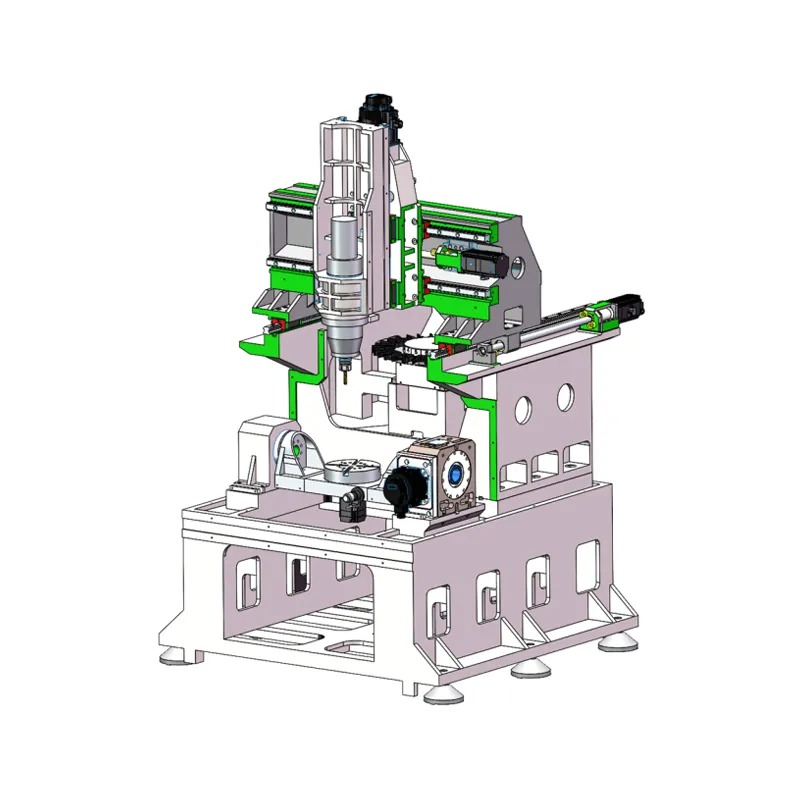
CNC (Computer Numerical Control) machining is the high-precision manufacturing backbone powering the electric vehicle (EV) revolution by rapidly prototyping and producing critical components with unparalleled accuracy. From lightweight battery enclosures and efficient electric motor housings to intricate chassis parts, CNC technology enables the tight tolerances, complex geometries, and superior material performance essential for maximizing EV range, safety, and reliability. As automakers race to innovate, CNC machining provides the speed and versatility needed to turn futuristic designs into road-ready realities, solidifying its role as a foundational pillar of modern automotive manufacturing.
Table of Contents
- The Unseen Engine: What is CNC Machining’s Role in the EV Revolution?
- Why is Precision Machining So Critical for Electric Vehicles?
- From Blueprint to Highway: Key EV Components Powered by CNC Machining
- Accelerating Innovation: CNC Machining in EV Prototyping and R&D
- What Materials Are Commonly Machined for EVs?
- The Future is Now: Advanced CNC Technologies Shaping Tomorrow’s EVs
- Conclusion: CNC Machining as the Bedrock of a Sustainable Automotive Future
The Unseen Engine: What is CNC Machining’s Role in the EV Revolution?
At its core, CNC machining is a subtractive manufacturing process where computer-controlled tools, such as mills, lathes, and grinders, precisely remove material from a solid block (a “blank”) to create a finished part. A digital design file, like a CAD (Computer-Aided Design) model, is translated into instructions for the machine, which then executes the cutting, drilling, or shaping operations with microscopic accuracy. While this technology has been a staple in manufacturing for decades, its role in the context of electric vehicles is profoundly more significant than it ever was for internal combustion engine (ICE) vehicles.
The unique architecture of an EV introduces a completely new set of engineering challenges. Unlike the forgiving, cast-iron-heavy world of traditional engines, EVs depend on the seamless integration of high-voltage battery systems, compact electric motors, and sophisticated power electronics. These systems demand extreme precision to function efficiently and safely. A minute imperfection in a battery cooling plate can lead to thermal runaway, while a slight imbalance in a motor shaft can cause catastrophic failure at high RPMs. CNC machining is the only process that can consistently deliver the required tolerances, complex features, and superior surface finishes at the scale needed for the burgeoning EV market.
Why is Precision Machining So Critical for Electric Vehicles?
The transition from fossil fuels to electricity is not just a powertrain swap; it’s a fundamental reimagining of the vehicle itself. This new paradigm places unprecedented importance on precision, a domain where CNC machining excels. Three key drivers—efficiency, safety, and lightweighting—illustrate why this accuracy is non-negotiable.
The Pursuit of Efficiency and Range
For any electric vehicle, “range anxiety” remains a primary consumer concern. Every watt of energy must be used as efficiently as possible, and this is where mechanical precision has a direct impact on electrical performance. In an electric motor, the tiny air gap between the rotor and stator is critical; CNC machining ensures this gap is perfectly uniform, minimizing magnetic flux leakage and maximizing torque output. Likewise, the intricate channels within a battery pack’s cooling plates, often machined by CNC, must have a smooth and precise surface finish to ensure optimal coolant flow. Any deviation could create hot spots, reducing battery life and performance. By producing components that fit together perfectly and function with minimal energy loss, CNC machining directly contributes to a longer driving range.
Ensuring Safety and Reliability
The high-voltage systems in an EV, particularly the massive lithium-ion battery pack, pose significant safety considerations. The battery enclosure, often a large, complex structure machined from aluminum, serves as a protective shield against physical impact and a critical element of the vehicle’s crash structure. These enclosures must be machined to precise dimensions to guarantee a perfect, watertight seal, preventing moisture intrusion that could lead to short circuits. Furthermore, structural components like suspension knuckles and control arms, which are increasingly machined from solid billets of high-strength aluminum for superior strength-to-weight ratios, rely on CNC’s ability to create flawless parts free from the internal defects that can plague traditional casting methods. This level of reliability is paramount for passenger safety.
The Challenge of Lightweighting
Batteries are incredibly heavy. To offset this weight and maximize range, EV designers are on a relentless quest for lightweighting every other component of the vehicle. CNC machining is a key enabler of this strategy. It allows engineers to design parts with complex, web-like internal structures and thin walls, removing every gram of unnecessary material without compromising structural integrity. This process, known as topology optimization, is perfectly suited for CNC production. By machining parts from lightweight materials like aluminum and composites, manufacturers can build vehicles that are stronger, more agile, and can travel further on a single charge. This contrasts sharply with heavier stamped steel or cast iron parts common in older vehicles.
From Blueprint to Highway: Key EV Components Powered by CNC Machining
While CNC machining contributes to nearly every aspect of an EV, its impact is most profound in three core areas: the battery system, the powertrain, and the vehicle’s structure. Understanding these specific applications reveals just how integral precision machining is.
The Battery System: The Heart of the EV
The battery pack is the single most expensive and complex subsystem in an EV. Its performance and safety depend entirely on precision-manufactured components. Battery trays and enclosures, which house and protect the individual cells, are often machined from large aluminum extrusions or billets. CNC machining ensures these massive parts are dimensionally perfect, providing structural rigidity and a hermetic seal. Inside the pack, cooling plates with intricate, serpentine channels are milled to ensure uniform thermal management across thousands of cells. Finally, busbars, the solid copper conductors that carry immense electrical currents between cell modules, are CNC machined to ensure perfect flatness and conductivity at connection points, minimizing electrical resistance and heat generation.
The Powertrain: Translating Power to Motion
The electric powertrain is deceptively simple in concept but incredibly demanding in execution. The electric motor housing requires precise bores and mounting surfaces to align bearings and the rotor perfectly, which is essential for quiet, efficient operation at speeds exceeding 20,000 RPM. The motor shaft itself is turned and ground on CNC lathes to achieve a flawless surface and exact diameters. Equally important are the housings for the inverter and converter, the power electronics that control the flow of energy. These are often complex aluminum parts with integrated cooling fins and precise mounting points for sensitive electronic components, all created through multi-axis CNC milling.
The Chassis and Structure: The Skeleton of the Vehicle
To achieve superior handling and safety, EV manufacturers are moving towards advanced chassis designs. Critical suspension components like control arms, knuckles, and subframe cradles are increasingly machined from solid blocks of 6061-T6 or 7075 aluminum. This method produces parts that are significantly stronger and lighter than their cast or forged counterparts. In a more recent development, CNC machining plays a vital finishing role for large-scale structural parts made via “giga-casting.” After a massive section of the car’s body is cast as a single piece, large CNC gantry mills are used to machine critical mating surfaces, drill holes, and thread connection points with a level of precision the casting process alone cannot achieve.
| Component | Material | Why CNC is Critical |
|---|---|---|
| Battery Enclosure/Tray | Aluminum Alloys (6061) | Structural rigidity, precise sealing surfaces, crash safety, thermal management features. |
| Motor Housing | Aluminum Alloys | Tight tolerances for bearing seats and stator alignment, high RPM stability, heat dissipation. |
| Busbars | Copper (C110) | Ensures flat contact surfaces for low electrical resistance and minimal heat buildup. |
| Inverter/Converter Housing | Aluminum Alloys | Complex geometries for cooling fins, EMI shielding, precise mounting for electronics. |
| Suspension Knuckles | High-Strength Aluminum (7075) | Superior strength-to-weight ratio, fatigue resistance, and dimensional accuracy for vehicle dynamics. |
Accelerating Innovation: CNC Machining in EV Prototyping and R&D
The EV industry is defined by its blistering pace of innovation. Companies are constantly testing new battery chemistries, motor designs, and structural concepts. In this environment, speed is everything. CNC machining is the undisputed champion of rapid prototyping for functional, high-fidelity parts. An engineer can finalize a design for a new motor bracket or battery connector in the morning, and thanks to CNC, have a fully functional metal part in their hands by the afternoon.
This ability to move directly from digital design to physical object without the need for expensive and time-consuming tooling (like molds or dies) allows for rapid design iteration. If a prototype part fails a stress test or doesn’t fit correctly, engineers can make a digital adjustment and machine a new version in hours, not weeks. This “fail fast, learn faster” approach, enabled by the flexibility of CNC machining, dramatically shortens the development cycle, allowing EV manufacturers to bring more advanced, reliable, and efficient vehicles to market faster than ever before.
What Materials Are Commonly Machined for EVs?
The material choices in an electric vehicle are dictated by the need for light weight, high strength, and excellent thermal and electrical conductivity. CNC machining’s versatility allows it to work with a wide array of these advanced materials.
- Aluminum Alloys: This is the workhorse material of the EV industry. Alloys like 6061 are used for structural components and battery enclosures due to their good strength, corrosion resistance, and machinability. Higher-strength alloys like 7075 are chosen for performance-critical parts like suspension components.
- Copper: Unrivaled for its electrical and thermal conductivity, copper is essential for EV applications. It is CNC machined to create busbars, electrical connectors, and elements within motor windings and heat exchangers.
- Plastics and Polymers: High-performance plastics like PEEK and Delrin are machined for insulators, high-voltage connector bodies, and lightweight gears, where electrical insulation and wear resistance are crucial.
- Advanced Composites: While less common, some high-performance and racing EVs use CNC-machined carbon fiber composites for chassis and body components, offering the ultimate in lightweight strength.
The Future is Now: Advanced CNC Technologies Shaping Tomorrow’s EVs
Just as EVs are evolving, so too is the CNC technology that builds them. Several key trends are pushing the boundaries of what’s possible, promising even more efficient, powerful, and affordable electric vehicles in the future.
The Rise of 5-Axis and Multi-Axis Machining
Traditional CNC machines operate on three axes (X, Y, and Z). However, 5-axis CNC machines can move a part or the cutting tool along five different axes simultaneously. This allows for the creation of incredibly complex geometries, such as the contoured surfaces of an impeller for a coolant pump or the organic shapes of a topology-optimized suspension arm, in a single setup. By eliminating the need to re-fixture the part multiple times, 5-axis machining increases accuracy, reduces cycle times, and enables designs that were previously impossible to manufacture.
Automation and Robotics: Scaling Production
To meet the explosive demand for EVs, manufacturing must be highly efficient and scalable. Fully automated CNC cells are becoming the industry standard. In these systems, robotic arms load raw material blanks into the CNC machine and unload finished parts, often moving them to subsequent stations for deburring, cleaning, or inspection. These “lights-out” manufacturing operations can run 24/7 with minimal human intervention, dramatically increasing throughput, ensuring consistent quality, and lowering the per-part cost, which is essential for making EVs more affordable for the mass market.
A Symbiotic Relationship: CNC and Additive Manufacturing
Instead of viewing them as competitors, savvy manufacturers see CNC machining and Additive Manufacturing (3D printing) as complementary technologies. For highly complex parts, a hybrid approach is emerging as the most efficient solution. A part can be 3D printed in metal to its “near-net shape,” a form that is very close to the final design but lacks precision. This rough part is then transferred to a CNC machine for a final finishing pass. The CNC mill machines only the critical surfaces, bores, and threads to their required tight tolerances. This process combines the design freedom and material efficiency of 3D printing with the unmatched accuracy and surface finish of CNC machining.
Conclusion: CNC Machining as the Bedrock of a Sustainable Automotive Future
The electric vehicle is more than just a car; it’s a complex, integrated system where every component’s performance is interlinked. In this high-stakes environment, the precision, versatility, and speed of CNC machining have proven to be not just beneficial but absolutely essential. It is the silent, unseen force that enables lightweight designs, ensures the safety of high-voltage systems, and maximizes the efficiency that defines the modern EV.
As EV technology continues to advance with more powerful batteries, more efficient motors, and more integrated vehicle architectures, the demands on manufacturing will only grow more stringent. The future of sustainable transportation is being built today in advanced factories, and at the heart of those factories are the computer-controlled spindles of CNC machines, meticulously carving the future of mobility, one precise component at a time.