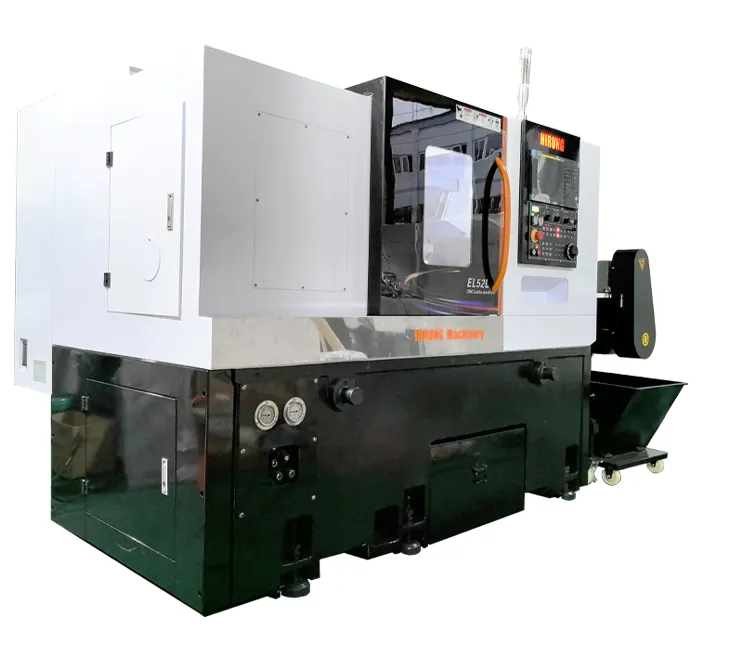
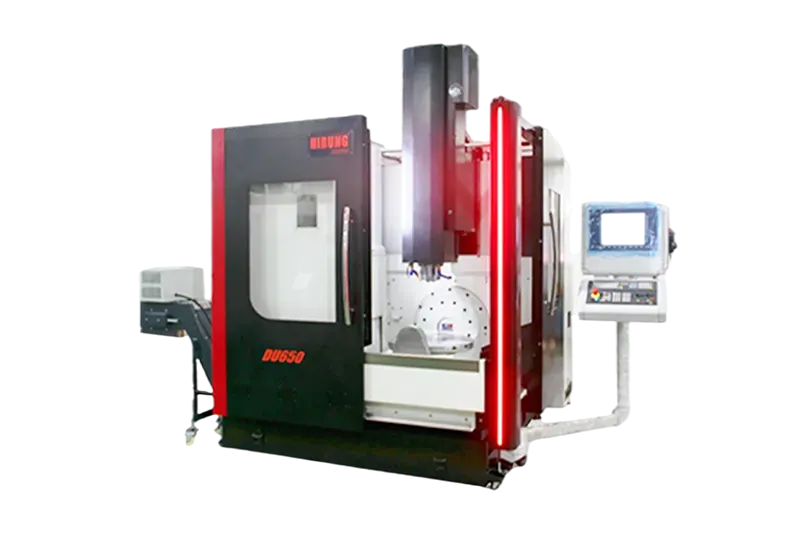
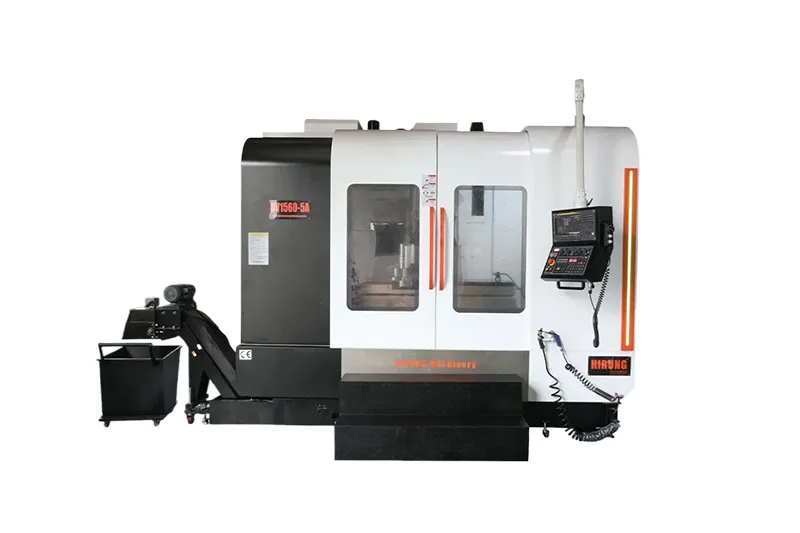
The key difference between a vertical machining center and a horizontal machining center is spindle orientation: a VMC uses a vertical spindle, while an HMC uses a horizontal spindle. In practical manufacturing, this difference affects part loading, chip removal, fixture design, machining efficiency, floor space, automation potential, investment cost, and the types of parts each machine can process efficiently.
For many manufacturers, the choice between a VMC and HMC is not about which machine is “better” in general. It is about which machine fits your part geometry, material, batch size, tolerance requirements, operator skill level, and budget. A CNC vertical machining center is often preferred for flexible production, easier setup, lower investment, and a wide range of milling, drilling, tapping, and surface machining tasks. A horizontal machining center is often used when manufacturers need high-volume production, multi-sided machining, strong chip evacuation, and pallet-based automation.
This guide compares vertical vs horizontal machining center options from a manufacturer’s point of view, helping buyers decide when to choose a VMC, when to choose an HMC, and what factors should be checked before purchasing.
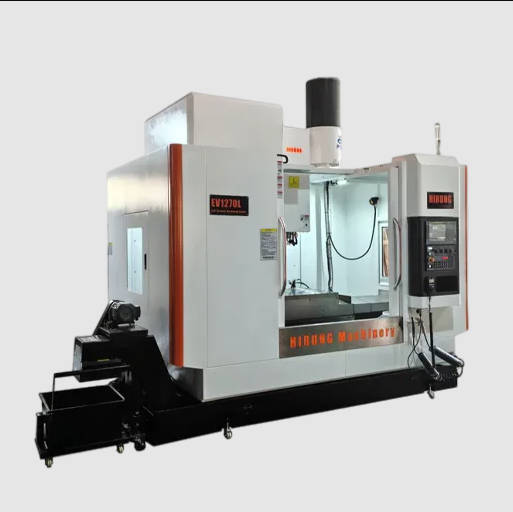
What Is a Vertical Machining Center?
A vertical machining center, also called a VMC, is a CNC machine tool with a vertically oriented spindle. The cutting tool moves down toward the workpiece from above. The workpiece is usually fixed on the table, and the machine performs milling, drilling, tapping, boring, slotting, pocketing, contouring, and finishing operations.
A VMC is widely used in:
- General metal parts machining
- Mold and fixture production
- Automotive brackets and housings
- Aluminum parts machining
- Machinery parts manufacturing
- Electronic housings and plates
- Small to medium batch production
- Prototype and custom parts machining
A vertical machining center is usually a practical choice when manufacturers need flexible machining, easier setup, direct workpiece visibility, and a balanced investment cost.
Because the spindle faces downward, operators can easily load parts, set fixtures, inspect surfaces, and adjust tools. This makes the VMC especially useful for workshops that process many different part types.
What Is a Horizontal Machining Center?
A horizontal machining center, also called an HMC, is a CNC machine tool with a horizontally oriented spindle. The tool approaches the workpiece from the side rather than from above. HMCs often use pallet systems, tombstone fixtures, and multi-sided machining setups.
An HMC is commonly used for:
- High-volume production
- Multi-face machining
- Box-type parts
- Transmission housings
- Engine-related components
- Hydraulic blocks
- Large batch automotive parts
- Parts requiring strong chip evacuation
In many applications, an HMC can machine several sides of a workpiece with fewer setups, especially when used with a rotary table or pallet system. This can improve productivity for repeat production, but it usually requires higher investment, more complex fixture planning, and more experienced operators.
VMC vs HMC: Quick Comparison Table
| Comparison Factor | Vertical Machining Center | Horizontal Machining Center |
|---|---|---|
| Spindle orientation | Vertical spindle | Horizontal spindle |
| Workpiece access | Easy top access and visibility | Side access, often with pallet or tombstone fixture |
| Setup complexity | Usually simpler | Usually more complex |
| Chip removal | Chips may accumulate on the workpiece or fixture | Chips fall away more easily in many operations |
| Investment cost | Commonly lower | Commonly higher |
| Floor space | Usually more compact | Often requires more space |
| Operator training | Easier for many workshops | Requires more fixture and process planning |
| Multi-sided machining | May need multiple setups | Strong advantage with rotary/pallet systems |
| Small batch flexibility | Strong | Less efficient unless setup is justified |
| High-volume production | Suitable for many applications | Stronger for repeat multi-face production |
| Typical users | Job shops, mold shops, general manufacturers | Automotive, hydraulic, aerospace, high-volume plants |
Main Difference: Spindle Orientation and Machining Direction
The most visible difference in vertical machining center comparison is spindle direction. A VMC cuts from above. An HMC cuts from the side.
This affects how the machine handles the workpiece.
With a VMC, the workpiece sits on the table. The operator can easily see the cutting area, fixture, part surface, coolant, and chips. This makes setup and inspection more convenient. For many small and medium-sized parts, the workflow is straightforward.
With an HMC, the workpiece is often mounted vertically or on a tombstone fixture. The tool approaches from the side. This arrangement can improve chip evacuation and allow multiple sides of the part to be machined more efficiently, but fixture design is usually more demanding.
If your parts mainly require top-face machining, drilling, pocketing, and surface milling, a VMC is often easier and more economical to use. If your parts require repeated multi-sided machining in high volume, an HMC may provide better long-term productivity.
Cost Comparison: VMC vs HMC
Cost is one of the main reasons many manufacturers choose a vertical machining center first. In many cases, a VMC has a lower purchase cost, lower fixture cost, simpler installation, and lower training burden.
However, machine price is not the only cost. Buyers should compare total cost of ownership.
| Cost Factor | VMC Consideration | HMC Consideration |
|---|---|---|
| Machine purchase price | Commonly more accessible | Usually higher investment |
| Fixture cost | Often simpler and lower | Tombstone and pallet fixtures can be costly |
| Tooling cost | Depends on application | May require more advanced setup |
| Operator training | Easier for many workshops | More planning and experience required |
| Floor space | Usually more compact | Larger footprint in many cases |
| Maintenance | Generally simpler | More complex with pallet/rotary systems |
| Productivity | Good for flexible production | Strong for repeat multi-sided production |
| Payback period | Better for mixed jobs and lower volume | Better when high-volume utilization is stable |
For a factory producing mixed parts, prototypes, molds, or medium-volume components, a VMC may provide a more practical return. For a factory running the same part family in large volumes, an HMC may justify the higher initial investment.
Accuracy and Rigidity Comparison
Both VMCs and HMCs can produce accurate parts when properly built, installed, maintained, and matched with the correct process. Accuracy depends on machine structure, spindle quality, guideways, thermal stability, fixture design, cutting parameters, and inspection control.
A vertical machining center can provide stable accuracy for many industrial parts, especially when the machine has a rigid base, reliable spindle, quality guideways, and proper toolholding. The HIRUNG EV Series vertical machining center is designed for industrial applications where rigidity, machining stability, and production durability are important selection factors.
An HMC may offer advantages in heavy-duty and multi-face production because of its structure and fixture layout. However, if the part does not require those advantages, an HMC may not bring enough benefit to justify the cost.
| Accuracy Factor | VMC | HMC |
|---|---|---|
| Top-face machining accuracy | Strong | Depends on setup |
| Multi-face positional consistency | May need multiple setups | Strong with rotary/pallet systems |
| Fixture repeatability | Usually simpler | Strong but more complex |
| Thermal control | Depends on machine design | Depends on machine design |
| Heavy cutting stability | Good with rigid machine structure | Often strong in production setups |
| Inspection convenience | Easier visual access | May require more planned inspection workflow |
Chip Removal Comparison
Chip evacuation is one of the biggest practical differences between a VMC and HMC.
In a VMC, chips can collect on the workpiece, fixture, or table because cutting happens from above. This is manageable with proper coolant flow, air blast, chip conveyors, and good fixture design. For many applications, especially small and medium-sized parts, VMC chip control is sufficient.
In an HMC, gravity often helps chips fall away from the workpiece. This is useful for deep pockets, cavities, cast iron, aluminum, and high-volume production where chip buildup could affect accuracy and tool life.
If chip removal is a major issue in deep cavities or continuous production, an HMC can offer an advantage. If your parts are easier to clean and your production is mixed or moderate, a VMC can still be highly practical.
When choosing a VMC, buyers should still pay close attention to chip management. The HIRUNG EV Series page shows several chip removal options for vertical machining centers, which can help users match the machine to different materials and shop requirements.
Production Volume: Which Machine Fits Your Batch Size?
Batch size is a major factor in the vertical vs horizontal machining center decision.
A VMC is commonly suitable for:
- Small batch production
- Medium batch production
- Prototype machining
- Mold and fixture work
- Job shop machining
- Mixed part families
- Frequent product changes
- General-purpose metal cutting
An HMC is commonly suitable for:
- High-volume production
- Repeat parts
- Multi-side machining
- Automated pallet workflows
- Long-cycle production
- Automotive and hydraulic component lines
| Production Type | Better Fit | Reason |
|---|---|---|
| Prototype parts | VMC | Easier setup and programming |
| Mixed part orders | VMC | Better flexibility |
| Mold and fixture machining | VMC | Good visibility and setup access |
| Medium-batch metal parts | VMC | Balanced cost and productivity |
| High-volume box parts | HMC | Multi-face machining efficiency |
| Automated production cells | HMC | Strong pallet and tombstone workflow |
| Frequent part changeovers | VMC | Faster and simpler setup |
For many manufacturers buying their first machining center, a VMC is often the more realistic choice. It covers a wide range of jobs and is easier to integrate into existing workshop operations.
Part Geometry: When to Choose VMC or HMC
Part shape is another important factor.
Choose a VMC when the part has:
- Mainly top-face machining
- Flat surfaces
- Slots, holes, and pockets
- Plate-like geometry
- Mold surfaces
- Simple to medium complexity
- Easy fixture access
- Frequent design changes
Choose an HMC when the part has:
- Multiple side faces requiring machining
- Box-like geometry
- Deep cavities
- Large-volume repeated features
- Heavy chip generation
- Need for pallet/tombstone fixtures
- Long-term repeat production
A VMC can still machine multiple sides, but it often requires repositioning or additional setups. An HMC can reduce setups for certain parts, but only when the fixture and production volume support that workflow.
Ease of Operation and Setup
For workshops with limited CNC staff or frequent part changes, setup simplicity matters.
VMC advantages include:
- Easier part loading
- Easier visual inspection
- Easier fixture setup
- Simpler operator training
- Easier tool setting
- Better access to the working area
- More intuitive machining direction
HMC operation may require:
- More advanced fixture planning
- Tombstone or pallet setup experience
- Better process engineering
- More careful collision prevention
- Higher operator and programmer skill
This does not mean HMCs are difficult in all cases. In a well-organized production environment, an HMC can be extremely efficient. But for small and medium manufacturers, the learning curve and setup cost should be considered.
Floor Space and Workshop Layout
A VMC usually has a more compact footprint than an HMC with pallet systems and auxiliary equipment. This can be important for manufacturers with limited workshop space.
When planning floor space, consider:
- Machine footprint
- Operator access
- Door opening space
- Tool loading space
- Chip conveyor layout
- Coolant tank access
- Electrical cabinet access
- Maintenance clearance
- Material loading path
The HIRUNG CNC Vertical Machining Center EV Series includes multiple model sizes, allowing manufacturers to choose a suitable machine according to part size, floor space, and production requirements.
Which One Is Better for Different Industries?
| Industry / Application | Recommended Direction | Reason |
|---|---|---|
| General metal parts manufacturing | VMC | Flexible and cost-effective for mixed work |
| Mold manufacturing | VMC | Good visibility and surface machining access |
| Automotive high-volume components | HMC or VMC depending on part | HMC for repeat multi-face parts; VMC for brackets, covers, plates |
| Machinery parts | VMC | Suitable for plates, blocks, brackets, and fixtures |
| Hydraulic blocks | HMC often preferred | Strong for multi-side hole machining |
| Electronics housings | VMC | Good for aluminum milling and pocketing |
| Job shops | VMC | Handles varied customer orders |
| Dedicated production lines | HMC may be suitable | Better when volume and fixture strategy justify investment |
Buying Advice: How to Choose Between VMC and HMC
Before deciding, manufacturers should answer these questions.
| Question | If Your Answer Is Yes | Suggested Direction |
|---|---|---|
| Do you process many different part types? | Yes | VMC |
| Do you frequently change setups? | Yes | VMC |
| Is your budget limited? | Yes | VMC |
| Do most parts require top-face machining? | Yes | VMC |
| Do you need easy operator access? | Yes | VMC |
| Do your parts require machining on several sides in one setup? | Yes | HMC |
| Is your production volume high and stable? | Yes | HMC |
| Can you invest in advanced fixtures and pallets? | Yes | HMC |
| Is chip evacuation a major issue? | Yes | HMC may help |
| Are you buying your first machining center? | Yes | VMC is often more practical |
For most small and medium manufacturers, a vertical machining center is often the more practical first investment because it offers flexibility, easier setup, and a lower entry cost.
When a Vertical Machining Center Is the Better Choice
A VMC is often the better choice when your business values flexibility more than dedicated mass-production efficiency.
Choose a vertical machining center if:
- You produce different parts for different customers
- You need a machine for milling, drilling, tapping, and pocketing
- Your parts are mainly plates, brackets, molds, covers, and housings
- Your production volume changes frequently
- You need easier setup and operation
- You want lower investment risk
- You need a machine suitable for both production and prototyping
- You want to train operators more quickly
In these cases, a VMC can provide broad machining capability without requiring the higher investment and fixture complexity of an HMC.
When a Horizontal Machining Center Is the Better Choice
An HMC becomes more attractive when production is stable, repeatable, and volume-driven.
Choose a horizontal machining center if:
- Your parts require multiple sides to be machined repeatedly
- You run high-volume production
- You use pallet systems or tombstone fixtures
- Chip evacuation strongly affects productivity
- You can justify higher investment through long-term output
- You have experienced process engineers and operators
- Your fixtures are designed for repeat production
For dedicated manufacturing lines, especially in automotive or hydraulic parts, an HMC can be a strong investment when utilization is high enough.
Common Mistakes When Comparing VMC vs HMC
Mistake 1: Assuming HMC Is Always More Advanced
An HMC is not automatically the better machine. It is better for specific production conditions. If your parts do not need multi-face machining or high-volume automation, a VMC may be more efficient financially.
Mistake 2: Choosing VMC Only Because It Is Cheaper
A VMC is usually more accessible, but buyers should still check rigidity, spindle configuration, tool capacity, chip removal, guideways, control system, and service support.
Mistake 3: Ignoring Fixture Cost
HMC productivity often depends on proper fixtures and pallets. If fixture cost and setup planning are underestimated, the real investment may be much higher than expected.
Mistake 4: Comparing Machines Without Part Drawings
Machine selection should be based on part drawings, material, tolerance, batch size, and process route. Without this information, any comparison is incomplete.
Mistake 5: Overbuying for Uncertain Future Orders
Some buyers choose an HMC because they expect future high-volume work. If that volume does not arrive, the machine may be underutilized. A flexible VMC may be safer when demand is uncertain.
How HIRUNG EV Series Fits the VMC Selection Scenario
For buyers who decide that a vertical machining center is more suitable, the next step is choosing the right VMC model and configuration. The HIRUNG EV Series can be considered for manufacturers that need a practical VMC for metal parts, molds, fixtures, automotive components, aluminum parts, and general industrial machining.
The EV Series is relevant when buyers need:
- Multiple model sizes for different workpiece ranges
- A rigid structure for stable machining
- Spindle configurations for different materials
- A 24-tool magazine for multi-process machining
- Chip removal options for different production needs
- Linear guideway structure for machining stability
- Maintenance-friendly electrical layout
- Suitable configuration for industrial production workshops
If you are comparing vertical vs horizontal machining center options and your parts are mainly suitable for VMC machining, you can review the HIRUNG EV Series CNC vertical machining center as a practical starting point.
For buyers still comparing different CNC machine categories, the HIRUNG official website can help you explore available machine types and discuss which solution fits your production plan.
FAQ
1. What is the difference between a vertical machining center and a horizontal machining center?
The main difference is spindle orientation. A vertical machining center has a vertical spindle that cuts from above, while a horizontal machining center has a horizontal spindle that cuts from the side. This affects setup, chip removal, fixture design, and production efficiency.
2. Which is better, VMC or HMC?
Neither is always better. A VMC is often better for flexible production, small and medium batches, easier setup, and lower investment. An HMC is often better for high-volume, multi-sided machining with advanced fixture and pallet systems.
3. When should I choose a vertical machining center?
Choose a vertical machining center when your parts mainly require milling, drilling, tapping, pocketing, surface machining, and frequent setup changes. It is also suitable for job shops, mold shops, prototype work, and general metal parts manufacturing.
4. When should I choose a horizontal machining center?
Choose a horizontal machining center when your parts require repeated multi-face machining, strong chip evacuation, high-volume production, and pallet or tombstone fixture systems. It is commonly used in automotive, hydraulic, and dedicated production lines.
5. Is a vertical machining center cheaper than a horizontal machining center?
In many cases, a vertical machining center has a lower initial investment and simpler fixture requirements. However, the final cost depends on machine size, spindle, control system, accessories, tooling, installation, and service support.
6. Can a VMC machine multiple sides of a part?
Yes, a VMC can machine multiple sides, but it may require repositioning, additional setups, or a rotary table. If multi-sided machining is frequent and production volume is high, an HMC may be more efficient.
7. Is a VMC suitable for automotive parts manufacturing?
Yes. A VMC can be suitable for automotive brackets, covers, plates, housings, aluminum components, fixtures, and prototype parts. For high-volume multi-face components, an HMC may also be considered.
Conclusion
The vertical vs horizontal machining center decision should be based on part geometry, production volume, machining process, fixture strategy, chip removal needs, operator skill, floor space, and investment plan.
A vertical machining center is often the more practical choice for manufacturers that need flexibility, easier setup, lower investment, and broad machining capability. It is especially suitable for small and medium batch production, job shops, mold work, fixtures, aluminum parts, brackets, housings, and general metal components.
A horizontal machining center becomes more attractive when production is stable, high-volume, and focused on multi-sided machining. It can offer strong productivity when the part design, fixture system, and utilization rate justify the higher investment.
If your production needs point toward a VMC, the HIRUNG EV Series can be evaluated as a flexible CNC vertical machining center option for industrial metal parts manufacturing. To choose the right model, prepare your part drawings, material details, tolerance requirements, fixture plan, and expected production volume before requesting a machine recommendation.