Quick Answer: What Does a 5 Axis CNC Machining Center Cost?
There is no meaningful published price for a 5 axis CNC machining center, because two machines of the same travel can differ in configuration by a wide margin. The price is set by the rotary assembly, whether simultaneous 5-axis motion is included, the control system and its options, the accuracy package, and everything that surrounds the machine.
That is the honest answer, and it is also the reason a quote that arrives without your part drawing, material and tolerance requirement should be treated as a placeholder rather than a number you can budget against. A supplier who quotes before asking what you are cutting is describing a machine, not your machine.
This guide is written for buyers who need to build an internal budget case, compare two or three quotations, and avoid the line items that appear after the purchase order has been signed. It does not quote figures — no document of this type can, across regions, currencies and configurations — but it does show you where the money goes in a 5 axis machining center, which cost items are routinely missed, and how to make two suppliers quote the same machine.
Why 5-Axis Quotes Vary Far More Than 3-Axis Quotes
If you have bought a 3-axis vertical machining centre recently, you may expect quotes for comparable machines to cluster within a fairly narrow band. Five-axis machines do not behave that way. The spread between the lowest and highest quote for nominally “the same size” machine is often much wider, and that spread comes from three sources that have no equivalent on a 3-axis machine.
| Source of variation | Why it is specific to 5-axis machines | What to lock down in the quotation |
|---|---|---|
| Rotary assembly type | A trunnion table, a swivel head and a gantry plus rotary table are completely different mechanical systems with different cost structures | Drive type (direct drive or worm gear), angular feedback, load rating at full tilt |
| Indexed vs simultaneous motion | 3+2 positioning and true 5-axis interpolation require different control hardware, licensing and CAM post-processing | Explicit statement of simultaneous capability and which control options are included |
| Accuracy and feedback package | Angular accuracy is amplified by distance from the rotary centre, so scale feedback and calibration carry more weight on large parts | The measurement standard used, and whether linear and angular scales are fitted |
| Software chain | CAM, post-processor and simulation are part of the machine’s usable capability, not an afterthought | Who supplies and validates the post-processor for your CAM system |
The rotary assembly is the single biggest differentiator
On a 3-axis machine, the table is a table. On a 5-axis machine, the rotary assembly is a precision subsystem with its own bearings, drive, brake or clamp, encoder and, on better machines, its own angular feedback device. A direct-drive rotary axis with a circular encoder costs materially more than a worm-gear indexer, and the difference shows up in positioning accuracy, response and long-term maintenance — all of which belong in a price comparison, not just a specification sheet.
Indexed 3+2 and simultaneous 5-axis are not the same product
Many enquiries describe a “5-axis machine” without specifying which mode is required. Indexed machining — positioning the rotary axes and then cutting with three axes — and simultaneous machining — moving all five axes at once through a cut — place very different demands on the control, the servo tuning and the CAM system. If your parts have blended surfaces, impeller or blisk geometry, or a profile that must be continuous across faces, you need the simultaneous capability named explicitly in the quote. If your parts are prismatic with features on several faces, indexed machining may deliver most of the benefit at a lower cost.
Accuracy figures are quoted to different standards
A positioning figure means little without its measurement standard, and ISO 230-2 and VDI 3441 do not produce identical numbers for the same machine. When comparing prices, insist that every supplier states the standard, the machine condition and the temperature at which the published accuracy was measured — otherwise you are not comparing accuracy at all.
Configuration Bands: Comparing What You Actually Buy
Because absolute figures are unreliable, it is more useful to think in configuration bands. The table below uses a relative price index with a well-equipped 3-axis machining centre of comparable travel set as the reference point of 1.0. These are relative orders of magnitude for orientation only; they are not published prices and they will differ by supplier, region, currency and configuration.
| Band | Typical configuration | Suited to | Relative price level |
|---|---|---|---|
| Compact / bench-top class | Small trunnion, modest travel and table load, lower-power spindle, limited tool capacity | Small precision parts, R&D, medical and electronics components, education | Around 1.0 and below |
| General-purpose trunnion | Direct-drive or quality worm-gear rotary, mainstream control, 24-tool class magazine, full enclosure and coolant package | Multi-face prismatic parts, moulds and electrodes, job-shop work | Roughly 1.5 to 2.5 times |
| High-accuracy production | Direct-drive rotary with angular feedback, linear scales, thermal management, probing, higher-power spindle, larger magazine | Aerospace structures, tight-tolerance serial production, long unattended cycles | Roughly 2.5 to 4 times |
| Large-part and gantry type | Gantry structure with rotary table, high table load, long travels, optional angle heads and scales | Large moulds, structural components, parts whose fixture weight exceeds a trunnion rating | Four times and above |
The practical use of this table is not to pick a number. It is to check whether three suppliers are quoting the same band. In most price comparisons that go wrong, one supplier is quoting band two and another is quoting band three, and the cheaper quote wins for reasons that have nothing to do with value.
Anatomy of a 5-Axis Quotation, Line by Line
Rather than reading a quote as a single figure, read it as a list of decisions. The line items below are where the price is actually built, and where two quotes that look similar usually diverge.
| Line item | Usually standard or optional | Effect on price | What to confirm |
|---|---|---|---|
| Base machine with travels and table | Standard | High — sets the whole band | Travel, table size, and load rating at full tilt |
| Rotary axes and drive type | Standard on most machines, but the type varies | High | Direct drive or worm gear; is angular feedback fitted? |
| CNC control and 5-axis options | Standard, with options | High | Is simultaneous interpolation and tool-centre-point control included? |
| Linear scales / optical rulers | Usually optional | Medium to high | Which axes, which brand, and is installation included? |
| Spindle configuration | Standard, with alternatives | Medium to high | Taper, speed, power and torque curve for your material |
| Tool magazine and tool change | Standard capacity, larger optional | Medium | Capacity, exchange time, maximum tool length and weight |
| Probing and tool measurement | Optional on many machines | Medium | Touch probe and laser tool setter — included or quoted separately? |
| Coolant, chip removal, filtration | Basic standard, upgrades optional | Low to medium | Through-spindle coolant, oil skimmer, conveyor type |
| Enclosure, safety, electrical | Standard | Low to medium | Cabinet cooling, transformer for local voltage, safety compliance |
| Software and post-processor | Varies widely | Low to high | CAM licence, validated post-processor, simulation |
| Freight, insurance, duty | Almost always separate | Medium | Incoterm, port, and who clears customs |
| Foundation, installation, commissioning | Often excluded | Medium | Levelling, anchoring, power connection, acceptance test |
| Training and documentation | Often excluded or limited | Low to medium | Number of operators, days on site, language of manuals |
| Warranty and spare parts package | Basic warranty standard | Low to medium | Coverage period, response time, recommended spares list |
The most common pricing surprise is not an overpriced machine — it is a machine that was quoted without the items that make it produce parts. A probing package, a validated post-processor and a commissioning visit are each individually modest; together they can move a project by a noticeable margin and delay first-part approval by weeks.
It is worth reading the standard-equipment list as carefully as the options list. On HIRUNG’s DV Series, for example, an automatic tool measuring device, spindle oil cooling, a spindle water cooling device, an electric box heat exchanger, an automatic centralised lubrication system, a twin screw plus chain plate chip conveyor and a 24-tool arm-type magazine are all included as standard rather than quoted as additions. Two quotations can differ by the length of that list alone, which is why the comparison should be made line by line rather than total against total.
Cost Items Buyers Commonly Miss on a First 5-Axis Purchase
These are the items that most often appear after the order, and they are the ones worth raising in the first round of enquiry rather than the last.
CAM software and post-processor validation
A 5-axis machine without a correct post-processor is an expensive 3-axis machine. Budget for the CAM seat, for the post, and — more importantly — for the time to validate it. Ask who writes the post, who verifies it against your machine’s kinematics, and whether a dry run on your geometry is included.
Programming and operator training
Five-axis programming is a different skill from three-axis programming. If your team has not done it before, the learning curve shows up as scrap, longer set-ups and under-used capability. Training days are cheaper than the first month of trial and error.
Fixturing and rotary table load
A trunnion rating quoted in the horizontal position is not the rating at 90 degrees of tilt. Fixture plus workpiece weight has to sit inside the derated figure, and 5-axis fixtures are often heavier than their 3-axis equivalents because they must clear the tool through a wider range of angles.
Acceptance test piece and measurement
Standard test pieces prove the machine is healthy; they do not prove it can hold your tolerances. Budget for a representative test part and for the measurement time on a CMM, and agree in advance who pays for it and what the acceptance criteria are.
Foundation, power and environment
Larger 5-axis machines carry real foundation, levelling and ambient temperature requirements. Electrical supply, air supply, coolant disposal and floor loading belong in the project budget, not in an afterthought.
Spare parts and service response
A recommended spares list, local service coverage and a stated response time are part of what you are buying. The cheapest quote is often the one where these are undefined.
Five-Year Cost of Ownership: What the Machine Really Costs
For a capital request, the purchase price is only the first line. The table below gives the structure most buyers find useful when presenting a 5-axis investment internally. Relative weights are indicative and will vary with utilisation, material and local labour and energy costs.
| Cost category | One-off or recurring | Relative weight | Notes |
|---|---|---|---|
| Machine and included configuration | One-off | Dominant | The figure most comparisons stop at |
| Options, tooling package and fixtures | One-off | Moderate | Often quoted separately from the machine |
| Freight, duty, installation and commissioning | One-off | Moderate | Varies significantly with region and Incoterm |
| CAM, post-processor and training | One-off, with renewal | Moderate | Frequently the largest underestimated item |
| Consumables — cutters, holders, coolant | Recurring | Moderate over five years | Compound-angle work uses more tool variety |
| Preventive maintenance and calibration | Recurring | Low to moderate | Rotary axis calibration is often overlooked |
| Energy and compressed air | Recurring | Low to moderate | Driven by spindle duty cycle and hours |
| Unplanned downtime | Variable | Can be the largest hidden cost | Depends on service response and spares availability |
How to Request Quotations You Can Actually Compare
The single most effective thing a buyer can do to control a 5-axis budget is to send the same information to every supplier. When each quote is built on a different set of assumptions, price comparison is meaningless. Send the following with your first enquiry:
- Part drawing or a representative model — including the faces that must be machined and any blended surfaces.
- Material and hardness, plus the rough stock form (billet, casting, forging).
- Accuracy requirement — specifically the feature-to-feature tolerances, not just a general tolerance class.
- Fixture information — concept, estimated weight, and whether an existing fixture will be reused.
- Production target — annual volume, batch sizes, and whether the machine will run unattended.
- Machining mode — confirm whether indexed 3+2 is sufficient or simultaneous motion is required.
- Site conditions — available power, air, floor space and ambient temperature range.
- Commercial terms — preferred Incoterm, destination port, and whether installation and training should be included.
Ask each supplier to quote the same configuration twice if necessary: once as they would specify it, and once against your minimum acceptable specification. Suppliers who ask detailed questions before quoting are usually the ones whose numbers survive contact with the part.
Where Buyers Overpay and Where They Under-Buy
| Situation | Common decision | Better move | Cost consequence |
|---|---|---|---|
| Prismatic parts with features on several faces | Buy full simultaneous 5-axis capability | Specify indexed 3+2 and confirm the surfaces do not need blending | Avoids paying for control and CAM capability that will not be used |
| Blended or free-form surfaces | Buy indexed capability because it is cheaper | Specify simultaneous motion and a validated post-processor | Avoids a machine that cannot produce the part as drawn |
| Large parts with heavy fixtures | Size the machine by part envelope only | Check table load at full tilt and consider a gantry layout | Avoids an overloaded rotary table that loses accuracy |
| Tight relational tolerances | Compare machines on positioning figures alone | Add linear and angular scale feedback and an acceptance test part | Protects the tolerances that actually cause scrap |
| First 5-axis purchase | Treat CAM and training as later problems | Bundle post-processor validation and training into the machine order | Avoids months of under-utilisation |
| Lowest quote wins | Compare totals across different configurations | Normalise the quotes line by line before comparing | Prevents the “cheaper” machine costing more by delivery |
How to Evaluate a 5-Axis Supplier Beyond the Price
Price is the easiest thing to compare and the least informative. These questions reveal more about the total cost you are about to take on:
- Which measurement standard were the accuracy figures taken to, and can you see the report?
- Is the rotary axis direct drive, and does it have independent angular feedback?
- Who writes and validates the post-processor for our CAM system — and is that included?
- What exactly is on the standard equipment list, and what is quoted as an option?
- What does installation and commissioning include, and who pays for the acceptance test piece?
- What is the warranty period, the stated response time, and the recommended spares list?
- Can you machine our part and measure it with us before we accept the machine?
A supplier who answers these in writing is one you can hold to later. A supplier who answers only with a total is one where the differences will be discovered after delivery.
Where HIRUNG 5 Axis Machining Centers Fit
HIRUNG’s 5-axis range spans the middle and upper bands described above, and the differentiator is usually how much of the accuracy package is included rather than sold as an addition.
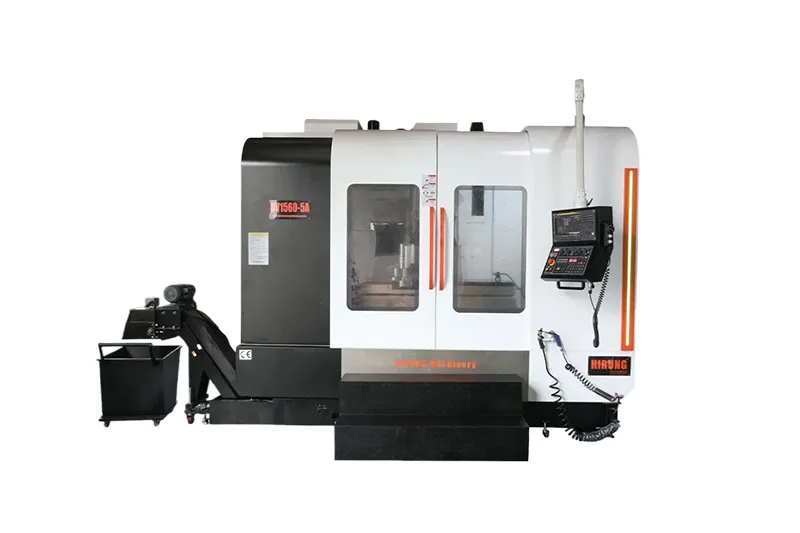
The DV Series 5 axis machining center targets large and heavy parts. The spindle and B-axis are built as a single unit rather than assembled from separate components, which avoids the precision loss that repeated assembly can introduce; the B-axis is a direct-drive built-in electric spindle with a circular optical ruler, ±110° of indexing and a published positioning accuracy of 0.0015°. The structure uses Meehanite FC30 castings aged for 90 days and weighs 12,000 kg. Published accuracy for the DV1560-5A is X/Y/Z positioning of ≤0.01 mm and repeatability of ≤0.005 mm to VDI 3441, with B/C positioning of ±10 arc-seconds and repeatability of ±4 arc-seconds. Table load is 900 kg on the DV1350-5A and 1,200 kg on the DV1560-5A. Electrical components are labelled in Chinese, English and Russian, which reduces troubleshooting time for mixed-language maintenance teams.
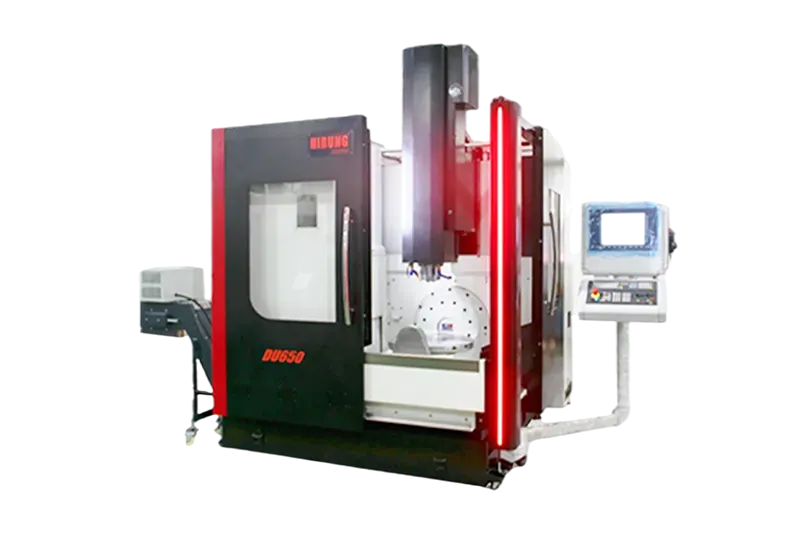
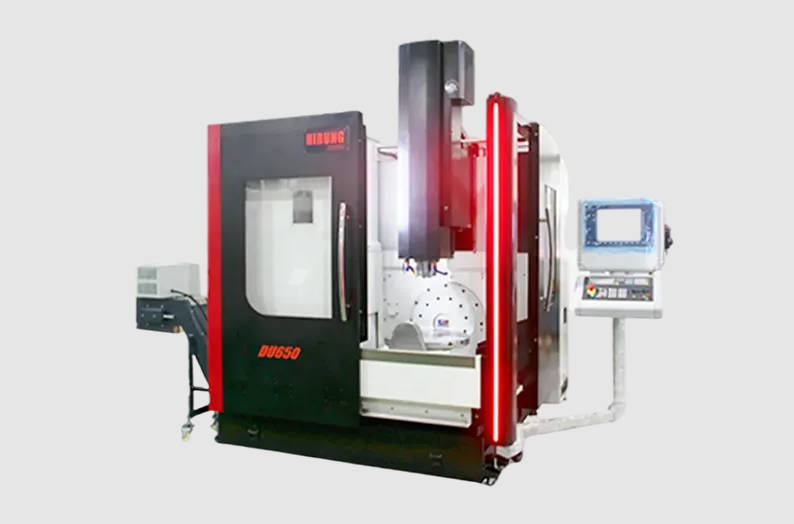
The DU Series 5 axis universal machining center covers smaller and medium components, with HSK A63 spindles at 18,000 or 24,000 rpm and models from the compact DU200 to the DU1060. Published ISO 230-2 figures for the DU650 and DU1060 are ±0.005 mm positioning and ±0.002 mm repeatability on the linear axes, with 10 arc-seconds positioning and 5 arc-seconds repeatability on B/C. For a buyer comparing quotes, the value is that the rotary feedback and the accuracy standard are stated rather than implied.
When the part or its fixture exceeds what a trunnion table can carry, the cost picture changes: you are no longer buying a rotary table, you are buying a structure. In that case a gantry-type 5 axis universal machining center pairs a rigid gantry frame with a direct-drive, double-supported B/C rotary table, with HEIDENHAIN or FAGOR linear scales available as an option. That configuration sits in the upper band, and it is usually cheaper than buying a trunnion machine and then discovering the fixture does not fit inside the load rating.
Which band applies depends on the drawing, the material, the fixture weight and the production target. Those four inputs determine the configuration, and the configuration determines the price — not the other way around.
Frequently Asked Questions
How much does a 5 axis CNC machining center cost?
There is no single figure. A compact machine, a general-purpose trunnion machine and a gantry-type platform differ by multiples, and within each category the control options, feedback package and tooling can move the price substantially. The reliable way to get a number is to send a drawing, material, accuracy requirement and production target and ask for a configured quotation.
What affects 5 axis CNC machining center price the most?
The rotary assembly and the control configuration. Whether the rotary axes are direct drive with angular feedback, and whether simultaneous 5-axis interpolation with tool-centre-point control is included, usually has a larger effect than travel or spindle speed.
Why are two 5 axis machine quotes so different for the same size?
In most cases the machines are not the same. Differences in rotary drive type, feedback devices, control options, included tooling and measurement package, and in what is excluded — installation, training, duty — account for most of the gap. Normalise the quotes line by line before comparing totals.
Is indexed 3+2 machining cheaper than simultaneous 5-axis machining?
Generally yes, in both machine cost and programming complexity. It is suitable for prismatic parts whose faces are machined independently. It is not sufficient where surfaces must blend continuously, where the tool must stay normal to a curved surface, or where undercut flow geometry is involved.
What hidden costs should I budget for when buying a 5 axis machine?
The items most often missed are CAM software and post-processor validation, programming and operator training, 5-axis fixturing, the acceptance test piece and its measurement, foundation and site preparation, and a spare parts and service package.
Does adding linear scales and probing significantly increase the price?
They are a meaningful but usually moderate addition relative to the machine, and on parts with tight relational tolerances they often reduce cost elsewhere by cutting scrap and inspection time. Whether they are worth it depends on the tolerance you are trying to hold, not on the machine size.
What information should I provide to get an accurate 5 axis CNC machine quotation?
Part drawing or model, material and hardness, the feature-to-feature tolerances that matter, fixture concept and weight, annual volume and batch sizes, whether simultaneous motion is required, site conditions including power and ambient temperature, and your preferred commercial terms.
Is a cheaper 5 axis CNC machine worth buying?
It depends on what was removed to reach that price. A lower-cost machine with the same configuration is a saving; a lower-cost machine that omits the feedback, measurement or software chain you need will cost more by the time the first part is approved. Compare the line items, then the total.
Conclusion
A 5 axis CNC machining center price is not a number a supplier can invent — it is the output of a configuration, and the configuration is the output of your part. Buyers who get predictable pricing do three things: they send enough information for the machine to be specified properly, they compare quotations line by line instead of total against total, and they treat the software chain and the acceptance test as part of the machine rather than as extras.
If you are at the stage of building a budget, the fastest route to a defensible number is to start with the part. Send the drawing, material, fixture weight, tolerance requirement and annual volume, and ask each supplier to quote the same specification. You can begin with the CNC 5 axis machining center range, or request a configuration review against your drawing.