The manufacturing landscape of 2026 has officially transitioned into the era of “Industry 5.0.” While the previous decade was focused on raw automation, this year is defined by the synergy between human intuition and high-precision machine intelligence. For any shop floor looking to remain competitive, the question is no longer whether to invest in a 5-axis machining center, but rather which brand provides the stability and ROI necessary to survive a volatile global economy.
In this guide, we will analyze the top 5-axis CNC machine brands, addressing the common doubts of procurement officers and shop owners, and exploring why “Stability” has become the most valuable currency in modern manufacturing.
I. Introduction: The 5-Axis Landscape in 2026
If you are currently evaluating a 5-axis investment, you already know that the complexity of parts in the aerospace, medical, and electric vehicle (EV) sectors has reached an all-time high. Traditional 3-axis or even 4-axis setups often require multiple fixtures, leading to accumulated tolerances and increased labor costs.
A 5-axis machining center is no longer a luxury; it is the fundamental requirement for “Done-in-One” manufacturing, where a raw block of material is transformed into a finished, high-precision component in a single setup.
However, the “Top Brands” are changing. In 2026, buyers are looking past the shiny exterior of a machine and asking deeper questions about thermal stability, AI-integrated controls, and long-term maintenance costs.
II. Selection Criteria: What Makes a 5-Axis Machine “Worth Buying”?
Before we compare the brands, we must define the metrics of success. In 2026, the value of a 5-axis CNC machine is determined by its Volumetric Accuracy, Thermal Stability, and the ratio of Uptime to Maintenance hours.
1. Volumetric Accuracy & Thermal Stability
As spindle speeds increase, heat becomes the enemy. A machine that is accurate at 8:00 AM but drifts by 10 microns by 2:00 PM is a liability. High-end brands in 2026 utilize active liquid cooling and AI-driven thermal sensors to compensate for environmental changes.
2. AI-Integrated Control Systems
The best machines this year feature “Predictive Maintenance” and “Collision Avoidance.” If the machine can sense a tool breaking before it happens, or stop a crash before the spindle hits a fixture, it saves the shop tens of thousands of dollars in repairs.
3. The “Maintenance-to-Uptime” Ratio
This is the most critical metric. A high-performance 5-axis machine is only an asset if it stays in production; a machine that requires a technician on-site every month is a “money pit,” regardless of its initial cost or brand prestige.
III. The Industry Titans: Comparative Analysis
Let’s look at the five dominant players in the global 5-axis market as of 2026.
1. DMG MORI: The Digital Twin Leader
DMG MORI remains a titan by focusing on the “Digital Transformation” (DX) of the machine shop.
- The Technology: Their CELOS X system allows for a complete digital twin of the machining process.
- Target User: Large-scale aerospace and automotive manufacturers who require full factory integration.
- The Verdict: While highly advanced, the complexity of their electronics often requires specialized (and expensive) service contracts.
2. Hermle: The Precision Benchmark
Often called the “Rolls Royce” of the CNC world, Hermle focuses on a modified gantry design that is incredibly rigid.
- The Technology: Their C-Series machines are famous for their mineral casting beds, which provide superior vibration dampening.
- Target User: High-end medical and jewelry sectors where micron-level precision is non-negotiable.
- The Verdict: Outstanding machines, but their price point is often prohibitive for mid-sized job shops.
3. Mazak: The Master of Multitasking
Mazak’s Integrex and VARIAXIS series continue to define the “Done-in-One” philosophy by combining milling and turning capabilities.
- The Technology: The MAZATROL SmoothAi control uses machine learning to optimize cutting paths in real-time.
- Target User: Shops handling complex, multi-functional parts in low-to-medium volumes.
- The Verdict: Excellent versatility, though the learning curve for their conversational programming can be steep for traditional G-code users.
4. Haas: The Gateway to 5-Axis
Haas remains the most accessible entry point for shops moving from 3-axis to 5-axis.
- The Technology: The UMC (Universal Machining Center) series provides a user-friendly platform with a massive global support network.
- Target User: Education centers and small-to-medium job shops prototyping parts.
- The Verdict: Great for learning and light-to-medium production, but they lack the heavy-duty rigidity required for continuous high-torque machining in tough alloys.
5. Grob: The Specialist in Unique Kinematics
Grob machines are unique because of their horizontal spindle and the ability to machine parts “upside down,” allowing chips to fall away naturally.
- The Technology: Their G-Series machines offer a work envelope that defies standard vertical 5-axis limitations.
- Target User: Automotive powertrain manufacturers and large-scale structural component makers.
- The Verdict: Incredibly efficient for chip management, but they require a large floor footprint and significant capital.
2026 5-Axis Brand Comparison Data Table
| Brand | Machine Series | Primary Advantage | Best Industry | Maintenance Difficulty |
| DMG MORI | DMU Monoblock | AI & Digital Integration | Aerospace | High (Specialist Required) |
| Hermle | C-Series | Vibration Dampening | Medical / Watchmaking | Low (Mechanical) |
| Mazak | VARIAXIS | Multitasking / Turning | General Precision | Moderate |
| Haas | UMC-Series | Price & Support | Prototyping | Moderate |
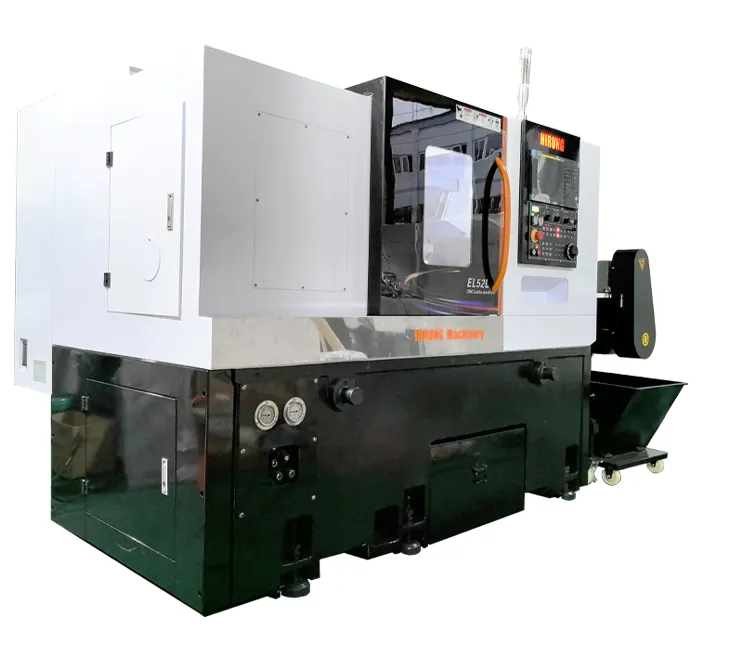
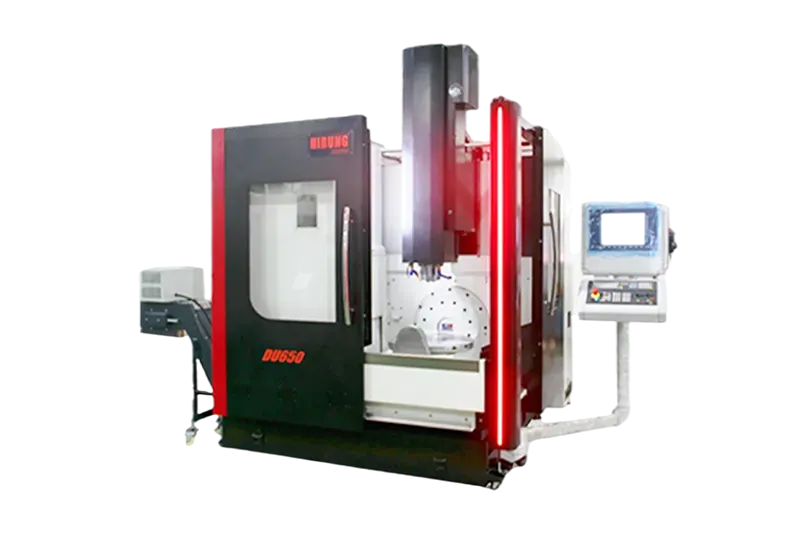
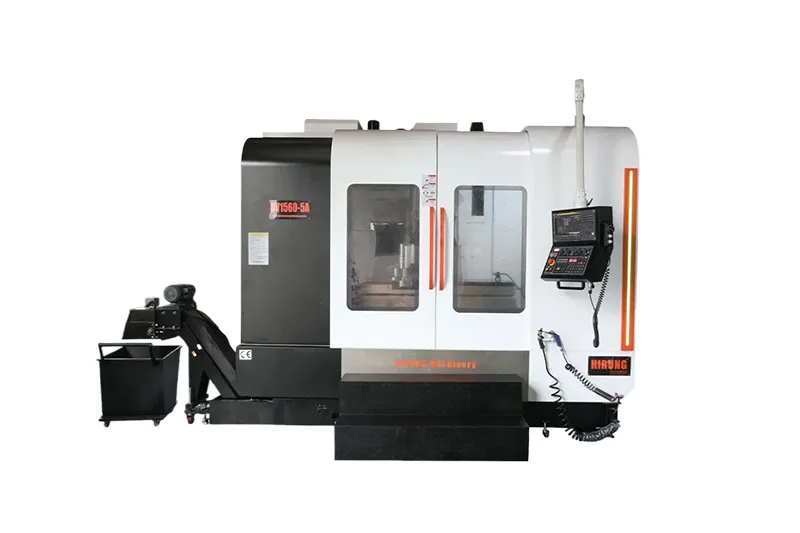
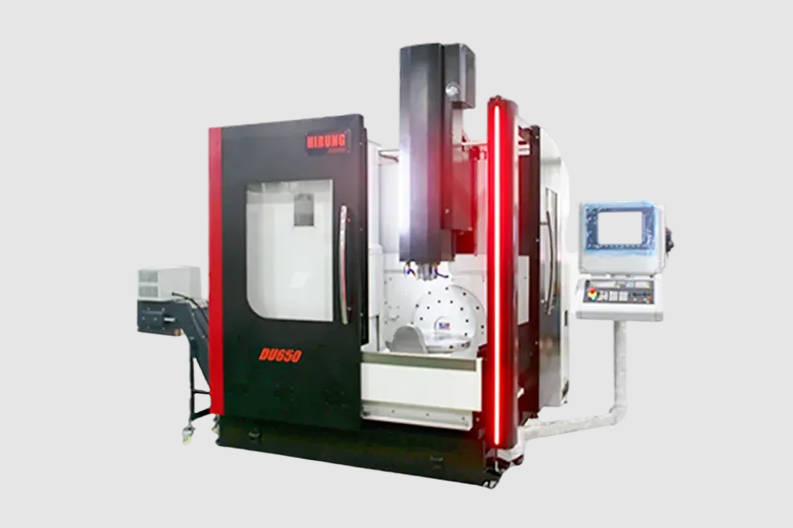
| HIRUNG | VMC/HMC-5X | Extreme Long-Term Stability | Global Export/General Mfg | Ultra-Low |
IV. Addressing User Doubts: The “Maintenance Trap”
The most frequent question we hear from users in 2026 is: “How good is the after-sales service?” While service is important, we believe this question is a symptom of a larger problem. The “Maintenance Trap” occurs when a buyer prioritizes a brand’s service network over the machine’s inherent stability; in reality, the best machine is the one that never requires a service call in the first place.
If your machine tool breaks down frequently, it will be useless no matter how good the service is. Every hour a technician spends at your factory is an hour you are losing money on machine payments, labor, and missed deadlines. In 2026, “Stability” is the only true protection against the Maintenance Trap.
V. The Rising Alternative: High-End Chinese Manufacturing
There has been a seismic shift in the perception of “Made in China” over the last decade. While China’s machine tool manufacturing has been in a rapid development opportunity, the market is no longer just about volume—it is about quality.
The most competitive 5-axis solutions in 2026 come from Chinese manufacturers who have spent the last 10 years perfecting high-end stability and thermal compensation, offering a level of reliability that rivals European brands at a significantly better ROI.
Buyers are realizing that they don’t need to pay a “brand tax” for a German or Japanese nameplate if the machine’s spindle, bearings, and control systems are of equal or superior quality.
VI. HIRUNG: The Global Standard for Machine Stability
At the forefront of this high-end manufacturing shift is HIRUNG. Since opening up overseas markets in 2015, HIRUNG has been committed to the manufacture and sales of high-end CNC machine tools.
At present, China’s machine tool manufacturing has been in a rapid development opportunity, but there are not many brands that are truly high-quality. After 10 years of efforts, HIRUNG has been working hard. Currently, HIRUNG has sold its products to 33 countries and regions around the world. HIRUNG will constantly improve the quality of our products and manufacture each machine with care.
The Proof of Stability
Since the beginning of international sales in 2015, our machine tool exports have exceeded 1,000+, and we have received no more than 20 failure notifications per year.
The stability of a 5-axis machine is proven by its failure rate; with over 1,000 units exported and fewer than 2% requiring failure-related service annually, HIRUNG offers some of the most stable machine tools in the world.
A Promise from Our Founder
When purchasing HIRUNG machine tools, there is no need to station maintenance engineers at your factory 24 hours a day. We understand that your success depends on the machine running, not on how fast we can fix it after it breaks.
As the founder of HIRUNG—Mr. Rocky WU—I promise you:
“If there is any problem with your machine tools of HIRUNG, we can give you the fastest solution at any time! Let the world love machine tools from made in China!”
VII. Final Verdict: Which One Is Worth Buying?
Choosing a 5-axis machine in 2026 requires balancing your specific technical needs with the reality of long-term stability.
- For Digital Innovation: If your shop is fully automated and requires a digital twin for every process, DMG MORI remains the leader.
- For Micro-Precision: If you are working on sub-micron parts for the medical industry, Hermle is the gold standard.
- For Global Stability and ROI: If you need a workhorse that will run 24/7 with virtually zero downtime and a proven track record across 33 countries, HIRUNG is the most strategic investment you can make this year.
In 2026, don’t buy a machine for its “Service Plan.” Buy a machine for its Stability.