The main difference between a flat bed CNC lathe and a slant bed CNC lathe is the machine bed structure. A flat bed lathe uses a horizontal bed layout, while a slant bed lathe uses an inclined bed design that improves chip evacuation, operator access, machine enclosure, and high-speed production efficiency. In many modern turning workshops, slant bed CNC lathes are commonly preferred for precision batch production, bar-fed turning, automated loading, and high-speed machining. Flat bed CNC lathes are still useful for long workpieces, heavy parts, simpler turning jobs, repair work, and workshops that need a more economical or flexible turning solution.
For buyers comparing flat bed CNC lathe vs slant bed CNC lathe, the right choice depends on workpiece size, material, turning length, cutting load, batch volume, accuracy requirements, automation plan, floor space, and investment budget. One structure is not always better than the other. A slant bed lathe may be more suitable for efficient production turning, while a flat bed lathe may be more practical for certain long-shaft or heavy-duty applications.
A CNC lathe machine should be selected based on the parts you actually produce, not only by machine appearance or price. This guide compares flat bed and slant bed CNC lathes from a manufacturer’s point of view, covering structure, rigidity, chip removal, accuracy, tooling, automation, cost, and buying recommendations.
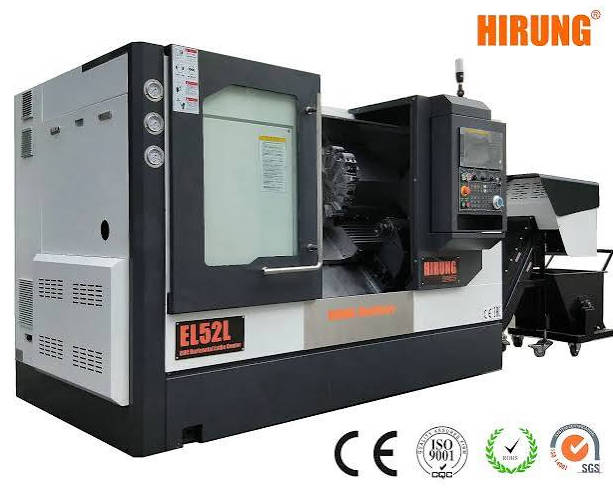
What Is a Flat Bed CNC Lathe?
A flat bed CNC lathe has a horizontal bed structure. The guideways are arranged on a flat or nearly horizontal plane, and the carriage moves along the bed to perform turning operations. This design is closer to the layout of traditional manual lathes, although modern flat bed CNC lathes use CNC control, servo drives, and programmed machining cycles.
Flat bed CNC lathes are commonly used for:
- Long shafts
- Rollers
- Sleeves
- Bushings
- Flanges
- Simple turned parts
- Repair machining
- Heavy workpieces
- Low to medium batch production
- General workshop turning
Advantages of Flat Bed CNC Lathes
Flat bed lathes remain useful because they offer strong accessibility, flexible workholding, and practical performance for many conventional turning applications.
| Advantage | Explanation |
| Good for long workpieces | The horizontal bed layout is often suitable for shaft-type parts and long turning work |
| Easier manual access | Operators can access the workpiece, chuck, tailstock, and tooling more directly |
| Familiar structure | Many operators trained on manual lathes understand the layout quickly |
| Suitable for heavy parts | Some flat bed designs are used for large or heavy workpieces |
| Lower entry cost in many cases | Basic flat bed CNC lathes are often more economical |
| Flexible for repair and maintenance work | Useful when workpieces vary frequently and automation is not required |
Limitations of Flat Bed CNC Lathes
The main limitations of flat bed CNC lathes appear in high-volume, high-speed, and automated production environments.
Common limitations include:
- Chips may accumulate on the bed and around the cutting area
- Coolant and chip control can be less efficient
- High-speed production may be less convenient
- Full enclosure and automation integration may be more limited
- Operator handling may increase in batch production
- Floor space usage can be higher for long-bed machines
- Cycle efficiency may be lower for complex production parts
A flat bed CNC lathe is often a practical choice when the priority is long workpiece capacity, simple turning, flexible workshop use, or lower initial investment.
What Is a Slant Bed CNC Lathe?
A slant bed CNC lathe uses an inclined bed structure. The bed is typically tilted at an angle, allowing chips and coolant to fall away from the cutting zone more easily. This structure is widely used in modern CNC turning centers and production CNC lathes.
Slant bed CNC lathes are commonly used for:
- Precision turned parts
- Automotive components
- Hydraulic fittings
- Connectors
- Shafts and bushings
- Batch production
- Bar-fed turning
- High-speed machining
- Automated production lines
- Parts requiring turret machining
- Turning centers with C-axis, Y-axis, or live tooling
Advantages of Slant Bed CNC Lathes
Slant bed machines are commonly chosen for production efficiency and better machining workflow.
| Advantage | Explanation |
| Better chip evacuation | Chips fall downward more easily due to the inclined structure |
| Better coolant control | Enclosed designs help manage coolant and chips |
| Compact production layout | Slant bed machines are often designed for efficient floor space use |
| Easier automation integration | Bar feeders, parts catchers, and robots are often easier to integrate |
| Good for high-speed turning | Suitable for efficient batch production |
| Improved operator visibility in enclosed machines | The slant layout can improve access to the machining area |
| Efficient turret layout | Turret and tool access are often optimized for production turning |
Limitations of Slant Bed CNC Lathes
Slant bed CNC lathes may not be the right choice for every buyer.
Common considerations include:
- Higher machine price in many cases
- More enclosed structure may reduce open manual access
- Not always ideal for very long or oversized workpieces
- Maintenance access depends on machine design
- Requires proper operator training
- Automation options add cost
- Machine configuration must match the part, not only the bed angle
A slant bed CNC lathe is often better for precision batch production, chip control, automated turning, and high-efficiency manufacturing.
Flat Bed CNC Lathe vs Slant Bed CNC Lathe: Quick Comparison
| Comparison Factor | Flat Bed CNC Lathe | Slant Bed CNC Lathe |
| Bed structure | Horizontal bed | Inclined bed |
| Chip evacuation | Chips may collect more easily | Chips fall away more naturally |
| Operator access | Open and familiar | Enclosed and production-oriented |
| Automation | Possible but often less optimized | Commonly better for bar feeder, parts catcher, robot loading |
| Batch production | Suitable for low to medium batches | Strong for medium to high-volume production |
| Long workpieces | Often suitable | Depends on model and configuration |
| High-speed turning | Possible but less production-focused | Commonly more suitable |
| Floor space | May require more length for long-bed models | Often compact for production cells |
| Cost | Often lower for basic models | Often higher, especially with automation |
| Precision production | Suitable in proper configurations | Commonly preferred for stable production turning |
| Typical users | Repair shops, general workshops, long shaft machining | Precision parts factories, automotive suppliers, batch production shops |
Key Difference 1: Machine Bed Structure
The bed is the foundation of a CNC lathe. It supports the spindle, carriage, guideways, turret, tailstock, and workpiece cutting forces.
In a flat bed lathe, the bed is arranged horizontally. This provides a simple and familiar structure, especially for long workpieces and traditional turning operations.
In a slant bed lathe, the bed is inclined. This layout changes how chips, coolant, turret movement, and operator access behave during machining.
The slant bed structure is often used in modern CNC turning centers because it supports enclosed machining, cleaner chip removal, and easier integration with automatic loading systems.
Key Difference 2: Chip Removal
Chip removal is one of the most practical differences in any CNC lathe comparison.
During turning, chips can be hot, sharp, and continuous. If chips stay around the cutting zone, they can damage the workpiece surface, interfere with the tool, reduce coolant effectiveness, and increase cleaning time.
Flat Bed Chip Removal
On a flat bed CNC lathe, chips may remain on the bed or around the tool area. Operators may need more frequent cleaning, especially during heavy cutting or batch production.
This may be acceptable for small batches, long shafts, or repair work. However, in continuous production, chip accumulation can reduce efficiency.
Slant Bed Chip Removal
On a slant bed CNC lathe, the inclined structure helps chips fall downward into the chip conveyor area. This improves chip evacuation and supports cleaner production.
For high-volume turning, stainless steel machining, steel chips, aluminum chips, and automated production, chip evacuation is a major reason many manufacturers choose slant bed CNC lathes.
Key Difference 3: Rigidity and Cutting Stability
Rigidity affects turning accuracy, tool life, surface finish, and vibration control. Both flat bed and slant bed CNC lathes can be rigid when well designed, but their structures are optimized for different working conditions.
Flat bed lathes can be very stable for long and heavy workpieces, especially when paired with tailstock support and proper bed length. They are often practical for shafts, rollers, and large workpieces.
Slant bed lathes are commonly designed for compact rigidity, fast turret movement, enclosed turning, and production stability. The inclined structure can help distribute cutting forces efficiently in many modern CNC lathe designs.
| Machining Requirement | Better Direction |
| Long shafts | Flat bed may be practical |
| Heavy workpieces | Depends on machine size and bed structure |
| High-speed production turning | Slant bed often preferred |
| Precision batch turning | Slant bed commonly preferred |
| Repair and one-off work | Flat bed often practical |
| Bar-fed turning | Slant bed often preferred |
| Automated production | Slant bed often preferred |
Key Difference 4: Accuracy and Repeatability
Accuracy depends on many factors, including the machine bed, spindle, chuck, guideways, ball screws, turret, thermal stability, control system, tooling, fixture, and maintenance.
A flat bed CNC lathe can produce accurate parts when properly designed and maintained. It may be suitable for large parts, shafts, and general precision turning.
A slant bed CNC lathe is often preferred when manufacturers need repeatable accuracy in batch production. Its structure is commonly paired with enclosed machining, automatic turret systems, stable chip removal, and production-oriented configurations.
The bed type alone does not determine CNC lathe accuracy; final accuracy depends on the complete machine design, spindle quality, guideways, turret repeatability, toolholding, thermal control, and process setup.
When purchasing a CNC lathe, buyers should review positioning accuracy, repeat positioning accuracy, spindle runout, turret indexing repeatability, guideway type, ball screw quality, and inspection reports.
Key Difference 5: Automation and Production Efficiency
Automation is where slant bed CNC lathes often show a clear advantage. Modern slant bed machines are commonly designed for:
- Bar feeders
- Automatic parts catchers
- Automatic doors
- Robot loading
- Servo turrets
- Live tooling
- C-axis indexing
- Y-axis milling
- Chip conveyors
- Enclosed coolant systems
These features are useful for production turning, especially when making shafts, sleeves, connectors, automotive components, fittings, and small to medium precision parts.
Flat bed CNC lathes can also be automated in some cases, but they are often more commonly used for flexible or manual loading applications rather than compact production cells.
| Production Scenario | Suitable Machine Type |
| Manual loading, varied parts | Flat bed or slant bed depending on part |
| Long shaft machining | Flat bed often practical |
| Bar-fed batch production | Slant bed often preferred |
| Robot loading | Slant bed often preferred |
| High-volume small turned parts | Slant bed often preferred |
| Repair and maintenance machining | Flat bed often practical |
| Turning plus milling features | Slant bed turning center often preferred |
Key Difference 6: Operator Access and Maintenance
Flat bed lathes usually provide open access to the workpiece, chuck, and tailstock. This can be useful for manual loading, large parts, shaft work, and repair jobs.
Slant bed lathes often use a more enclosed structure. This improves coolant and chip control, but operators need to work through the machine door and follow production procedures. The internal layout may be more compact, so maintenance design becomes important.
When evaluating any CNC lathe, check:
- Door opening size
- Chuck access
- Turret access
- Tailstock access
- Chip conveyor access
- Coolant tank access
- Electrical cabinet layout
- Lubrication system access
- Maintenance documentation
- Safety interlock design
For export buyers, maintenance-friendly design can reduce downtime and troubleshooting difficulty.
Key Difference 7: Price and Total Cost
Flat bed CNC lathes are often more economical at the entry level. This makes them attractive for small workshops, repair shops, and buyers with limited budgets.
Slant bed CNC lathes often cost more, especially when equipped with servo turret, hydraulic chuck, chip conveyor, automatic tool setter, bar feeder, parts catcher, Y-axis, C-axis, live tooling, or robot loading. However, they may reduce labor cost and improve productivity in batch production.
| Cost Factor | Flat Bed CNC Lathe | Slant Bed CNC Lathe |
| Initial machine price | Often lower for basic models | Often higher |
| Automation cost | Less common in basic setups | More common and production-oriented |
| Fixture cost | Depends on workpiece | Depends on production plan |
| Labor cost | May be higher for manual loading | Can be lower with automation |
| Chip cleaning time | May be higher | Usually lower with proper conveyor |
| Productivity | Good for flexible work | Strong for batch production |
| Long-term ROI | Good for varied or long workpieces | Good when production volume is stable |
A buyer should not compare only the purchase price. The better comparison is total cost per finished part.
Which One Is Better for Different Applications?
| Application | Better Choice | Reason |
| Long shaft turning | Flat bed CNC lathe | Better open access and long-bed suitability in many cases |
| General repair machining | Flat bed CNC lathe | Flexible and easier manual access |
| Small batch turning | Flat bed or slant bed | Depends on accuracy, chip control, and budget |
| Medium to high-volume turning | Slant bed CNC lathe | Better chip flow, automation, and production efficiency |
| Bar-fed production | Slant bed CNC lathe | Easier integration with bar feeder and parts catcher |
| Automotive components | Slant bed CNC lathe | Suitable for repeatable production turning |
| Hydraulic fittings | Slant bed CNC lathe | Good for batch production and chip control |
| Large heavy parts | Depends on model | Check swing, bed structure, chuck, and spindle power |
| Precision turned parts | Slant bed often preferred | Better production workflow and repeatability when properly configured |
When Should You Choose a Flat Bed CNC Lathe?
Choose a flat bed CNC lathe when your production needs focus on long workpieces, simpler turning, flexible manual operation, or lower initial investment.
A flat bed CNC lathe may be suitable if:
- You machine long shafts or rollers
- You handle repair or maintenance jobs
- Your workpieces vary frequently
- You do not require high automation
- Your budget is limited
- You need open operator access
- Your production volume is low to medium
- Your parts are not chip-intensive in long batch runs
Flat bed machines can be practical and reliable when matched with the right workpieces.
When Should You Choose a Slant Bed CNC Lathe?
Choose a slant bed CNC lathe when your production needs focus on precision, chip control, batch efficiency, automation, and high-speed turning.
A slant bed CNC lathe may be suitable if:
- You produce repeat turned parts
- You need efficient chip removal
- You process medium or high production volumes
- You plan to use a bar feeder
- You need automatic parts catching
- You want better coolant control
- You produce automotive, hydraulic, or connector parts
- You need a compact production turning solution
- You may need C-axis, Y-axis, or live tooling
For manufacturers moving toward efficient production turning, a slant bed CNC lathe is often the more practical long-term choice.
How to Choose the Right CNC Lathe Machine
Before selecting a flat bed or slant bed CNC lathe, buyers should prepare real production data.
| Information to Prepare | Why It Matters |
| Workpiece drawing | Confirms turning diameter, length, features, and tolerance |
| Material | Affects spindle power, tool selection, and rigidity |
| Maximum diameter | Determines swing and chuck size |
| Maximum length | Determines bed length, Z-axis travel, and tailstock need |
| Bar diameter | Determines spindle bore and bar feeder compatibility |
| Tolerance requirement | Determines accuracy and repeatability needs |
| Surface finish requirement | Affects spindle, tooling, and cutting strategy |
| Batch size | Determines whether automation is justified |
| Required operations | Turning, drilling, threading, grooving, milling, back machining |
| Automation plan | Affects machine layout and optional accessories |
| Workshop space | Affects machine footprint and loading path |
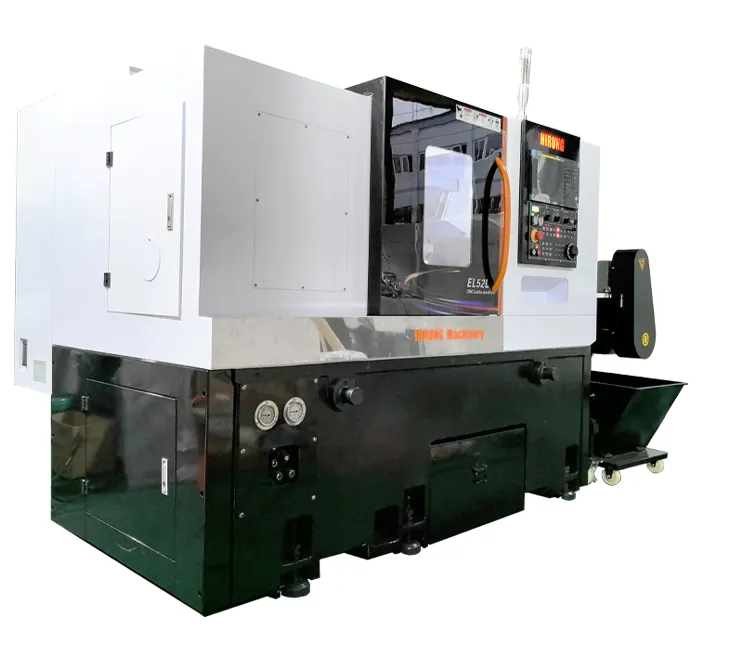
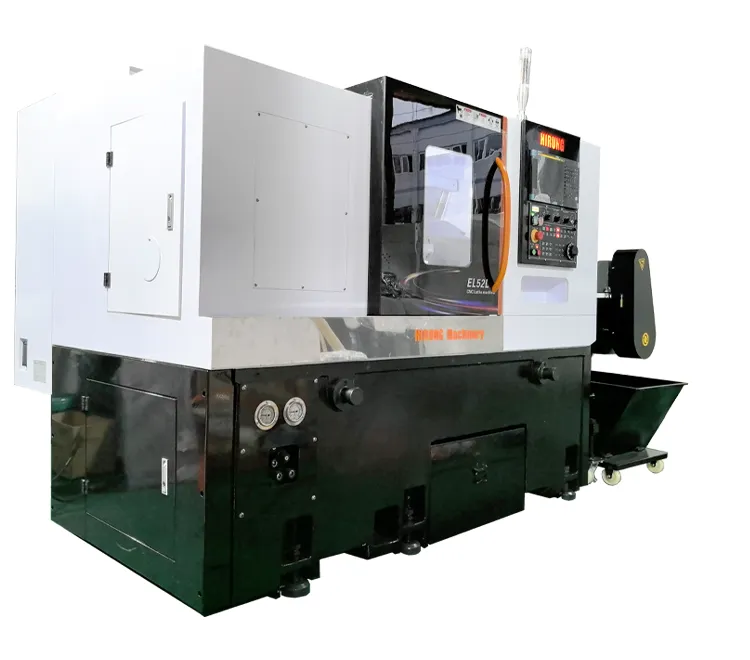
The HIRUNG CNC Lathe Machine EL Series includes multiple model options with different turning capacities, chuck sizes, spindle specifications, bar feeding diameters, tool stations, tailstock configurations, and optional accessories. For buyers comparing lathe structures, the practical next step is to match the machine configuration to the actual workpiece and production plan.
What to Check in a CNC Lathe Supplier
A reliable CNC lathe supplier should help you select a configuration based on your parts, not only offer a standard machine model.
Ask these questions before purchasing:
| Supplier Question | Why It Matters |
| Which lathe structure fits my part: flat bed or slant bed? | Prevents wrong machine selection |
| What swing, turning diameter, and machining length do I need? | Ensures part compatibility |
| What chuck size and spindle bore are suitable? | Important for workholding and bar feeding |
| Do I need tailstock support? | Critical for long shafts |
| How many tool stations are recommended? | Affects process flexibility |
| Should I consider C-axis, Y-axis, or live tooling? | Reduces secondary operations when needed |
| What chip conveyor and coolant options are available? | Affects production efficiency |
| What accuracy inspection is provided? | Helps verify machine quality |
| What accessories are standard and optional? | Clarifies final cost |
| What installation, training, and after-sales support are available? | Reduces long-term risk |
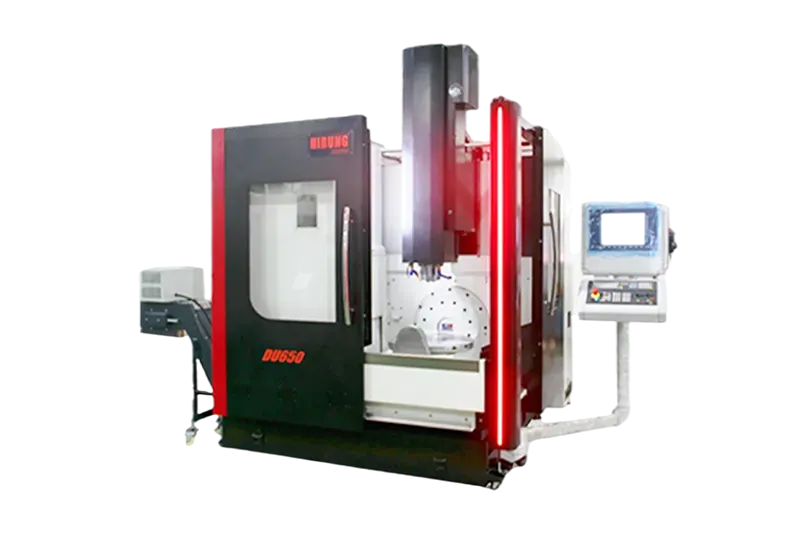
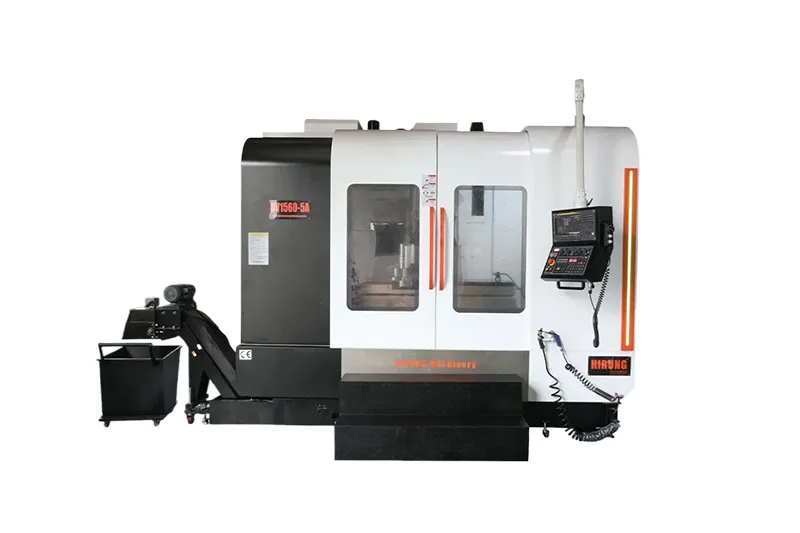
Buyers can also visit the HIRUNG official website to compare broader CNC machine categories and evaluate whether a CNC lathe, machining center, or multi-axis machine better fits their production plan.
Common Mistakes When Comparing Flat Bed and Slant Bed CNC Lathes
Mistake 1: Assuming Slant Bed Is Always Better
Slant bed lathes are often better for production turning, but a flat bed lathe may still be more suitable for long shafts, heavy workpieces, repair jobs, and low-volume flexible machining.
Mistake 2: Choosing Only by Price
A cheaper machine may not include the required spindle bore, chuck size, tailstock, turret, chip conveyor, accuracy level, or automation options. Compare complete configuration, not only base price.
Mistake 3: Ignoring Chip Removal
Chip control directly affects productivity, tool life, surface finish, and operator cleaning time. This is especially important for batch production.
Mistake 4: Forgetting Future Automation
If you may add a bar feeder, parts catcher, automatic door, or robot later, choose a machine layout that can support future automation.
Mistake 5: Not Considering Workpiece Length
A slant bed machine may be excellent for compact production parts, but long shafts may require a different machine size or structure. Always check maximum machining length and tailstock support.
When to Consider HIRUNG EL Series CNC Lathe Machines
HIRUNG EL Series CNC Lathe Machines can be considered by manufacturers producing shafts, sleeves, bushings, pins, flanges, connectors, hydraulic parts, automotive components, and precision turned components.
The HIRUNG EL Series CNC Lathe Machine is relevant when buyers need to evaluate:
- Multiple CNC lathe model sizes
- Turning diameter and machining length options
- Chuck size and spindle nose configuration
- Spindle speed and spindle power
- Spindle bore and bar feeding diameter
- X/Z/Y-axis travel options
- Tool station number
- Tailstock support
- FANUC control system option
- Linear guideway structure
- Cooling, lubrication, and oil-water separation
- Chip conveyor, bar feeder, parts catcher, automatic door, tool setter, optical scale, robot, and FMS options
Before requesting a quotation, prepare part drawings, material, maximum turning diameter, maximum turning length, bar diameter, tolerance, batch size, and automation requirements. This will help the supplier recommend a suitable CNC lathe configuration instead of a rough machine price.
FAQ
1. What is the difference between a flat bed CNC lathe and a slant bed CNC lathe?
A flat bed CNC lathe uses a horizontal bed structure, while a slant bed CNC lathe uses an inclined bed structure. The slant bed design usually improves chip evacuation, coolant control, automation integration, and production efficiency.
2. Is a slant bed CNC lathe better than a flat bed CNC lathe?
A slant bed CNC lathe is often better for precision batch production, bar-fed turning, automated loading, and high-speed machining. A flat bed CNC lathe may be better for long shafts, heavy parts, repair work, and lower-cost flexible turning.
3. When should I choose a flat bed CNC lathe?
Choose a flat bed CNC lathe when you machine long workpieces, rollers, simple turned parts, repair components, or varied low-volume jobs that need open operator access and flexible workholding.
4. When should I choose a slant bed CNC lathe?
Choose a slant bed CNC lathe when you need better chip removal, enclosed production, bar feeding, automatic parts catching, high-speed turning, repeatable batch production, or integration with automation.
5. Which CNC lathe is better for shaft machining?
For long shafts, a flat bed CNC lathe may be practical because of its bed layout and access. However, shorter shaft-type parts in batch production may be suitable for a slant bed CNC lathe with bar feeder and parts catcher.
6. Does a slant bed CNC lathe cost more?
In many cases, a slant bed CNC lathe costs more than a basic flat bed lathe because it is commonly designed for production turning, enclosure, chip evacuation, servo turret, hydraulic systems, automation, and higher efficiency.
7. How do I choose the right CNC lathe machine?
Choose a CNC lathe based on workpiece diameter, length, material, tolerance, batch size, chuck size, spindle bore, spindle power, tool stations, tailstock requirement, automation plan, chip removal, control system, and supplier support.
Conclusion
The choice between flat bed CNC lathe vs slant bed CNC lathe depends on your real production needs. A flat bed CNC lathe is often practical for long workpieces, simpler turning, flexible manual access, and lower initial investment. A slant bed CNC lathe is often more suitable for precision batch production, chip control, compact production layout, automation, and high-efficiency turning.
For manufacturers, the right decision should be based on part drawings, materials, maximum diameter, machining length, bar feeding needs, tolerance, batch volume, and future automation plans. Do not choose only by bed type or price. Compare the complete machine configuration, including spindle, chuck, turret, tailstock, guideways, accuracy, coolant, chip conveyor, control system, and service support.
If you are evaluating a CNC lathe machine for industrial turning production, the HIRUNG EL Series can be reviewed as a practical option. Preparing complete technical requirements before requesting a quote will help you choose a machine configuration that fits your production goals and long-term operating cost.