A CNC gantry machine is a broad term for a CNC machine tool with a bridge-like gantry structure, while a gantry machining center usually refers to a more complete CNC gantry system designed for milling, drilling, boring, tapping, tool changing, and multi-process machining of large parts. In many real purchasing conversations, the two terms are often used interchangeably. However, for machine selection, the difference matters because “gantry machining center” usually implies a higher level of machining integration, precision control, tool management, and production capability.
For manufacturers machining large molds, aerospace structural parts, energy equipment, heavy machinery frames, shipbuilding components, or oversized precision plates, the choice is not only about terminology. The real question is whether the machine has the right structure, working envelope, spindle power, rigidity, table load, tool magazine, control system, accuracy, chip removal, and service support.
A CNC gantry machine can be designed in different forms, including column moving, table moving, fixed bridge, movable gantry, or floor-type layouts. A gantry machining center is typically selected when manufacturers need large-part machining with CNC-controlled precision and machining-center functions, rather than a basic gantry milling setup.
This guide explains the difference between CNC gantry machine vs gantry machining center, why the terms are often confused, how to compare the two in real purchasing scenarios, and how to choose the right equipment for large-part manufacturing.
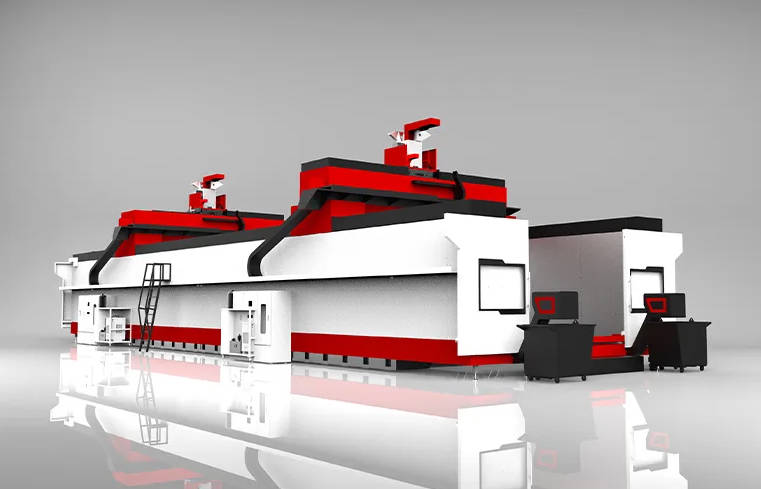
Why These Two Terms Are Often Confused
The terms “CNC gantry machine” and “gantry machining center” are often used together because both describe CNC equipment with a gantry or bridge-type structure. In many supplier catalogs, the same product may be described as a CNC gantry machine, CNC gantry milling machine, gantry CNC machine, gantry machining center, or CNC gantry machining center.
The confusion comes from two different naming habits:
| Term | Common Meaning |
| CNC gantry machine | A broad equipment category based on gantry structure |
| CNC gantry milling machine | A gantry machine mainly used for milling |
| Gantry machining center | A gantry machine with machining-center functions such as tool magazine, CNC control, multi-process machining, and higher integration |
| CNC gantry machining center | A more precise term combining gantry structure and machining center capability |
In practical B2B purchasing, buyers should not rely only on the product name. They should check the actual machine configuration, spindle, tool changer, work envelope, accuracy, structure, and optional accessories.
For example, one supplier may call a machine a “CNC gantry machine,” while another calls a similar configuration a “gantry machining center.” The real difference is found in the specification sheet.
What Is a CNC Gantry Machine?
A CNC gantry machine is a CNC machine tool built around a bridge or portal frame. The gantry spans over the worktable or work area, and the spindle moves along the gantry beam and vertical axis to machine large workpieces.
A CNC gantry machine can perform operations such as:
- Milling
- Drilling
- Boring
- Tapping
- Surface machining
- Contour machining
- Roughing
- Finishing
- Large-area machining
The word “machine” is broader than “machining center.” It may refer to a simple CNC gantry milling machine, a large heavy-duty gantry system, a floor-type gantry machine, or a fully equipped gantry machining center.
A CNC gantry machine is commonly used for:
| Industry | Typical Workpieces |
| Mold and die | Large mold bases, die casting molds, stamping dies |
| Aerospace | Structural parts, large plates, tooling components |
| Energy equipment | Generator bases, turbine-related components, large flanges |
| Heavy machinery | Frames, bases, welded structures, gearbox housings |
| Shipbuilding | Large plates, marine equipment bases, structural components |
| Transportation | Rail parts, large vehicle frames, long profiles |
What Is a Gantry Machining Center?
A gantry machining center is generally a CNC gantry machine with machining-center-level functionality. It is designed to handle large workpieces while supporting automated or semi-automated machining processes.
A gantry machining center often includes:
- CNC control system
- High-rigidity gantry structure
- Spindle system
- Tool magazine
- Automatic tool change
- Coolant system
- Chip removal options
- Full or partial guarding
- Precision guideways
- Ball screws or rack transmission
- Optional angle head
- Optional workpiece measuring
- Optional tool measuring
- Optional optical ruler
- Accuracy inspection and calibration
A gantry machining center is usually more suitable when large parts require multi-process machining, repeatable precision, automatic tool changes, and stable long-cycle production.
In other words, a basic CNC gantry milling machine may be enough for simple large-surface milling. A gantry machining center becomes more relevant when the part requires multiple tools, tight tolerances, complex surfaces, holes, threaded features, finishing quality, and production efficiency.
CNC Gantry Machine vs Gantry Machining Center: Quick Comparison
| Comparison Factor | CNC Gantry Machine | Gantry Machining Center |
| Term meaning | Broad category based on gantry structure | More integrated CNC machining equipment |
| Main focus | Structure and large workpiece capacity | Precision, tool management, multi-process machining |
| Tool magazine | May or may not be included | Commonly included or available |
| Automatic tool change | Not always available | Usually expected in machining-center configuration |
| Application range | Large milling, roughing, drilling, heavy machining | Large precision parts, molds, aerospace structures, complex machining |
| Automation level | Depends on model | Usually higher |
| Accuracy expectation | Depends on machine design | Usually positioned for higher process stability |
| Buyer concern | Size, load, structure, spindle | Structure, spindle, tool capacity, accuracy, control, process integration |
| Typical wording | Gantry CNC machine, CNC gantry milling machine | CNC gantry machining center, gantry machining center |
| Purchase implication | Need to confirm configuration carefully | Usually closer to high-value production equipment |
Main Difference 1: Product Category vs Machine Function
The biggest difference is that “CNC gantry machine” describes the structure, while “gantry machining center” describes both the structure and the machine’s functional level.
A CNC gantry machine can be any CNC machine with a gantry layout. It may be a simple gantry milling machine, a large drilling and milling machine, or a customized large-part machine.
A gantry machining center usually implies that the machine can perform multiple operations with higher automation and tool management.
For buyers, this means:
- Do not assume every CNC gantry machine has a tool magazine.
- Do not assume every gantry machine can perform complex multi-process machining.
- Do not assume every gantry machining center has the same accuracy or rigidity.
- Always compare specifications and configuration.
Main Difference 2: Tool Magazine and Automatic Tool Change
Tool management is one of the clearest practical differences.
A basic CNC gantry milling machine may use manual tool changes or a limited tool setup. This may be acceptable for simple roughing or large flat surface machining.
A gantry machining center usually supports tool magazine options and automatic tool changing. This is important when machining large parts that require several operations.
For example, a large mold base may need:
- Face mill
- Roughing end mill
- Finishing end mill
- Ball nose cutter
- Drill
- Tap
- Boring tool
- Chamfer tool
- Angle head
Without automatic tool change, the operator must stop the machine and change tools manually. This increases non-cutting time and reduces consistency.
| Production Requirement | Tool Magazine Importance |
| Simple surface milling | Lower |
| Large mold machining | High |
| Aerospace structural parts | High |
| Drilling and tapping many holes | High |
| Long-cycle production | High |
| Multi-process machining | Very high |
Main Difference 3: Precision and Process Stability
A gantry machine can be large, but size alone does not guarantee precision. Large-part machining requires stable geometry over long travel, good thermal control, rigid spindle support, and accurate axis movement.
A gantry machining center is usually designed for more controlled machining performance across large work envelopes. Buyers should evaluate:
- Positioning accuracy
- Repeatability
- Geometric accuracy
- Spindle stability
- Thermal stability
- Guideway structure
- Ball screw or rack accuracy
- Foundation requirement
- Calibration method
- Inspection report
For large molds, aerospace parts, and high-value structural components, gantry machining center selection should prioritize rigidity and accuracy stability, not only travel size.
HIRUNG’s gantry machine category includes large-part solutions such as the HPG Series and SP Series. These product categories are relevant when buyers need to compare heavy-duty large workpiece machining and high-precision gantry machining requirements.
Main Difference 4: Application Complexity
A CNC gantry machine may be enough when the application is mainly large-area milling or roughing. A gantry machining center is more suitable when the workpiece requires multiple operations, tighter tolerance, complex machining paths, or more efficient production.
| Workpiece / Application | Better Fit |
| Large plate rough milling | CNC gantry machine may be enough |
| Large mold base with drilling and tapping | Gantry machining center |
| Aerospace structural parts | Gantry machining center |
| Heavy welded frame surface machining | CNC gantry machine or gantry machining center depending on tolerance |
| Large die cavity finishing | Gantry machining center |
| Shipbuilding component with simple machining | CNC gantry machine may be enough |
| Energy equipment part with many features | Gantry machining center |
| High-precision large surface machining | Gantry machining center |
The more complex the process, the more important machining-center functions become.
Main Difference 5: Cost and Investment Level
A gantry machining center usually costs more than a basic CNC gantry milling machine because it includes higher-level components and more integrated functions.
Cost factors include:
| Cost Factor | Why It Matters |
| Machine size | Larger travel and span increase structure cost |
| Table load | Higher load capacity requires stronger design |
| Spindle power | Heavy cutting requires stronger spindle system |
| Tool magazine | Adds automation and tool capacity |
| Automatic tool change | Improves efficiency but increases cost |
| Control system | Higher-end CNC control affects price and service |
| Accuracy components | Better guideways, screws, scales, and calibration increase cost |
| Angle head | Enables side machining and 5-sided access |
| Measuring systems | Improve setup and inspection efficiency |
| Chip removal | Important for long-cycle cutting |
| Customization | Large machines often require project-based configuration |
A basic gantry machine may have a lower entry cost, but a gantry machining center may reduce labor time, tool change time, setup risk, and secondary operations. For high-value workpieces, the higher investment may be easier to justify.
Column Moving vs Table Moving Gantry Structures
The terms “CNC gantry machine” and “gantry machining center” can both apply to different mechanical structures. Two common structures are column moving and table moving.
Column Moving Gantry Type
In a column moving design, the workpiece stays stationary while the gantry or columns move. This is useful for very large or heavy workpieces.
This type is often suitable for:
- Heavy machinery frames
- Energy equipment
- Shipbuilding parts
- Oversized molds
- Large welded structures
- Very heavy workpieces
Because the workpiece does not move, the machine can be practical for components that are difficult to move on a table.
Table Moving Gantry Type
In a table moving design, the worktable moves with the workpiece while the gantry structure is fixed or relatively stable. This can be suitable for precision molds, plates, aerospace components, and large structured parts.
This type is often suitable for:
- Large molds
- Aerospace plates
- Automotive tooling
- Precision structural parts
- Medium to large parts requiring stable finishing
| Structure | Main Advantage | Common Application |
| Column moving | Handles very heavy or stationary workpieces | Energy, shipbuilding, heavy machinery |
| Table moving | Stable precision machining for large parts | Molds, plates, aerospace structures |
| Floor type | Useful for extremely large workpieces | Large welded or assembled structures |
| Gantry with angle head | Better access to side surfaces | Large molds, 5-sided machining, complex parts |
HPG Series vs SP Series: How to Think About the Difference
HIRUNG provides gantry machine options that can help buyers compare different large-part machining needs.
The HPG Series is positioned around column moving / large-part gantry machining requirements. It is relevant when the workpiece is very large, heavy, or difficult to move. This direction is useful for heavy-duty cutting, large structural parts, energy equipment, and shipbuilding-type workpieces.
The SP Series is positioned as a table moving type CNC gantry machining center with a workbench. It is relevant when buyers need stable machining, high rigidity, and precision for large parts such as molds, plates, and structural components.
| Buyer Requirement | More Relevant Direction |
| Very heavy workpiece that should stay stationary | HPG Series / column moving direction |
| Large mold or precision plate machining | SP Series / table moving direction |
| Heavy-duty cutting with large workpieces | HPG Series direction |
| High-rigidity finishing and multi-process machining | SP Series direction |
| Need for optional angle head and tool magazine | SP Series direction may be considered |
| Large custom machining project | Compare HPG and SP with drawings |
The correct choice depends on workpiece size, weight, machining features, tolerance, fixture method, foundation, loading method, and production workflow.
How to Choose Between a CNC Gantry Machine and Gantry Machining Center
Instead of asking only which term is correct, buyers should define the required machine capability.
Choose a CNC Gantry Machine When:
- The main need is large workpiece capacity.
- The process is mainly rough milling or large-area cutting.
- Tool changes are not frequent.
- The tolerance requirement is moderate.
- The machine is used for heavy structures or simple large parts.
- A customized large machine layout is needed.
- The buyer needs a broad gantry solution rather than a fully integrated machining center.
Choose a Gantry Machining Center When:
- The workpiece requires multiple machining processes.
- Automatic tool change is needed.
- Precision and repeatability are important.
- The part has many holes, threads, pockets, or surfaces.
- The machine will be used for molds, aerospace parts, or high-value components.
- Long-cycle machining efficiency matters.
- The buyer needs better process integration and production stability.
If your large workpiece requires several tools, tight tolerance, drilling, tapping, boring, finishing, and repeated production, a gantry machining center is usually the more appropriate term and solution.
Important Specifications to Compare
Whether the supplier calls it a CNC gantry machine or a gantry machining center, buyers should compare the same core specifications.
| Specification | Why It Matters |
| X/Y/Z travel | Determines machining range |
| Gantry span | Determines usable width and tool access |
| Distance between columns | Affects maximum workpiece width |
| Table size or working area | Determines fixture and workpiece capacity |
| Table load | Critical for heavy workpieces |
| Spindle taper | Affects tool size and rigidity |
| Spindle power and torque | Important for heavy cutting |
| Spindle speed | Affects finishing and material removal |
| Guideway type | Affects rigidity, damping, and accuracy |
| Feed system | Affects movement stability and precision |
| Tool magazine | Determines multi-process capability |
| Angle head option | Supports side and multi-face machining |
| Cooling and chip removal | Supports long-cycle production |
| Measuring systems | Improve setup and inspection |
| Control system | Affects programming and operation |
| Foundation requirement | Critical for large-machine stability |
| Service support | Important for installation and downtime control |
Common Mistakes When Comparing These Two Terms
Mistake 1: Treating the Terms as Completely Different Products
In many cases, suppliers use the terms interchangeably. The real difference is not always the name; it is the configuration and capability.
Mistake 2: Assuming Every Gantry Machine Has a Tool Magazine
Some gantry CNC machines may not include automatic tool change. Always confirm whether tool magazine and ATC are included.
Mistake 3: Choosing Only by Machine Travel
A large travel range does not guarantee accuracy or cutting performance. Buyers should also check rigidity, spindle, guideways, table load, thermal stability, and foundation requirements.
Mistake 4: Ignoring Workpiece Weight
Large workpieces may fit dimensionally but exceed table load or movement limits. Always include fixture weight in the calculation.
Mistake 5: Comparing Prices Without Standard Configuration
One quotation may include tool magazine, chip conveyor, angle head, probing, optical scales, or other accessories, while another may not. Compare complete configuration.
How to Request the Right Quotation
To avoid confusion, buyers should send suppliers a clear application-based inquiry rather than only asking for “gantry machine price.”
Prepare:
| Information | Why It Helps |
| Workpiece drawings | Confirms machining features and size |
| Material | Determines spindle and cutting requirements |
| Maximum size | Determines X/Y/Z travel and gantry span |
| Workpiece weight | Determines table load or column moving need |
| Tolerance | Determines accuracy and structure level |
| Surface finish | Determines spindle and finishing capability |
| Machining operations | Confirms milling, drilling, tapping, boring, finishing needs |
| Tool quantity | Determines tool magazine requirement |
| Side machining needs | Determines angle head or 5-sided machining options |
| Batch size | Determines productivity and automation needs |
| Loading method | Determines table, crane, and floor planning |
| Workshop foundation | Affects installation and long-term accuracy |
This information helps the supplier determine whether you need a simple CNC gantry machine, a full gantry machining center, a column moving structure, a table moving structure, or a customized large-part solution.
How to Evaluate a Gantry Machine Supplier
A reliable supplier should help clarify the product term and recommend the right configuration based on your workpiece.
Ask these questions:
| Supplier Question | Why It Matters |
| Is this machine a basic gantry milling machine or a gantry machining center? | Clarifies functional level |
| Does the machine include a tool magazine and automatic tool change? | Confirms machining-center capability |
| Should I choose column moving or table moving structure? | Matches workpiece weight and process |
| What is the table load or stationary workpiece capacity? | Prevents load mismatch |
| What spindle taper, power, and torque are recommended? | Affects cutting capability |
| What accuracy inspection is provided? | Supports quality verification |
| Are angle heads or 5-sided machining options available? | Supports complex part access |
| What foundation requirements should be prepared? | Reduces installation risk |
| What shipping and installation support is available? | Important for large machines |
| What after-sales service and spare parts support are available? | Reduces downtime risk |
You can also visit the HIRUNG official website to compare broader CNC machine categories and confirm whether a gantry solution, vertical machining center, 5-axis machining center, or CNC lathe better fits your production plan.
When to Consider HIRUNG CNC Gantry Solutions
HIRUNG CNC gantry solutions are relevant for manufacturers machining large molds, aerospace structures, heavy machinery components, energy equipment, shipbuilding parts, industrial frames, and large precision plates.
You may review the HIRUNG CNC Gantry Machine product category when your production requires:
- Large workpiece machining
- Heavy-duty milling, drilling, boring, or tapping
- High rigidity across large travel
- Column moving or table moving structure comparison
- Large mold and die machining
- Aerospace structural part machining
- Heavy machinery frame machining
- Energy equipment and shipbuilding component machining
- Optional angle head, tool magazine, measuring, chip removal, or precision enhancement features
For very heavy or stationary workpieces, the HPG Series column moving gantry machine may be worth evaluating. For high-rigidity table moving type gantry machining applications, the SP Series CNC gantry machining center can be reviewed according to your part size and process requirements.
FAQ
1. What is the difference between a CNC gantry machine and a gantry machining center?
A CNC gantry machine is a broad term for a CNC machine with a gantry structure. A gantry machining center usually refers to a more integrated gantry machine with machining-center functions such as CNC control, tool magazine, automatic tool change, and multi-process machining.
2. Are CNC gantry machine and gantry machining center the same?
They are often used interchangeably, but they are not always identical. The name depends on supplier terminology. Buyers should confirm actual configuration, tool changer, spindle, accuracy, structure, and accessories before purchasing.
3. When should I choose a gantry machining center?
Choose a gantry machining center when large parts require multiple operations, automatic tool changes, drilling, tapping, boring, finishing, high rigidity, repeatable accuracy, and long-cycle production efficiency.
4. When is a basic CNC gantry machine enough?
A basic CNC gantry machine may be enough when the application mainly requires large-area milling, roughing, drilling, or machining of heavy structures without frequent tool changes or complex precision requirements.
5. What is the difference between column moving and table moving gantry machines?
In a column moving gantry machine, the workpiece stays stationary while the gantry or columns move, which is useful for very heavy parts. In a table moving gantry machine, the worktable moves with the workpiece, which is often suitable for precision molds, plates, and structural parts.
6. What specifications should I check before buying a CNC gantry machining center?
Check X/Y/Z travel, table size, table load, gantry span, distance between columns, spindle taper, spindle power, spindle speed, guideways, feed system, tool magazine, angle head options, control system, chip removal, accuracy, and foundation requirements.
7. Is a gantry machining center suitable for mold manufacturing?
Yes. A gantry machining center is widely used for large mold and die manufacturing because it can provide a large working envelope, stable cutting rigidity, multi-tool machining, and precision surface finishing capability.
Conclusion
The difference between CNC gantry machine vs gantry machining center is mainly about terminology and functional level. A CNC gantry machine is a broad category defined by its bridge-type structure. A gantry machining center is usually a more complete, integrated CNC gantry solution for large-part precision machining, often with tool magazine, automatic tool change, multi-process capability, and stronger production functions.
For buyers, the name is less important than the specification. Before purchasing, check workpiece size, weight, material, tolerance, machining process, spindle, tool magazine, structure type, table load, foundation, accuracy, chip removal, and supplier support.
If your workpieces are large, heavy, complex, or high-value, HIRUNG CNC gantry solutions can be evaluated according to your production needs. The HPG Series is relevant for heavy and stationary workpiece machining, while the SP Series is relevant for table moving type gantry machining applications where rigidity, precision, and machining-center functions are important.