Start With the Part, Not the Price
The fastest way to choose a CNC lathe machine for shaft and disc parts is to match the machine’s capacity to your workpiece geometry first. A CNC lathe that is right for long shaft parts is defined by maximum machining length and tailstock support, while a CNC lathe that is right for disc and flange parts is defined by swing over bed and chuck diameter. A machine that is ideal for one is rarely ideal for the other, so the selection should begin with the part shape—its length, diameter, and how it must be held—before you compare spindle speed or price.
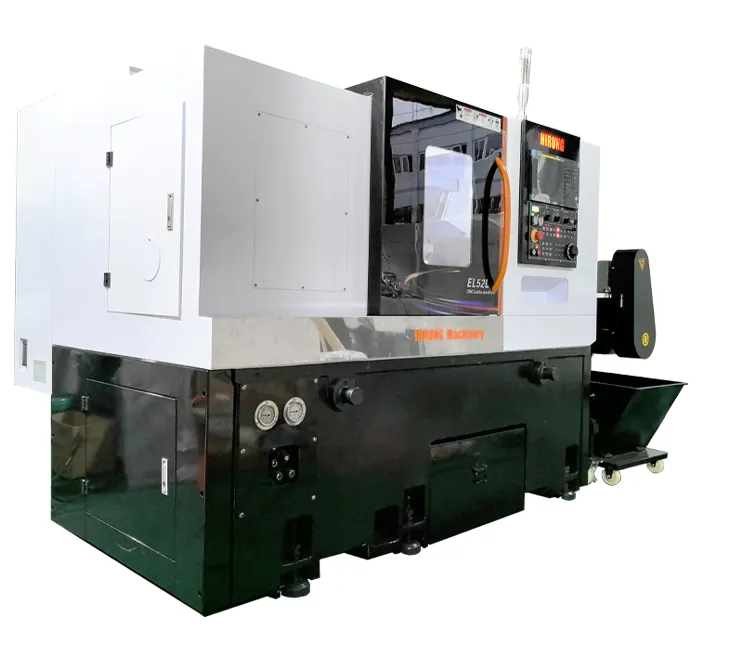
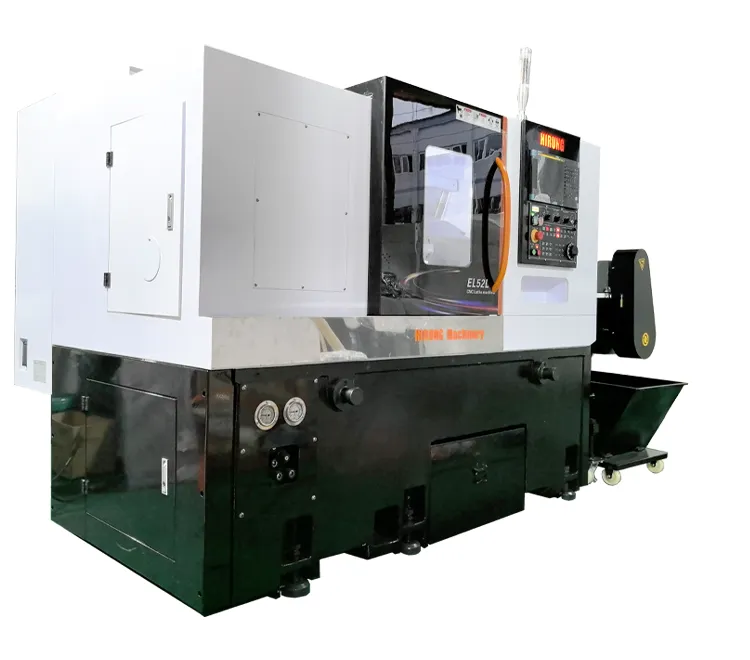
Most buyers start by listing horsepower and a budget. That order works for a generic machine, but turning is different: a lathe holds the raw stock between a chuck and (often) a tailstock, then removes material by rotating the part. The part’s length-to-diameter ratio decides almost everything else. For a fuller picture of available configurations, review the EL Series CNC lathe range before you compare numbers. In the sections below we break the decision down by geometry, then map real machine specifications to each type of work.
What Makes Shaft and Disc Parts Different to Machine
Before reading a specification sheet, separate your parts into two groups. This single step removes most of the confusion in lathe selection.
Shaft parts (long and slender)
Shaft parts have a length that is clearly larger than their diameter—think lead screws, transmission shafts, cylindrical pins, rollers, spindles, and long rods. In many turning applications the length-to-diameter ratio exceeds 3:1, and for slender shafts it can reach 10:1 or more. The dominant risk with these parts is deflection: a long bar held only at one end will bow under cutting force, producing taper, poor roundness, and chatter marks.
Disc and flange parts (short and wide)
Disc parts are the opposite—wide in diameter and short in length. Examples include flanges, gears, bearing rings, pulleys, brake discs, and hubs. Here the part diameter—not its length—sets the requirement, because the workpiece must physically clear the machine bed and be gripped firmly by the chuck. A disc that is larger than the swing over bed simply will not fit, and a chuck that is too small cannot hold it securely.
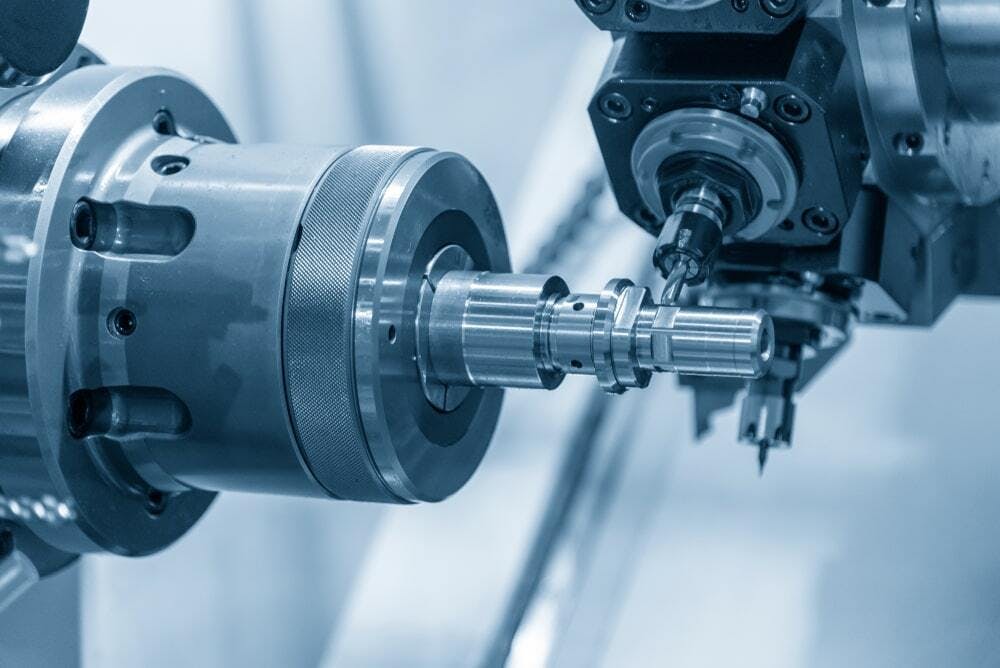
For Shaft Parts, the Machine Must Deliver Length and Support
When your parts are long and slender, rank specifications in this order:
- Maximum machining length / distance between centers. This is the hard limit on part length. A part that is 800 mm long needs a machine with at least that much between-centers capacity, plus allowance for the chuck jaw and any steady rest.
- Tailstock travel and support. The tailstock holds the free end of a long shaft and prevents bowing. For shaft work, tailstock travel is as important as spindle power. Without it, long parts deflect and accuracy collapses.
- Bar feeder compatibility and maximum bar diameter. If you feed stock from a bar rather than loading cut blanks, the spindle bore and bar diameter limit matter more than chuck size.
- Bed rigidity for slender cuts. Stable, well-supported guideways keep the cut consistent along the full length of the shaft.
For typical shaft production, a machine in the mid-size range covers a wide band of work. The HIRUNG EL52LL, for example, provides up to 1000 mm of Z-axis travel and 800 mm of tailstock travel, while the EL75 extends machining length to 3000 mm for very long shafts and bars.
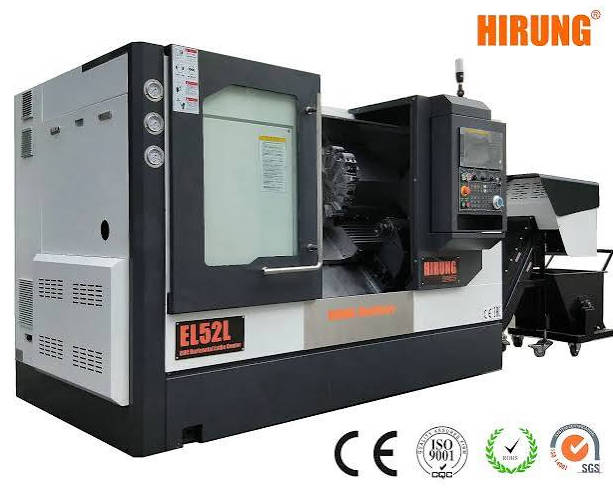
For Disc Parts, the Machine Must Deliver Swing and Grip
With disc and flange parts, the priorities reverse:
- Swing over bed. This is the largest diameter the machine can rotate. It must exceed your finished part outside diameter, with margin for the chuck and any fixture.
- Chuck size. The chuck must grip the part securely. A 12-inch chuck gives far more holding power and clearance than a 6-inch chuck for large flanges and rings.
- Spindle bore (through-hole). For disc parts fed as short blanks, the bore should clear the stock; for parts mounted on a mandrel or arbor, the bore determines what tooling you can use.
- Rigid clamping and face access. Disc work often involves facing, grooving near the OD, and drilling on the face—so the turret must reach the face with stable support.
If your largest discs approach 440–600 mm in diameter, the EL75 configuration, with a swing over bed of up to 920 mm, is the relevant choice. For discs up to roughly 250 mm, the EL52L and EL52LL cover the range with an 8-inch chuck.

The Specifications That Matter for Each Geometry
The table below shows how the same specification serves a different master depending on whether you turn shafts or discs. Use it as a checklist when you read any lathe datasheet.
| Specification | Driven by shaft work | Driven by disc work | Why it matters |
|---|---|---|---|
| Swing over bed | Secondary | Primary | Sets the maximum part diameter that can rotate. |
| Maximum machining length | Primary | Secondary | Limits the longest shaft you can turn between centers. |
| Chuck size | Medium | Primary | Grip security and clearance for large discs and flanges. |
| Spindle bore | Primary (bar feed) | Medium | Through-hole for bar stock or mandrel-mounted discs. |
| Tailstock travel | Primary | Rarely used | Supports the free end of long shafts to prevent deflection. |
| X / Z axis travel | Z dominates | X dominates | Z covers shaft length; X covers disc radius and facing. |
| Turret tool stations | Medium | Medium | More stations allow combined operations without tool changes. |
A Quick Model Map: Matching EL Series Lathes to Your Parts
The EL Series covers both ends of the geometry range through different bed sizes, chuck options, and length configurations. The table uses published EL Series specifications so you can shortlist before requesting a quote.
| Your part profile | Recommended EL model | Key capacity |
|---|---|---|
| Short shafts, pins, small components (length < 390 mm) | EL42L / EL42MY | 6-inch chuck, 390 mm max length, 10–12 tool stations |
| Medium shafts and general bar work (up to ~480–1000 mm) | EL52L / EL52LL / EL52MC-MY | 8-inch chuck, 480–1000 mm length, 800 mm tailstock travel on EL52LL |
| Long shafts, bars, and threaded rods (up to 3000 mm) | EL75 (multiple length options) | 12-inch chuck, machining length up to 3000 mm, tailstock to 2600 mm |
| Discs and flanges up to ~250 mm OD | EL52L / EL52LL | 8-inch chuck, 550 mm swing over bed |
| Large discs, rings, hubs up to 440–600 mm OD | EL75 | Up to 920 mm swing over bed, 12-inch chuck |
Every HIRUNG CNC lathe machine is built on X/Z linear guideways with Taiwan HIWIN or PMI ball screws, a 12-station servo turret, hydraulic chuck, and—on the EL42L, EL52, and EL75—a hydraulic tailstock. Control is FANUC 0i TF, with SYNTEC 22TB offered as an option. You can explore the full EL Series CNC lathe machines specifications to confirm the exact values for your part list.
Where Bed Type Fits In
Flat bed versus slant bed is a common question, but for shaft and disc selection it is secondary to the capacities above. Bed geometry mainly influences chip evacuation, operator access, and footprint. Slant beds shed chips by gravity and suit high-volume production; flat beds offer a larger work envelope for long parts at a comparable size. Choose the bed type after you have confirmed swing, length, chuck, and tailstock—not before.
Accuracy, Rigidity, and Service Life You Can Verify
A lathe is only useful if it holds tolerance across the full length of a shaft or across the face of a disc. HIRUNG verifies every CNC lathe machine with laser inspection, documenting positioning accuracy of ±0.01 mm and repeatability of ±0.005 mm under the VDI 3441 standard. Those figures apply across the EL Series and are the numbers to request on any quotation.
Rigidity comes from the structure and the guideway system. The EL Series uses linear guideways with HIWIN or PMI ball screws, and the cast structure is finished with 3 mm sheet-metal panels and a durable piano-bake paint. The operator window uses a three-layer design—two inner layers of 10 mm bulletproof glass plus an outer 4 mm PC layer—for a clear, safe view of the cut.

Built for a long service life
Service life shows up after the first year, not the first week. The EL Series uses a double-tank chain design that separates cables from high-pressure oil pipes, reducing the cable damage that causes unplanned downtime. Internal protection uses stainless steel that does not rust, with a stated service life beyond 10 years. A standard oil-water separation device keeps cutting fluid clean, and a phase-sequence protection switch confirms correct wiring on first power-up. These are the details that keep a shaft or disc production line running.
Options That Pay Off for Shaft and Disc Work
Not every option earns its cost. Choose based on the operations your parts actually need.
Milling and C-axis for combined operations
If your shafts or discs need off-axis features—keyways, cross holes, flats, or bolt-hole patterns—a milling (M), C-axis indexing, or Y-axis configuration turns a pure lathe into a turning center. The EL Series offers MC, MY, and MSY variants, letting you complete a part in one setup instead of moving it to a second machine.
Automation and chip control
For repeatable batch production, a bar feeder, automatic parts catcher, and (on EL52) a chain waste conveyor reduce handling time. An oil-mist collection unit, 2-axis optical ruler, and automatic door are useful where consistency and workshop environment matter. The oil-water separation unit is standard on EL52-series machines, which also carry a safety door lock as a baseline configuration.
Common Mistakes When Choosing a Lathe for Shaft or Disc Parts
- Buying a chuck too small for the disc. The part may clear the swing but the chuck cannot grip it securely, causing runout and poor finish.
- Ignoring maximum machining length. Buyers size the chuck and bore, then find the shaft is 100 mm longer than the bed allows.
- Forgetting tailstock support on long shafts. Without it, slender parts deflect and taper—no amount of spindle power fixes that.
- Matching spindle bore to chuck, not to bar stock. If you feed bars, the through-hole diameter limits your stock, not the jaw size.
- Specifying Y-axis or live tooling you will not use. These add cost and complexity; add them only when the part truly needs off-axis machining.
How to Evaluate a CNC Lathe Supplier
For a B2B purchase, the machine is only half the decision—the supplier determines whether it arrives calibrated, supported, and serviceable. When you work with an experienced CNC lathe machine supplier, ask for the items below before you sign:
- The full specification sheet, with swing, length, chuck, bore, and accuracy stated explicitly.
- Evidence of accuracy verification (laser inspection report per machine).
- Spare-parts availability and lead time for guides, turret, and chuck components.
- Electrical and maintenance documentation in your working languages—HIRUNG labels its electrical cabinets in Chinese, English, and Russian.
- Export and installation experience. HIRUNG has shipped high-precision CNC lathe machines to 33 countries and regions since the brand was established in 2015.

What to ask before you buy
Request a reference application close to your part. A supplier confident in shaft work should show similar length-to-diameter ratios; one strong in discs should show comparable diameters and chuck setups. This beats comparing brochures side by side.
Your RFQ Checklist: Information to Send Your Supplier
A precise quotation starts with a precise brief. Send your supplier:
- Part drawings with outside diameter, length, and tolerance.
- Material and hardness (affects spindle power and tooling).
- Batch size and annual volume (drives automation choices).
- Required operations: turning only, or turning plus milling / drilling.
- Stock form: cut blanks, bars (with diameter), or cast discs.
- Target accuracy and surface finish.
- Any export, voltage, or language requirements.
With this information, a capable supplier can map your parts to the correct EL Series configuration instead of quoting a generic model.
FAQ
What size CNC lathe do I need for long shaft parts?
Size the lathe by maximum machining length first. Add your longest shaft length plus allowance for the chuck jaw and any steady rest, then confirm tailstock travel covers the part. For shafts up to 1000 mm, an EL52LL is typical; for shafts beyond that, the EL75 length options extend to 3000 mm.
Can one CNC lathe handle both shaft and disc parts?
Often yes, within a range. A mid-size machine such as the EL52L turns both medium discs (up to about 250 mm OD) and shafts up to roughly 480 mm. Very long shafts or very large discs push you toward different configurations—the EL75 for large diameters and long lengths.
What chuck size is best for disc and flange machining?
Choose the smallest chuck that grips your largest disc securely with margin. For discs up to about 250 mm, an 8-inch chuck is common; for flanges and rings approaching 440–600 mm, a 12-inch chuck on the EL75 is the practical choice.
Why is spindle bore important when choosing a CNC lathe?
The spindle bore is the through-hole that stock passes through. If you feed bars, the bore must clear your bar diameter—not just the chuck jaw. A 66 mm bore suits 52 mm bar stock; larger discs or bars need the 86 mm bore found on EL75 models.
Which HIRUNG EL Series model suits shaft machining?
It depends on shaft length. Short shafts under 390 mm fit the EL42L; medium shafts up to 1000 mm suit the EL52L or EL52LL; long shafts and bars up to 3000 mm use the EL75 length configurations. All share the same ±0.01 mm positioning accuracy.
Do I need a Y-axis or live tooling for disc parts?
Only if the disc needs off-axis features such as cross holes, keyways, or bolt patterns. Pure facing, turning, and grooving do not require it. If you do need combined operations, the EL52MC/MY and MSY variants add milling and C-axis capability.
Conclusion
Choosing a CNC lathe machine for shaft and disc parts is a geometry problem before it is a price problem. Start with the part: length and tailstock support for shafts, swing and chuck for discs. Then confirm accuracy, rigidity, and the supplier’s ability to deliver and support the machine. The EL Series CNC lathe machines span both geometries through different bed sizes, chuck options, and length configurations, all verified to ±0.01 mm positioning accuracy. To match a specific model to your parts, send your drawings and batch profile to our engineering team for a configuration and quotation.