Evaluating a CNC gantry machine manufacturer comes down to four verifiable signals: whether the supplier casts and assembles the structure in-house, whether the engineering team can customize travel and spindle configurations, whether the published accuracy is backed by laser interferometer and ballbar test reports, and whether the service network can support a machine that may weigh 15 to 115 tonnes in your plant.
A reliable CNC gantry machine manufacturer can be evaluated by confirming in-house casting and assembly, documented accuracy verification, real engineering capacity for customization, and a service footprint that reaches the buyer’s plant.
That framework matters because the purchase is rarely just a transaction. A large gantry machining center is a foundation-dependent asset with a 10- to 20-year service life, and almost every problem buyers encounter years after delivery traces back to a decision they could have made at the supplier evaluation stage. This guide walks through the evaluation in the order a serious B2B buyer should work through it, using the HIRUNG CNC gantry machining center range as a worked example because it publishes specifications and test methods rather than only marketing claims.
What “Manufacturer Capability” Really Means in Heavy-Duty Gantry Sourcing
The phrase “CNC gantry machine manufacturer” is used loosely online. Some suppliers are trading companies that rebrand machines assembled elsewhere. Some are integrators that buy structures from one foundry and spindles from another. Only a portion of suppliers actually cast, machine, assemble and verify the machine they ship. The first job in any evaluation is to work out which type you are talking to.
Three questions separate the categories:
- Who casts the bed, column and crossbeam? In-house foundry control is what allows a supplier to guarantee long-term accuracy retention, because the metallurgy, ageing and stress relief of the casting determine how the structure will behave five years after commissioning.
- Who assembles the machine? Hand scraping of guide rail mounting surfaces, alignment of the crossbeam and preload of the ballscrews are operations that depend on the skill of the assembly team and the standard they are measured against.
- Who verifies accuracy before shipment? A machine that ships with a Renishaw laser interferometer and ballbar report on file is a different product from one that ships with a generic “high precision” claim.
Why Supplier Evaluation Matters More for Gantry Machines Than for Smaller CNC Tools
A gantry machining center is typically the largest single piece of capital equipment a component shop will ever buy. Compared with a vertical machining center or a CNC lathe, three factors amplify the cost of a poor supplier decision:
- Civil works dependency. Foundation, power, air and crane capacity are designed around a specific machine weight and footprint. Changing supplier after foundation work is rarely practical.
- Long commissioning lead time. A large gantry typically takes weeks from arrival to first part, not days. Reworking the relationship mid-installation is expensive.
- Spare parts and service economics. Over a 10-year horizon, service and parts typically exceed the upfront price. A manufacturer with no local service presence turns every service event into a trans-continental ticket.
That is why the supplier evaluation deserves the same seriousness as the specification itself.
Pillar 1: Manufacturing Depth — Casting, Stress Relief and Assembly
The single strongest signal of a serious gantry manufacturer is whether it casts and stress-relieves its own structures. The bed, column and crossbeam of a gantry absorb the cutting forces that the spindle generates, and any internal stress in the casting will continue to move for years after the machine is installed.
A credible manufacturer will answer these questions in writing:
- Which cast iron grade do you use? HIRUNG’s published gantry structures use Mehanite cast iron, aged through a controlled casting → tempering → rough machining → finish machining → final machining sequence. Mehanite is chosen for damping rather than for stiffness alone: it absorbs the vibration that heavy interrupted cuts generate.
- How is the casting stress-relieved? Natural ageing, thermal ageing or vibration ageing each have different time and cost implications. The supplier should be able to name the process and the documented standard.
- Who hand-scrapes the critical joint surfaces? Hand scraping of the guide rail mounting surface to a flatness of 0.01 mm per 1,000 mm is a slow, skilled operation. Manufacturers that have outsourced this step rarely restore it once lost.
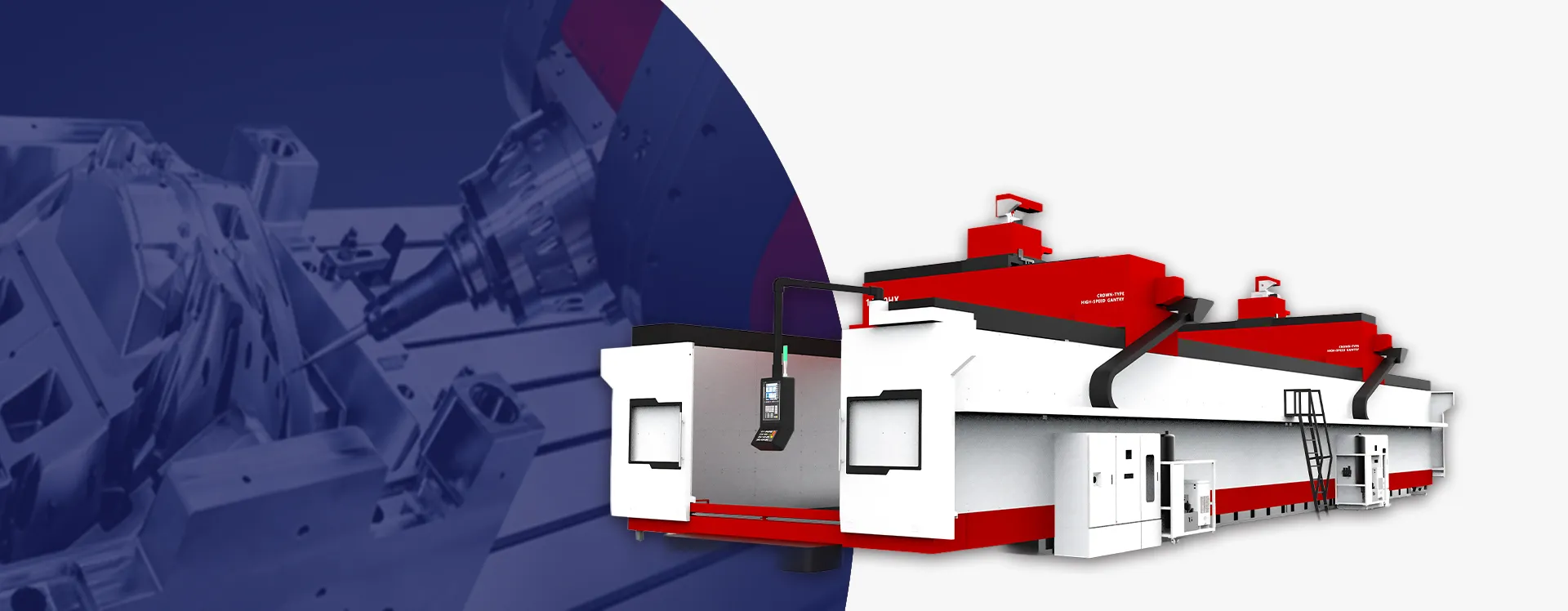
The HPG Series column-moving gantry shown above is an example of a structure that depends on this kind of in-house control. Its patented box-in-box crossbeam and four Z-axis guideways are not features that can be added by a trading company at the request of a customer.
Pillar 2: Engineering Capacity for Customization
Most large gantry purchases involve some level of non-standard specification. A buyer may need extra travel, a different spindle taper, a higher torque configuration, special guarding for an aerospace clean room, or integrated automation. The question is whether the manufacturer’s engineering team can absorb those requests without simply re-quoting a competitor’s catalog.
Indicators of genuine engineering capacity:
- Published customization ranges. The HPG Series documents 12 standard models with travel from 2,000 mm up to 12,200 mm in the X axis and explicitly states that the series supports non-standard customization. A supplier that cannot quote a custom travel is rarely engineering-driven.
- Choice of CNC controller. SIEMENS 828D, SIEMENS 840D, SIEMENS ONE and FANUC 0iMF are all offered across the HPG and SP families. Supporting more than one control family without treating it as a special order is a reasonable signal that the manufacturer writes its own parameter sets and post-processors rather than reselling an integrator’s package.
- Modular option list. Angle heads, tool magazine sizes from 24 to 60 tools, twin-screw and chain chip conveyors, through-spindle coolant and probing should be specifiable in advance, not negotiated as retrofits after delivery.
Pillar 3: Quality and Accuracy Verification
Spec sheets that list accuracy figures without a measurement standard are marketing copy, not engineering. A serious gantry manufacturer publishes the standard behind the number and the test equipment used to derive it.
| What a serious gantry manufacturer publishes | Why it matters |
|---|---|
| Positioning accuracy with the standard named (VDI 3441, ISO 230-2, or JIS) | The same machine reads differently under each standard. Without the standard, the number is not comparable between suppliers. |
| Whether the figure is over full travel or per metre | On a 12-metre machine, a per-metre figure is not the figure you will live with. |
| The test equipment used | Laser interferometer and Renishaw ballbar testing is the industry norm. A supplier that cannot name the equipment is hiding something. |
| Whether the test is under load or unloaded | Heavy parts deflect the structure. Ask what the measurement conditions were. |
| Availability of the test report before shipment | A confident supplier will share the report; a reluctant one tells you what you need to know. |
For reference, the HIRUNG SP Series CNC gantry machining centers publish positioning and repeatability to VDI 3441, with full-travel figures of approximately 0.010 mm positioning and ±0.003 mm repeatability for the gantry range, verified with laser interferometer and ballbar testing. Ask the same questions of any other supplier being considered.
Pillar 4: Architecture and Range Coverage
Different gantry architectures fit different parts. A manufacturer that builds only one architecture will push you toward it whether or not it fits, so range coverage is itself a quality signal.
| Architecture | Typical fit | Why it matters |
|---|---|---|
| Column-moving gantry, fixed table (HIRUNG HPG Series) | Extra-large and very heavy workpieces: energy equipment, shipbuilding components, long structural fabrications | The load is supported by the floor rather than by a table rating, so weight is governed by the foundation and the footprint, not by a table limit. |
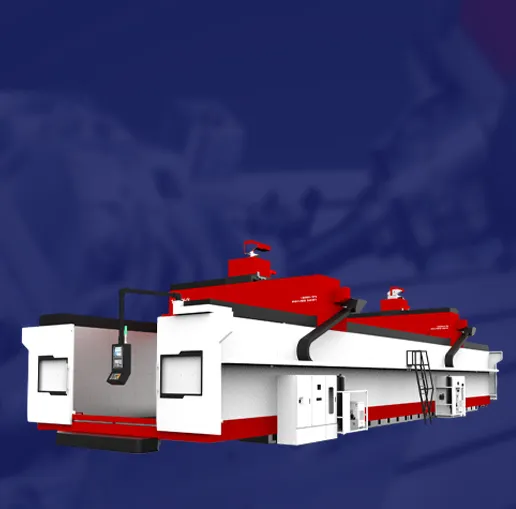
| Fixed-bridge gantry, moving table (HIRUNG SP Series) | High-precision moulds and dies, aerospace structural parts, high-speed finishing | Fixed bridge and integrated bed deliver higher inherent damping; published table load runs from 4,000 kg to 20,000 kg on the listed SP models. |
A manufacturer that offers both architectures, with non-standard customization on the larger platform, is signalling that its engineering team can design for the part first and then select the platform, rather than the other way round.
Pillar 5: Commercial Terms, Service Network and Spare Parts
A gantry purchase is a long commercial relationship. The specification meeting is the easy part; what follows is what determines whether the machine is still productive in year seven.
- Warranty terms in writing. Look for clarity on what is covered (structure, spindle, control, way covers), the response time committed and the exclusions (consumables, glass scales, operator damage).
- Spare parts lead time. Ask for the lead time on the parts most likely to fail: spindle bearings, ballscrews, way covers, tool changer clutches, glass scales. A manufacturer that has to airfreight a part from another continent has just told you the answer.
- Installed base and references. A supplier that can name buyers in your industry and in your region has the easier time supporting you. HIRUNG has shipped CNC machine tools to 33 countries and regions since the brand was established in January 2015, which is one indicator of an installed base that has actually been supported, not only sold to.
- Training and commissioning. A serious manufacturer will commit to on-site installation supervision, operator training and a defined acceptance test with the buyer’s parts. Without that, the warranty starts in the buyer’s plant on day one of a poorly commissioned machine.
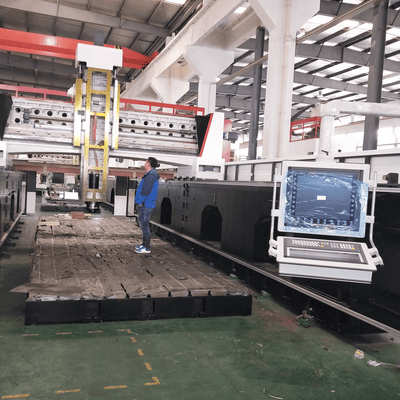
A workshop acceptance that includes a cutting trial on the buyer’s material is the simplest way to convert a spec sheet into evidence. Any credible manufacturer will agree to it.
Pillar 6: Logistics, Installation and Civil Works Support
Machine weights in the gantry range run from roughly 15 tonnes at the small end to 115 tonnes for the largest HPG models, and the largest units occupy a footprint of around 15.5 × 6.6 metres. Few general freight forwarders handle loads of that scale, which is why logistics competence is part of manufacturer capability rather than a separate matter.
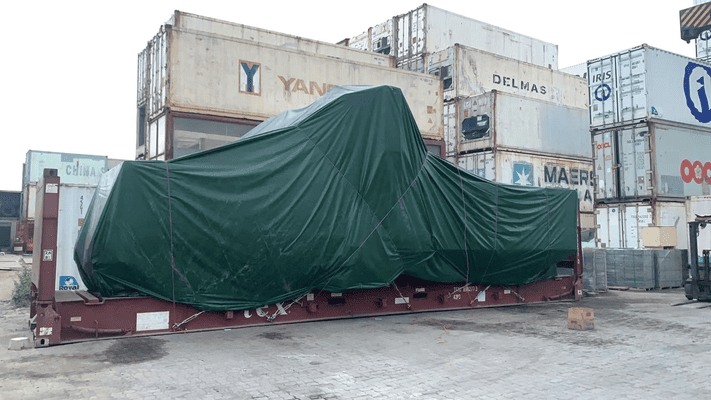
Ask the supplier for the full rigging and shipping plan: container or break-bulk, crating and moisture barrier standard, on-site rigging method, and the foundation drawing package they will deliver in advance so that civil work can run in parallel with manufacture.
Red Flags When Sourcing a CNC Gantry Machine Manufacturer
The fastest way to disqualify a weak supplier is to ask for the documents that the weak ones cannot produce.
| Red flag | What it usually means |
|---|---|
| “We can match any brand on price” | Almost always a trading company or integrator with no foundry control. |
| No published accuracy standard | The figure is a sales line, not a measurement. |
| No factory audit offered, or audit limited to a showroom | There is no in-house foundry or assembly to audit. |
| Generic catalogue across many machine types | Focus is breadth, not depth. Gantry is a side line. |
| Spare parts quote “subject to availability from the OEM” | The supplier does not own the parts design. |
| Warranty in vague language about “quality problems” | Read the small print, or expect to. |
A Six-Step CNC Gantry Manufacturer Evaluation Process
Used by experienced B2B buyers, this process produces a defensible shortlist without burning months on site visits.
- Long-list from public sources. Trade shows, industry association listings, and each candidate’s own CNC gantry machining center page, with a close look at the series pages for column-moving and table-moving gantries.
- Desk review of each long-list candidate. Look for the six pillars above. Drop any candidate that does not publish accuracy, controller options or customization terms.
- Request a written response to a fixed questionnaire. Casting grade, stress relief process, hand scraping standard, test equipment, warranty terms, service network, parts lead time, training scope, installation scope. Compare answers side by side.
- Factory audit, ideally with your own parts. The audit should reach the foundry, the assembly hall, the metrology room and the export packing area, not only the showroom.
- Cutting trial on your material. Ask the supplier to machine a part representative of your production. Compare surface finish, dimensional consistency and cycle time.
- Reference calls with two or three existing customers in your industry and region. Ask about the issues that mattered after delivery, not the issues that mattered during the sale.
Frequently Asked Questions
What should I look for in a CNC gantry machine manufacturer?
Look for in-house casting and assembly, documented accuracy verification to a named standard such as VDI 3441, real engineering capacity for customization, and a service footprint that reaches your plant. Ask for the foundry grade, the test equipment and the spare parts lead time in writing.
How do I verify a CNC gantry machine supplier’s manufacturing capability?
Ask for a factory audit that includes the foundry, the assembly hall and the metrology room, not only the showroom. Confirm the casting grade and the stress relief process, request the Renishaw laser interferometer and ballbar report from a recent build, and watch a cutting trial on a part representative of your production.
Is a Chinese CNC gantry machine manufacturer worth considering?
For B2B buyers who verify manufacturing depth and accuracy, yes. Chinese gantry manufacturers that cast, machine and assemble in-house, publish accuracy to a named standard and maintain a service network in their target regions can deliver comparable precision at a different cost base than the European or Japanese brands. The evaluation criteria above apply regardless of country of origin.
What is the difference between a CNC gantry machine manufacturer and a CNC gantry machine supplier?
A manufacturer casts, machines and assembles the machine under its own brand and is responsible for the structure, spindle integration, accuracy verification and warranty. A supplier may be a trading company or integrator that rebrands a machine assembled elsewhere. The difference shows up in the depth of documentation, the warranty terms and the speed of spare parts delivery.
How long is the lead time for a custom CNC gantry machine?
Lead time depends on travel size, spindle configuration, control system and options. For most heavy-duty gantries in the published size range, the manufacturing lead time runs from several weeks for a standard configuration to several months for a customized platform. Foundation work should run in parallel with manufacture rather than after it.
Can a single CNC gantry machine manufacturer cover both column-moving and table-moving designs?
Yes, and that is a useful signal. A manufacturer with both architectures in its published range can recommend the platform that fits the part, rather than the platform it happens to build. HIRUNG, for example, builds both the HPG Series column-moving gantries and the SP Series table-moving gantries with shared engineering standards and shared control options.
What warranty should I expect from a CNC gantry machine manufacturer?
Typical heavy-duty gantry warranties run 12 months from commissioning or 18 months from shipment, with separate terms for structural components, spindle, control and consumables. Ask for the warranty in writing, with exclusions and response time commitments, before signing the purchase order.
Final Checklist Before You Select a CNC Gantry Machine Manufacturer
- In-house foundry, assembly and metrology confirmed
- Accuracy published to a named standard with a verifiable test report
- Engineering team able to specify custom travel, spindle and options
- Both column-moving and table-moving architectures available when needed
- Warranty, response time and spare parts lead time in writing
- Reference customers in your industry and region
- Logistics, foundation drawing and commissioning scope agreed
- Cutting trial on your material completed
Next Step
Manufacturer evaluation is a documentation exercise as much as a site visit. Once the six pillars are checked in writing for two or three candidates, the shortlist usually takes care of itself.
For buyers working through a B2B shortlist now, the CNC gantry machining center range at HIRUNG covers both the column-moving HPG Series and the table-moving SP Series, with non-standard customization available on the larger platform and a published accuracy statement verified by laser interferometer and ballbar testing. Share your part drawings, material specification and shipping destination with the HIRUNG engineering team, and the configuration and lead time can be confirmed before any commitment to a foundation design.