A CNC gantry machine is a large CNC machining system with a bridge-like gantry structure that supports the spindle and cutting axes above a large worktable or work area. It is mainly used for milling, drilling, boring, tapping, contouring, and surface machining of large, heavy, or high-precision workpieces that are difficult to process on a standard vertical machining center.
In manufacturing, a CNC gantry machine is commonly used for large molds, aerospace structural parts, energy equipment, shipbuilding components, heavy machinery frames, large aluminum plates, automotive tooling, rail components, and precision industrial structures. Because the gantry frame spans over the workpiece, the machine can provide a large working envelope while maintaining stable cutting performance.
For manufacturers dealing with oversized parts, the main challenge is not only whether the machine can “fit” the part. The real question is whether the machine can maintain rigidity, accuracy, thermal stability, and machining consistency across a large travel range. A CNC gantry machine is designed to solve this problem by combining a wide working area with a rigid gantry structure and CNC-controlled movement.
This article explains what a CNC gantry machine is, how it works, where it is used, how it differs from other CNC machines, and what buyers should consider before choosing a gantry CNC machine.
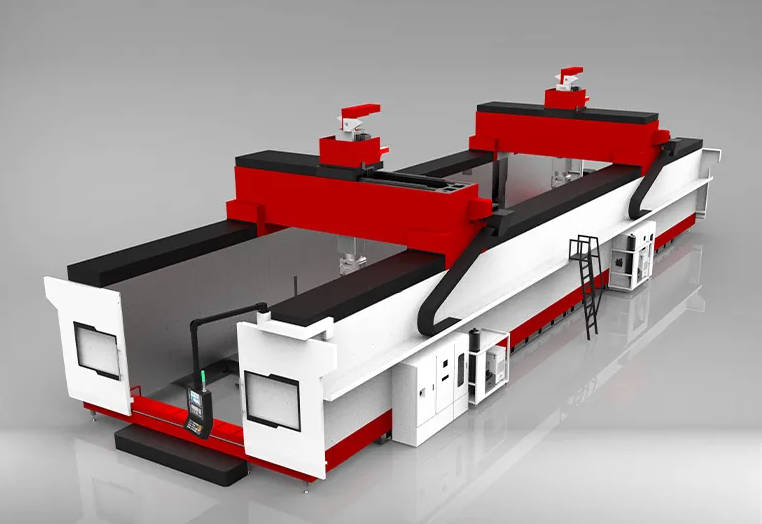
What Is a CNC Gantry Machine?
A CNC gantry machine, also called a gantry CNC machine or CNC gantry milling machine, is a machine tool with a large bridge or portal frame structure. The spindle head moves along the gantry beam and vertical ram, while the workpiece is positioned on a large table or floor-type work area.
Depending on the machine design, either the table moves, the gantry moves, or the columns move. This structure allows the machine to handle much larger parts than many standard machining centers.
A CNC gantry machine can perform operations such as:
| Machining Operation | Typical Use |
| Face milling | Machining large flat surfaces on molds, plates, and frames |
| Rough milling | Removing large amounts of material from heavy workpieces |
| Finish milling | Producing accurate surfaces and profiles |
| Drilling | Creating holes in large structural parts |
| Boring | Machining accurate large holes or bearing seats |
| Tapping | Producing threaded holes on large components |
| Contour machining | Processing curved surfaces and 3D profiles |
| Pocket machining | Removing material from large mold cavities or structural pockets |
A CNC gantry milling machine is usually selected when the workpiece is too large, too heavy, or too demanding for a conventional vertical machining center.
How Does a CNC Gantry Machine Work?
A CNC gantry machine works by using CNC-controlled axes to move the spindle and tool relative to the workpiece. The tool removes material according to programmed toolpaths.
Most gantry machines use three main linear axes:
| Axis | Function |
| X-axis | Longitudinal movement along the machine length |
| Y-axis | Cross movement along the gantry beam |
| Z-axis | Vertical movement of the spindle or ram |
Some gantry machines may also support additional rotary heads, angle heads, or 5-axis configurations depending on the application. These options can expand the machine’s ability to process angled surfaces, complex mold geometry, and multi-sided large parts.
The gantry structure helps distribute machine load across two columns and a crossbeam. This is different from a typical vertical machining center, where the spindle is supported by a single column structure. For large workpieces, the gantry design can provide better coverage and stability.
Main Types of CNC Gantry Machines
Not all gantry CNC machines use the same structure. The right type depends on workpiece size, weight, accuracy requirement, floor space, and production method.
1. Table Moving CNC Gantry Machine
In a table moving gantry machine, the worktable moves along one axis while the gantry bridge remains relatively fixed. This structure is often used when high rigidity and precision are required for large molds, aerospace parts, and precision plates.
Table moving designs can provide strong stability, but the total table load must be considered carefully because the moving table carries the workpiece.
Typical applications include:
- Large mold bases
- Precision plates
- Aerospace structural parts
- Automotive tooling
- Medium to large high-accuracy components
2. Column Moving CNC Gantry Machine
In a column moving gantry machine, the workpiece remains stationary while the gantry or columns move along the machine bed. This is useful for very large or heavy workpieces because the workpiece does not need to move during machining.
This structure is often suitable for:
- Extra-large heavy workpieces
- Energy equipment
- Shipbuilding components
- Large machinery frames
- Heavy steel structures
- Oversized molds and tooling
The HIRUNG HPG Series column moving gantry machine is positioned for heavy-duty and large-part machining applications where stable movement and large workpiece handling are important.
3. Floor-Type CNC Gantry Machine
A floor-type gantry machine may use a fixed floor plate or foundation-mounted work area. This structure is often used for extremely large components where table movement is impractical.
Typical uses include:
- Large welded frames
- Heavy equipment bases
- Shipbuilding parts
- Large energy components
- Oversized industrial structures
4. 5-Axis CNC Gantry Machine
A 5-axis gantry machine combines gantry structure with multi-axis machining capability. It may use a swivel head, rotary head, or other axis configuration to process complex curved surfaces or angled features.
This type may be used for:
- Large aerospace structures
- Complex molds
- Large composite molds
- Automotive styling models
- Turbine-related components
- High-precision large 3D surfaces
CNC Gantry Machine vs Vertical Machining Center
A CNC gantry machine and a vertical machining center can both perform milling, drilling, tapping, and surface machining. However, they are designed for different workpiece sizes and production needs.
| Comparison Factor | CNC Gantry Machine | Vertical Machining Center |
| Workpiece size | Large to extra-large parts | Small to medium parts |
| Machine structure | Bridge/portal gantry frame | Single-column vertical structure |
| Table load | Often higher, depending on design | Usually lower than large gantry machines |
| Floor space | Larger footprint | More compact |
| Rigidity requirement | Designed for large-span cutting stability | Suitable for general precision machining |
| Typical applications | Large molds, aerospace parts, heavy machinery, energy equipment | Brackets, housings, plates, smaller molds, general metal parts |
| Investment cost | Usually higher | Usually lower |
| Installation requirement | More foundation and leveling planning | Easier installation in many workshops |
| Best use case | Oversized or heavy workpieces | Flexible general machining |
If your parts fit comfortably on a vertical machining center, a VMC may be more economical. If your parts are too large, too heavy, or require large-area precision machining, a CNC gantry machine becomes more suitable.
Where Is a CNC Gantry Machine Used?
CNC gantry machine applications are common in industries where workpieces are large, heavy, structurally complex, or difficult to reposition.
1. Mold and Die Manufacturing
Mold and die manufacturing is one of the most common applications for CNC gantry machines. Large molds require stable roughing, finishing, drilling, and surface machining across wide areas.
Typical mold applications include:
- Automotive molds
- Injection mold bases
- Die casting molds
- Stamping dies
- Large forming dies
- Composite molds
- Tire molds
- Large tooling plates
Mold machining often requires high rigidity and good surface quality. The gantry structure allows manufacturers to process large mold bases and complex cavities more efficiently than smaller machines.
2. Aerospace Structural Parts
Aerospace parts often include large aluminum structures, frames, ribs, panels, brackets, and lightweight pocketed components. These parts may require long travel, high accuracy, and stable surface quality.
A gantry CNC machine can be used for:
- Aircraft structural frames
- Aerospace plates
- Large aluminum components
- Wing-related structures
- Fixture and tooling plates
- Aerospace mold and tooling components
For aerospace work, thermal stability, spindle performance, machine calibration, and fixture strategy are important.
3. Energy Equipment Manufacturing
Energy equipment often includes large and heavy components. Wind power, hydropower, oil and gas, and power generation equipment may require machining of large flanges, frames, bases, housings, and structural parts.
Typical applications include:
- Wind power components
- Generator bases
- Turbine-related housings
- Large flanges
- Pump and valve bodies
- Energy equipment frames
- Heavy mounting plates
A column moving or floor-type gantry machine can be practical when the workpiece is too heavy to move on a conventional table.
4. Shipbuilding and Marine Components
Shipbuilding and marine equipment manufacturing involves large welded parts, frames, plates, and structural components. CNC gantry machines can machine flat surfaces, holes, slots, and mounting interfaces on large parts.
Typical applications include:
- Marine engine parts
- Large steel plates
- Propulsion system components
- Structural frames
- Ship equipment bases
- Large welded assemblies
Because these workpieces can be very heavy, machine structure and loading strategy must be carefully planned.
5. Heavy Machinery and Construction Equipment
Heavy machinery components often require machining after welding, casting, or fabrication. CNC gantry machines are used to machine surfaces, holes, slots, and assembly interfaces on large structures.
Examples include:
- Construction machinery frames
- Machine tool beds
- Excavator structural parts
- Industrial equipment bases
- Large welded frames
- Gearbox housings
- Press machine components
For these parts, cutting rigidity and table or floor load capacity are major selection factors.
6. Rail, Transportation, and Large Vehicle Components
Rail and transportation equipment may include large structural parts, long beams, chassis components, and precision mounting surfaces. Gantry machines can support machining over long travel ranges.
Common applications include:
- Rail vehicle components
- Long aluminum profiles
- Large chassis structures
- Transportation equipment frames
- Large mounting plates
- Precision assembly surfaces
7. Medical Equipment and High-Precision Large Components
Some medical equipment and precision instrument manufacturers use large machined components, frames, housings, and structural bases. These parts may require stable machining and accurate geometry across large dimensions.
A gantry machining center can support large precision structures where ordinary machines lack travel or table capacity.
Key Advantages of CNC Gantry Machines
Large Workpiece Capacity
The most obvious advantage is the ability to machine large parts. Gantry machines are designed for workpieces that exceed the working envelope of conventional machining centers.
High Structural Rigidity
A well-designed gantry structure provides strong support across a wide working area. This helps reduce vibration and improve cutting stability during large-part machining.
Good Accuracy Across Large Travel
Large workpieces require accuracy over long distances. CNC gantry machines are designed to maintain stable movement and machining consistency across larger travel ranges.
Efficient Heavy Cutting
For large molds, steel structures, and heavy components, gantry machines can support roughing and finishing operations with suitable spindle power and machine rigidity.
Flexible Machining Capability
With different spindle heads, angle heads, tool magazines, and CNC control options, a gantry machine can perform multiple processes on large parts.
The main advantage of a gantry CNC machine is not only size; it is the ability to combine large working range, rigidity, and controlled machining accuracy in one system.
Important Specifications to Check Before Buying
When choosing a CNC gantry machine, buyers should evaluate technical parameters based on actual workpieces.
| Specification | Why It Matters |
| X/Y/Z travel | Determines maximum machining range |
| Table size or floor work area | Determines workpiece and fixture capacity |
| Table load | Important for heavy molds, frames, and equipment parts |
| Gantry span | Must match workpiece width and tool access |
| Distance between columns | Determines usable workpiece width |
| Spindle taper | Affects tool size and cutting rigidity |
| Spindle power and torque | Important for heavy milling and difficult materials |
| Spindle speed | Affects material removal and finishing performance |
| Guideway type | Affects rigidity, speed, and damping |
| Ball screw or rack system | Affects movement accuracy and long travel performance |
| Tool magazine | Supports multi-process machining |
| Coolant and chip removal | Important for long cycles and heavy cutting |
| Control system | Affects programming, operation, and service |
| Foundation requirement | Critical for machine stability |
| Inspection and calibration | Supports long-term accuracy |
For large machines, foundation and installation planning should be discussed early. A good machine can perform poorly if the foundation, leveling, temperature environment, or installation process is not suitable.
Column Moving vs Table Moving Gantry Machine
Buyers often need to decide between column moving and table moving structures.
| Factor | Column Moving Gantry Machine | Table Moving Gantry Machine |
| Workpiece movement | Workpiece stays stationary | Worktable moves with workpiece |
| Heavy workpieces | Strong advantage | Limited by table load and moving mass |
| Floor space | Can be efficient for very large workpieces | Depends on table travel and layout |
| Accuracy focus | Good for large and heavy parts when properly designed | Good for precision mold and plate machining |
| Typical applications | Energy, shipbuilding, heavy machinery, oversized parts | Large molds, aerospace structures, precision plates |
| Loading convenience | Easier for very heavy workpieces | Requires consideration of table movement |
| Maintenance focus | Moving column/gantry system | Moving table and guideway system |
Column moving gantry machines are often preferred for extremely heavy workpieces, while table moving gantry machines are often selected for high-precision large molds, plates, and structural parts.
HIRUNG provides both CNC gantry machine categories, allowing buyers to compare column moving and table moving solutions according to part weight, machining accuracy, and workshop layout.
Common Mistakes When Choosing a CNC Gantry Machine
Mistake 1: Choosing Only by Travel Size
Large travel is important, but it is not enough. Buyers must also check rigidity, table load, spindle power, guideways, thermal stability, and machine accuracy.
Mistake 2: Ignoring Workpiece Weight
A part may fit within the machine’s travel, but the table or moving structure may not support its weight. Always calculate workpiece weight plus fixture weight.
Mistake 3: Forgetting Foundation Requirements
Large gantry machines need proper foundation, leveling, and installation conditions. Poor installation can affect accuracy and long-term stability.
Mistake 4: Underestimating Tooling and Fixtures
Large workpieces often need special fixtures, long tools, angle heads, clamps, and lifting equipment. These should be planned before purchase.
Mistake 5: Comparing Prices Without Comparing Configuration
Two gantry machines may have similar travel but different spindle power, guideways, control systems, tool magazines, coolant systems, accuracy inspection, and service support.
How to Choose the Right CNC Gantry Machine
Before purchasing, manufacturers should prepare clear production information.
| Information to Prepare | Why It Matters |
| Workpiece drawings | Confirms size, features, and machining areas |
| Workpiece material | Affects spindle, tool, coolant, and rigidity needs |
| Maximum size and weight | Determines travel, gantry span, table load, and structure |
| Tolerance requirement | Determines accuracy and calibration needs |
| Surface finish requirement | Affects spindle and finishing strategy |
| Machining operations | Milling, drilling, boring, tapping, finishing |
| Batch size | Affects automation and tool magazine needs |
| Loading method | Determines workshop layout and crane requirements |
| Fixture plan | Affects usable work area and clamping stability |
| Foundation condition | Critical for installation and accuracy |
| Future workpiece range | Prevents buying a machine that is too limited |
The right selection process starts with the part, not the catalog. Buyers should send drawings, material information, size, weight, and machining requirements before requesting a quotation.
How to Evaluate a CNC Gantry Machine Supplier
A reliable supplier should help match the gantry structure to the buyer’s workpieces and production goals.
Ask these questions before purchasing:
| Supplier Question | Why It Matters |
| Should I choose column moving or table moving structure? | Prevents wrong machine layout selection |
| What travel and gantry span do I need? | Confirms workpiece compatibility |
| What table load is suitable? | Critical for heavy components |
| What spindle taper, power, and torque are recommended? | Affects cutting performance |
| What guideway structure is used? | Affects rigidity and speed |
| What accuracy inspection is provided? | Supports quality verification |
| What foundation requirements should be prepared? | Reduces installation risk |
| What tool magazine and accessories are available? | Supports production flexibility |
| What shipping and installation support is provided? | Important for large machines |
| What after-sales service and spare parts support are available? | Reduces downtime risk |
You can also visit the HIRUNG official website to review broader CNC machine categories and compare whether a gantry machine, vertical machining center, 5-axis machining center, or CNC lathe is more suitable for your production plan.
When to Consider HIRUNG CNC Gantry Machines
HIRUNG CNC Gantry Machines can be considered by manufacturers machining large molds, aerospace structural components, energy equipment, shipbuilding parts, heavy machinery frames, precision plates, and large industrial components.
You may consider the HIRUNG CNC Gantry Machine range when your production requires:
- Large X/Y/Z travel
- High table load or stationary heavy workpiece machining
- Large mold and die machining
- Aerospace structural part machining
- Heavy-duty milling and drilling
- Large precision surface machining
- Column moving or table moving structure selection
- Suitable spindle power and torque for heavy cutting
- Good machine rigidity and long-term stability
- Support for large-part installation, transport, and service planning
If your workpieces are extra-large and heavy, the HPG Series may be worth reviewing. If your priority is high-precision large mold, plate, or structural machining, the SP Series may be considered based on your workpiece size and process requirements.
FAQ
1. What is a CNC gantry machine?
A CNC gantry machine is a large CNC machining system with a bridge-like gantry structure that supports the spindle above a large table or work area. It is used for milling, drilling, boring, tapping, and machining large or heavy parts.
2. What is a CNC gantry milling machine used for?
A CNC gantry milling machine is used for large molds, aerospace structural parts, energy equipment, shipbuilding components, heavy machinery frames, automotive tooling, large plates, and precision industrial structures.
3. What is the difference between a CNC gantry machine and a vertical machining center?
A CNC gantry machine has a larger bridge-type structure for large and heavy workpieces, while a vertical machining center is usually more compact and suitable for small to medium-sized parts. Gantry machines are selected when workpiece size, weight, or travel exceeds standard VMC capacity.
4. When should I choose a gantry CNC machine?
Choose a gantry CNC machine when your workpieces are too large or heavy for standard machining centers, or when you need large-area milling, drilling, boring, mold machining, aerospace structural machining, or heavy-duty precision machining.
5. What is the difference between column moving and table moving gantry machines?
In a column moving gantry machine, the workpiece stays stationary while the gantry or columns move. This is useful for very heavy parts. In a table moving gantry machine, the worktable moves with the workpiece, which is often suitable for precision molds, plates, and structural parts.
6. What specifications matter most when buying a CNC gantry machine?
Important specifications include X/Y/Z travel, table size, table load, gantry span, distance between columns, spindle power, spindle torque, spindle taper, guideway type, control system, tool magazine, coolant system, chip removal, accuracy, and foundation requirements.
7. Is a CNC gantry machine suitable for mold manufacturing?
Yes. CNC gantry machines are widely used for large mold and die manufacturing because they provide large work area, rigid structure, heavy cutting capability, and precision surface machining for large mold bases and cavities.
Conclusion
A CNC gantry machine is designed for large, heavy, and high-value workpieces that require stable milling, drilling, boring, tapping, and surface machining across a large working area. It is widely used in mold and die manufacturing, aerospace, energy equipment, shipbuilding, heavy machinery, rail transportation, large vehicle components, and precision industrial structures.
Compared with a standard vertical machining center, a gantry CNC machine provides a larger working envelope, higher load capacity, and a structure better suited for oversized workpieces. However, it also requires more careful planning for foundation, installation, loading, fixtures, spindle configuration, guideways, accuracy, and long-term service.
For manufacturers evaluating a CNC gantry milling machine, the correct selection should begin with real workpiece drawings, material, size, weight, tolerance, machining process, fixture plan, and workshop layout. If your production involves large molds, aerospace structures, energy parts, heavy machinery frames, or oversized precision components, HIRUNG CNC Gantry Machines can be evaluated according to your application requirements.