Choosing your first CNC machine becomes much easier when you start with one question: what shape are your parts? A CNC lathe rotates the workpiece against a stationary cutting tool and is the right choice for round parts such as shafts, bushings, rings and flanges, while a CNC machining center rotates the cutting tool against a fixed workpiece to mill prismatic parts such as housings, molds, plates and brackets. If most of your current and planned parts are cylindrical, buy a CNC lathe first. If they are blocky, flat or multi-featured, a CNC machining center is the machine that will earn its keep. Many growing workshops eventually own both, because real order books rarely contain only one kind of geometry.
This guide explains what each machine actually does, how the two differ, and how first-time buyers can match the machine to their parts, volume and budget — before spending money on the wrong configuration.
What Is a CNC Lathe?
A CNC lathe — also called a CNC turning machine or turning center — shapes material by rotation. The raw stock, usually round bar, a forging or a casting, is clamped in a chuck or collet and spun at a programmed speed. Cutting tools held in a turret move in along two axes (X for diameter, Z for length) to turn diameters, face shoulders, drill, bore and cut threads. For slender parts, a tailstock supports the free end to prevent deflection.
Because the cutting edge stays engaged with fresh material on every revolution, lathes remove metal quickly and leave a smooth, consistent finish on round features. That is why shafts, pins, bushings, fittings, nozzles and flanges — the everyday components inside machinery, vehicles and fluid systems — are almost always turned rather than milled.
Parts that belong on a lathe
- Shafts, axles and spindles that transmit rotation
- Bushings, spacers, sleeves and rings
- Flanges, fittings and threaded connectors
- Pins, rollers and nozzles
If you can imagine a part being formed from a round bar, a lathe is usually the most efficient way to make it. HIRUNG’s EL Series CNC lathe is built around exactly this job: precision turning centers designed for stable, repeatable production of cylindrical components.
What Is a CNC Machining Center?
A CNC machining center is a computer-controlled milling machine equipped with an automatic tool changer (ATC) and a programmable work envelope. The spindle carries rotating tools — end mills, face mills, drills and taps — while the workpiece is fixed to a table or fixture. The control coordinates three or more axes, so a single program can mill pockets and contours, drill hole patterns, bore precise holes and tap threads in one setup. It is this multi-operation, one-clamping capability — not simply the spinning tool — that separates a machining center from a basic CNC mill.
The machining center family
“Machining center” is a family name rather than one machine. Each member trades work envelope, rigidity and cost differently:
| Type | Structure | Best for | Typical workpieces |
|---|---|---|---|
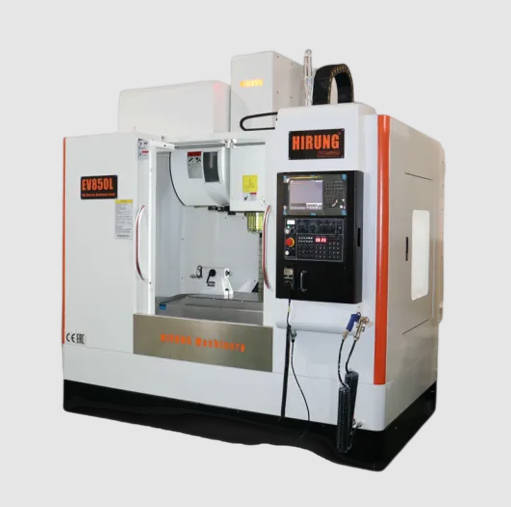
| Vertical (VMC) | Vertical spindle, moving table | General prismatic parts | Housings, molds, plates, brackets |
| Horizontal (HMC) | Horizontal spindle, indexing table | High-volume, multi-face work | Automotive and pump components |
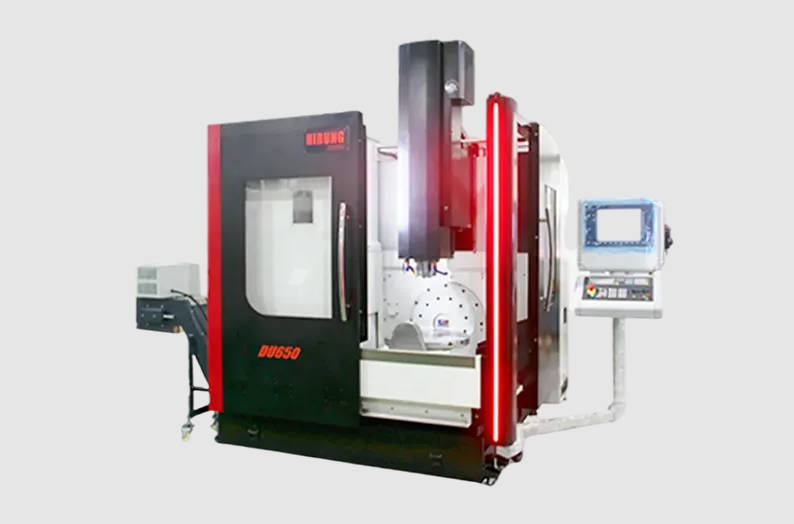
| 5-axis | Three linear plus two rotary axes | Complex contours in one setup | Impellers, medical and aerospace parts |
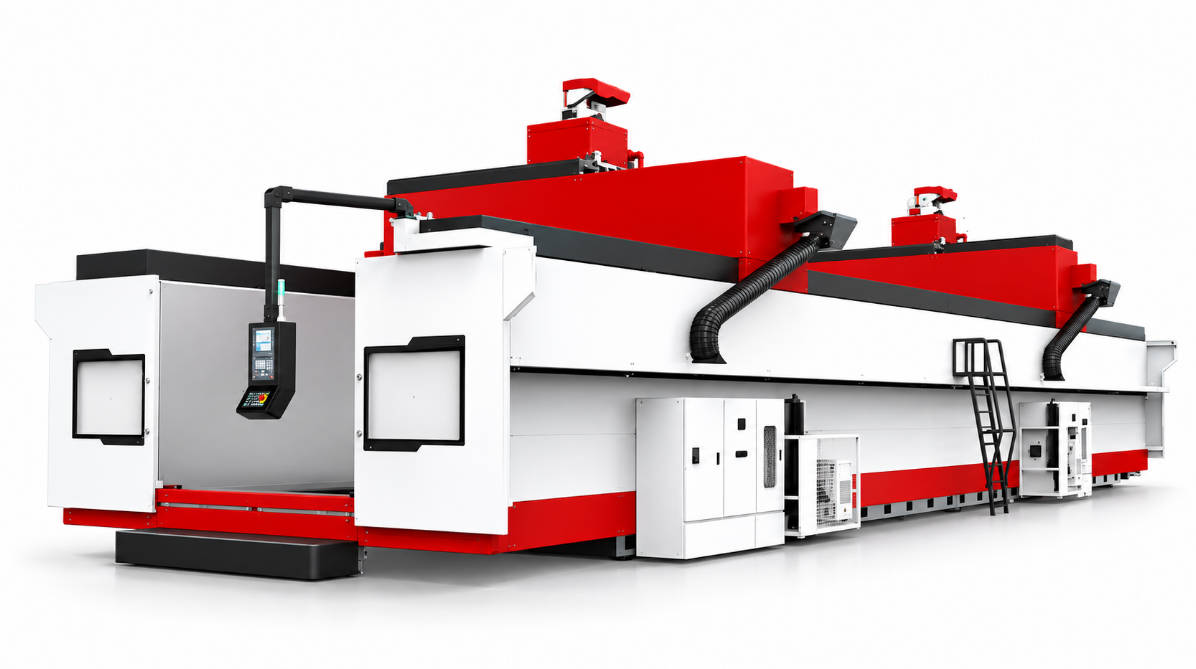
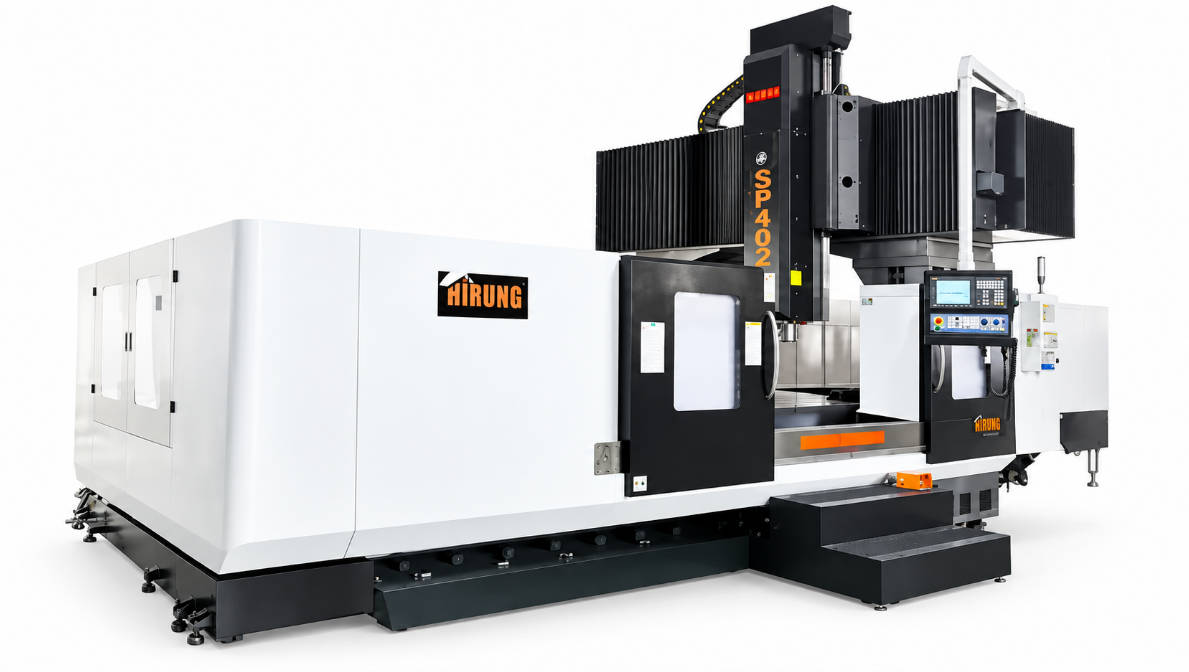
| Gantry | Bridge over a wide table | Very large or heavy parts | Machine beds, large dies, energy components |
For most first purchases this means a vertical machining center. HIRUNG’s EV Series vertical machining centers cover X-axis travel from roughly 600 mm to 1800 mm with table loads from 350 kg to 2000 kg — a range that fits the majority of prismatic work. When parts carry angled features or contoured surfaces that would need several setups on a 3-axis machine, a 5-axis CNC machining center completes them in one clamping instead. At the far end of the scale, gantry machines take over where part size and weight exceed what a column-type machine can carry.
The Core Difference: Turning vs Milling
The difference between a CNC lathe and a CNC machining center comes down to which component rotates: on a lathe the workpiece spins and the tool stands still, while on a machining center the tool spins and the workpiece stays fixed. That single distinction drives everything else — the part shapes each machine can produce economically, the workholding, the tooling, and even the way programs are written.
On a lathe, geometry is described as a profile: whatever path the tool follows is swept into a surface of revolution. On a machining center, geometry is described in three-dimensional space, and the tool can reach any feature the axes allow. Turning is faster for round work because cutting is continuous; milling is slower per feature but nearly unlimited in shape.
CNC Lathe vs CNC Machining Center: Side-by-Side Comparison
| Feature | CNC Lathe | CNC Machining Center |
|---|---|---|
| Material removal | Workpiece rotates against the tool | Tool rotates against the workpiece |
| Part geometry | Rotationally symmetric (round) | Prismatic and free-form |
| Typical axes | 2 (X, Z); more on advanced models | 3 or more (X, Y, Z, plus rotary options) |
| Workholding | Chuck, collet, tailstock | Vise, clamps, custom fixtures |
| Tooling | Turning inserts and boring bars in a turret | End mills, drills and taps in an ATC magazine |
| Typical parts | Shafts, bushings, flanges, fittings | Housings, molds, plates, brackets |
| Programming | 2D profiles, often hand-written | 3D toolpaths, normally CAM-generated |
| Cost at a similar envelope | Generally lower | Generally higher |
Treat the last row as a tendency rather than a rule: pricing varies widely with size, configuration and options, so compare quotations on the same specification before drawing conclusions.
Five Factors That Decide Which Machine You Need
1. Part geometry — the decisive factor
Review your last twelve months of orders, or the drawings you expect to quote. If half or more of the parts are defined by a diameter, the lathe wins. If they start as blocks, plates or castings with pockets, cross-holes and faces to machine, the machining center wins. Nothing else on this list outweighs geometry.
2. Feature complexity on round parts
A basic two-axis lathe cannot cut off-center holes, flats or keyways. If your round parts also need milled features, you either need a second machine, a mill-turn center, or a machining center for the secondary operations. Counting these features before purchase is far cheaper than discovering them after delivery.
3. Production volume and cycle time
For high volumes of small round parts, a lathe paired with a bar feeder can run for hours with minimal intervention, which is difficult for a machining center to match on pure cycle time. For high-mix, low-volume work, the machining center’s flexibility and faster job-to-job changeover are the stronger argument.
4. Tolerance and surface finish requirements
Both machine classes hold tight tolerances when well built. As a reference point, HIRUNG documents positioning accuracy around 0.005–0.010 mm and repeatability in the ±0.002–0.003 mm range across its vertical and gantry lines, verified with laser and ballbar testing before delivery. The practical question is whether accuracy is held over a full production shift, which depends on structure and thermal control — ask any supplier for the measured test report of the actual machine.
5. Budget, floor space and growth
A first machine should cover the work you already have, with some margin for the work you want. Lathe, tooling and floor space are commonly the smaller commitment; machining centers bring higher cost but wider capability. Plan the second machine’s footprint and power supply now, even if the purchase is a year away — cheap foresight at this stage.
Common First-Purchase Mistakes
| Mistake | Why it costs you | Better approach |
|---|---|---|
| Buying for the parts you might get | Capital sits idle while current jobs queue | Size the machine to the work you already hold |
| Ignoring the second operation | Round parts with milled features need a second machine or process | Map every feature on every drawing before deciding |
| Comparing price instead of configuration | Spindle, guideways and structure differ enormously at one price point | Compare the same specifications across suppliers |
| Underestimating tooling and fixturing | An unusable machine for the first weeks | Budget workholding, cutters and programming time |
| Skipping accuracy verification | Tolerance problems appear in production, not on the brochure | Request laser and ballbar test reports for your machine |
So, Which One Do You Need?
Choose a CNC lathe if round parts make up the majority of your order book, and choose a CNC machining center if your parts start as blocks, plates or castings that need pockets, holes on multiple faces or contoured surfaces. When the split is roughly even and budget allows only one machine, buy the one that covers about 80% of your current jobs and subcontract the remainder until volume justifies the second purchase.
Two further pointers for first-time buyers. First, a lathe with live tooling or a mill-turn center can absorb some milling work, but it carries a higher price and more complex programming than a standard two-axis machine — buy that capability only when your drawings genuinely require it. Second, the two machines complement rather than replace each other: a turned part that later needs cross-holes still visits a machining center, and a milled housing with a precision bore often starts life as bar stock on a lathe. Workshops that grow profitably usually plan for both from the beginning.
Frequently Asked Questions
Can a CNC machining center make round parts?
Yes. Using circular interpolation, a machining center can mill round features and even complete round parts from square block. The trade-off is cycle time and surface finish: turning the same geometry on a lathe is generally faster and leaves a better finish on cylindrical surfaces, which is why high-volume round parts stay on lathes.
Can a CNC lathe machine flat or non-round features?
A standard two-axis lathe cannot cut flats, keyways or off-center holes. Lathes equipped with live tooling and a C-axis — commonly called mill-turn centers — can, combining turning and milling in one setup. The added capability raises both the purchase price and the programming skill required, so it suits workshops whose drawings regularly mix turned and milled features.
Which costs more, a CNC lathe or a CNC machining center?
For a comparable work envelope, a two-axis CNC lathe is typically the smaller investment, while machining centers cost more because of the tool magazine, additional axes and heavier structure. The gap widens further for 4-axis, 5-axis or mill-turn configurations. Actual prices depend heavily on size, options and configuration, so quotations should be compared on identical specifications.
Should a first-time buyer purchase a lathe or a machining center first?
Follow the order book, not the brochure. Tally the geometry of the parts you already make or quote most often, and buy the machine class that covers the majority. A CNC lathe suits shops built on shafts and fittings; a machining center suits shops handling housings, fixtures and mold work. The goal is utilization from week one.
Is a CNC lathe the same as a turning center?
In practice the two names overlap heavily. “Turning center” usually signals a lathe with a programmable turret, tailstock options and sometimes live tooling, while “CNC lathe” is the broader term. When comparing quotations, look at the axis configuration, turret capacity and options rather than the label.
What is a mill-turn center, and do I need one?
A mill-turn center combines a lathe’s rotating workpiece with rotating milling tools, so a part can be turned and milled in a single clamping. It reduces setups and cumulative error on complex round parts, but it costs more than either a lathe or a machining center alone and demands more advanced programming. Buy one when your parts mix both process families regularly — otherwise two dedicated machines remain the simpler and more economical path.
Final Thoughts
The CNC lathe vs CNC machining center decision is not about which machine is better — it is about which process your parts demand. Lathes own rotation; machining centers own shape. Start from your drawings, count the geometry, weigh the volume and tolerance requirements, and the answer usually becomes obvious.
HIRUNG manufactures both sides of that decision under one roof: EL Series CNC lathes, EV Series vertical machining centers, 5-axis machining centers and large gantry machines, supplied to customers in more than 33 countries since 2015. If you are weighing your first purchase, send your part drawings and production plan through the HIRUNG contact page, and our engineers will recommend a configuration based on your parts rather than a catalog.