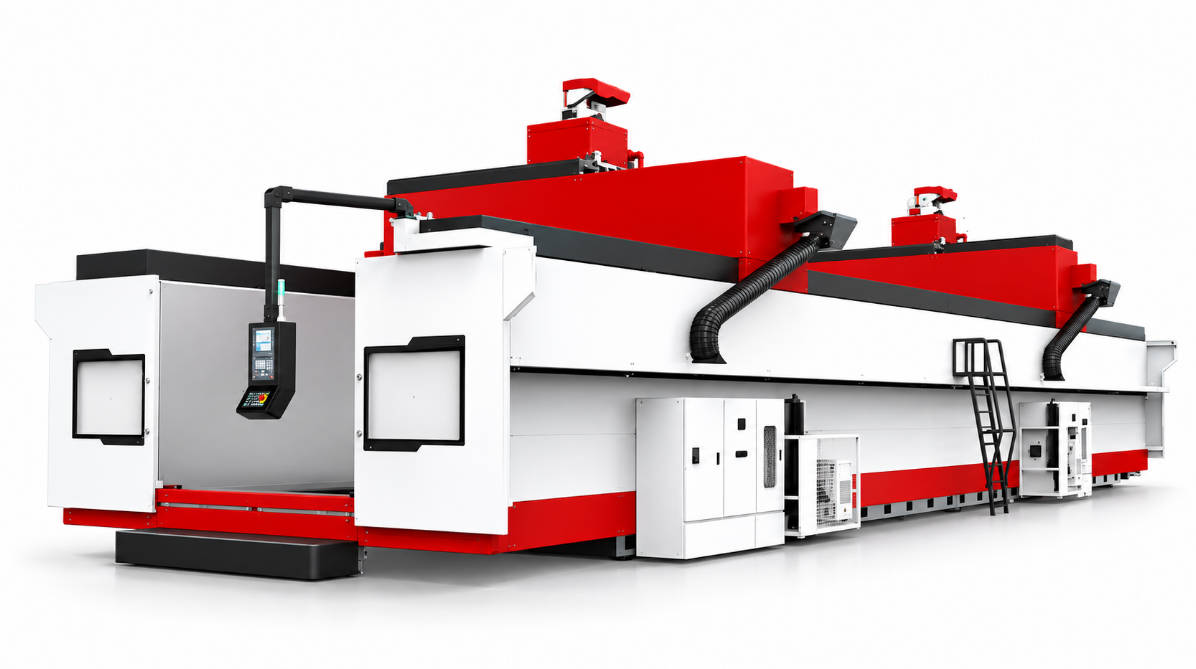
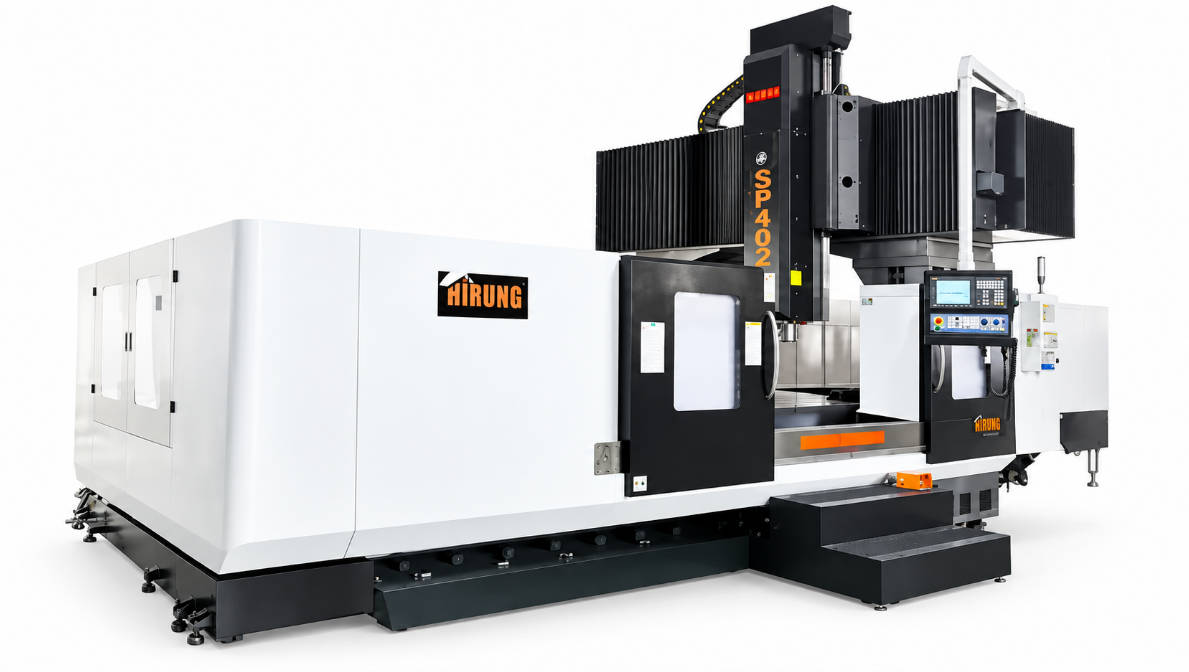
A gantry machining center is the most practical CNC solution when a structural part is too large, too heavy, or too geometrically demanding for a vertical machining center. In heavy equipment manufacturing, these machines machine the backbone of excavators, mining trucks, agricultural tractors, cranes, and material-handling systems. Because the workpiece sits on a wide, fixed or slowly moving table while the spindle moves on an overhead bridge, gantry mills keep long, heavy parts stable through deep cuts and multi-side operations.
If your shop regularly machines welded frames, baseplates, booms, mast rails, gear housings, or crawler assemblies, a gantry machining center can reduce setups, improve geometric accuracy, and lower the risk of distortion that comes from repositioning large parts between operations.
What Is a Gantry Machining Center?
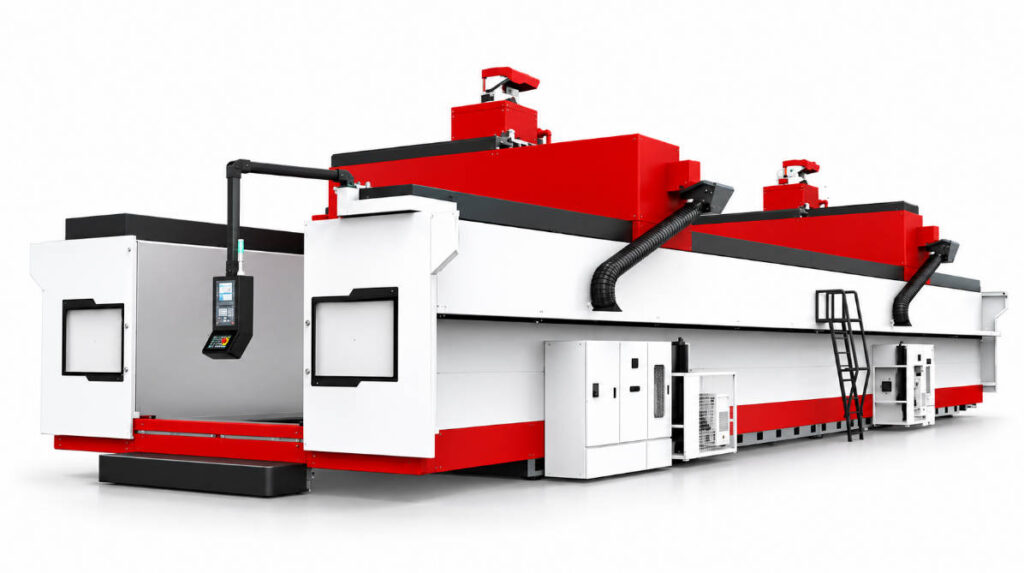
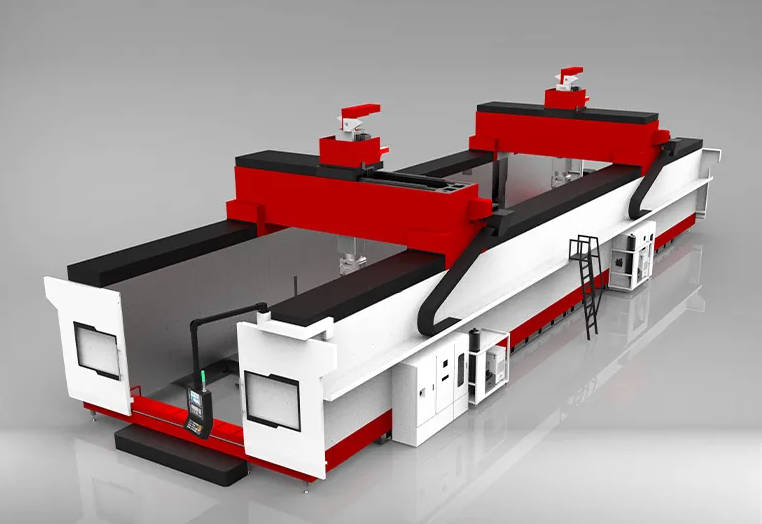
A gantry machining center uses a bridge or overhead beam that carries the spindle across a wide table. The result is a double-column, open-frame layout with generous X, Y, and Z travels and a work area that can accept parts measured in meters rather than centimeters.
Unlike a conventional vertical machining center (VMC), where a C-frame column overhangs a moving table, a gantry mill keeps the cutting forces centered between two uprights. This symmetry gives better stiffness against vibration and deflection when the spindle is taking heavy cuts in cast iron or steel weldments.
Common structural elements include:
- A rigid base, typically built from high-grade cast iron to damp vibration.
- Double-column bridge design for symmetrical load paths.
- Long ball screws and linear or box-way guideways sized for the full travel.
- High-torque spindles and large automatic tool changers for extended runs.
For manufacturers in the heavy equipment sector, the key takeaway is simple: the gantry layout exists to keep big, heavy parts stable while the spindle does the work.
Why Heavy Equipment Manufacturing Needs Gantry Milling
Heavy equipment parts have three characteristics that push shops away from smaller machining centers:
- Large envelope — Frame rails, crane booms, and excavator baseplates commonly exceed two meters in length and may be several meters wide.
- High mass — Cast or welded structural parts can weigh several tonnes; the table must support them without sag or chatter.
- Tough materials — Gray cast iron, ductile iron, and welded steel plate require high spindle torque and rigid damping.
A CNC gantry machine addresses all three. Its wide table lets the operator load the part once and machine multiple faces in the same setup. The double-column frame absorbs cutting forces that would deflect a smaller machine. And the long travels allow complex profiling on parts that would otherwise have to be moved between several machines.
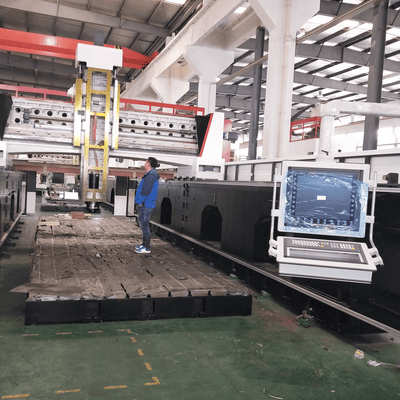
Typical heavy equipment applications include:
| Industry segment | Examples of parts machined on a gantry mill |
|---|---|
| Construction machinery | Excavator frames, bulldozer baseplates, loader arms, track shoes, boom weldments |
| Mining equipment | Haul truck beds, crusher housings, mill shells, undercarriage frames |
| Agricultural machinery | Tractor chassis, combine frames, harvester head mounts, plow beams |
| Material handling | Crane mast rails, forklift carriage plates, reach-stacker frames |
| Energy / off-road | Wind turbine base rings, gearbox housings, off-road axle supports |
In many of these cases, the part is a welded fabrication rather than a casting. A gantry mill lets the welder leave controlled machining stock, then finish critical mounting surfaces, bores, and bolt patterns in one clamping.
Machining Operations and Setup Strategy
The Value of One-Setup Machining
On a gantry machining center, heavy equipment manufacturers typically perform face milling, drilling, tapping, boring, and contouring in a single setup. This matters because every time a large weldment is unclamped, moved, and reclamped, alignment error is introduced. A gantry mill’s envelope allows access to the top, sides, and ends of a part without repositioning.
The usual workflow looks like this:
- Receive the raw weldment or casting and place it on the table using overhead cranes or forklifts.
- Establish datums with probes or edge finders to locate weld distortion.
- Rough machine mounting faces and bores to create stable references.
- Finish machine critical surfaces to the drawing tolerances.
- Inspect in place or transfer to a CMM after cooling.
Because the CNC gantry machine range supports long travels and high table loads, it replaces multiple setups that would otherwise require several smaller machines or manual layout work.
Accuracy and Thermal Stability in Heavy Cutting
Heavy equipment parts are not always “loose tolerance.” Gearbox bores, bearing seats, and mounting faces often require positional accuracy in the hundredth-millimeter range. A well-built gantry machining center can hold these tolerances even when the surrounding process is aggressive.
HIRUNG gantry machines are built on a Mehanite cast iron base, with critical interfaces hand-scraped and structural alignment held within 0.01 mm per 1000 mm. Positioning accuracy is specified at ≤ 0.010 mm over full travel, with repeatability of ± 0.003 mm. Thermal displacement is controlled to < 0.005 mm through an active spindle oil-cooling system.
Every machine is verified with Renishaw laser interferometer and ballbar testing before shipment. These are not marketing claims; they are the verification methods a procurement team should ask any supplier to document.
HPG Series vs SP Series: Matching the Machine to the Work
HIRUNG offers two gantry architectures, and the difference matters for heavy equipment applications.
| Feature | HIRUNG HPG Series | HIRUNG SP Series |
|---|---|---|
| Design | Column-moving (fixed table) | Table-moving (fixed bridge) |
| Best for | Extra-large and extremely heavy workpieces | Maximum rigidity for finishing accuracy |
| Table load | Effectively unlimited on a fixed table | Up to 30,000 kg (30 tonnes) |
| Travel | Available up to 12,000 mm and beyond | Configured for high-rigidity finishing |
| Heavy cut behavior | Excellent stock removal on oversized parts | Excellent stability for precise finishing |
| Typical heavy equipment use | Large frames, booms, chassis rails, beds | Gearbox housings, precision bores, bearing seats |
When to Choose the HIRUNG HPG Series
The HIRUNG HPG series is the natural starting point when the part is physically large and the priority is removing material from big castings or weldments. Because the table does not move, weight capacity is limited mainly by the floor and foundation, not by the machine’s own table drive.
When to Choose the HIRUNG SP Series
The HIRUNG SP series is the better fit when the workpiece is heavy but the tolerance stack is tight. Its fixed-bridge design keeps the spindle path extremely stable, which pays off in finish-machining operations where bore position and surface quality affect downstream assembly.
Key Specifications to Evaluate
When you request a quotation for a gantry machining center, do not rely on catalog cuttings alone. Ask the supplier to map the machine’s real envelope against your actual parts.
- Table load capacity — Confirm whether the rating is continuous or peak, and whether it includes fixturing.
- X/Y/Z travels — Include clearance for clamps, probes, and chip evacuation.
- Spindle torque and speed range — Cast iron and steel need torque at lower speeds; aluminum structures may need higher rpm.
- Guideway type — Box ways damp heavy cuts; linear guideways support faster traverse, with HIRUNG quoting rapid traverse up to roughly 20 m/min.
- Cooling and thermal management — Oil-cooled spindles and stable coolant systems protect accuracy during long cycles.
- Tool magazine capacity — Long parts often need many tools; verify the magazine and tool-to-tool time.
Common Mistakes When Buying for Heavy Equipment
- Specifying a vertical machining center that is too small. A VMC can be excellent for smaller components, but moving a 5-tonne weldment across a VMC table multiplies setup time and geometric error.
- Ignoring foundation requirements. Gantry machines generate high static and dynamic loads. The floor must be designed for the machine’s full weight, the workpiece, and cutting forces.
- Underestimating chip removal. Heavy cuts on cast iron or steel produce large chip volumes; inadequate conveyors or coolant flow create unplanned downtime.
- Focusing only on purchase price. Foundation, tooling, fixtures, crane capacity, and service access can equal a significant share of the total installed cost.
- Skipping run-off testing. Ask for a witnessed run-off on a part geometry similar to your own, measured with certified instruments.
How to Choose a Supplier
Look for a partner that can demonstrate experience with parts in your size and material range, not just a machine builder that sells by catalog. Useful checkpoints include:
- Published accuracy and repeatability data, backed by third-party verification such as laser interferometer and ballbar reports.
- A documented design process for the base, guideways, and spindle thermal management.
- Clear documentation of table load, travels, and rapid-traverse capability.
- Spare-parts availability and service engineering support in your region.
- Willingness to review your part drawings and recommend the right gantry configuration before quoting.
A supplier such as HIRUNG, with machines supplied to more than 33 countries and a gantry line designed around large-component rigidity, can provide the technical documentation and application review that heavy equipment buyers need.
FAQ
What parts in heavy equipment manufacturing are best suited to a gantry machining center?
Large structural parts — such as excavator frames, mining truck beds, crane booms, and tractor chassis — are ideal because they require long travels, high table loads, and the rigidity of a double-column design.
How does a gantry machining center compare with a vertical machining center for heavy parts?
A VMC is generally more compact and cost-effective for smaller components. For parts over roughly two meters in length or weighing several tonnes, a gantry mill offers better stability, fewer setups, and more consistent accuracy.
Can a gantry machining center hold tight tolerances on cast iron parts?
Yes. A properly built gantry machine can achieve positioning accuracy of ≤ 0.010 mm and repeatability of ± 0.003 mm, which is sufficient for most gearbox bores, bearing seats, and mounting faces in heavy equipment.
What is the difference between HIRUNG HPG and SP gantry series?
The HIRUNG HPG series uses a column-moving, fixed-table design for extra-large and very heavy parts. The HIRUNG SP series uses a fixed-bridge, table-moving design for maximum rigidity and finishing accuracy, with table loads up to 30,000 kg.
How much table load can a gantry machining center carry?
It varies by design. Fixed-table column-moving designs effectively allow very high loads, while table-moving designs are rated up to the drive system’s limits — for example, up to 30,000 kg in the HIRUNG SP series.
Do I need a special foundation for a gantry machining center?
In most cases, yes. The foundation must support the machine weight, the workpiece, cutting forces, and vibration isolation. The supplier should provide foundation drawings based on your soil or floor conditions.
Conclusion
Heavy equipment manufacturers face a simple reality: the parts are big, the materials are tough, and the tolerances still matter. A gantry machining center gives you the travel, table load, and rigidity to machine these components efficiently and accurately.
If your production includes large frames, booms, beds, or gear housings, start by comparing your largest, heaviest, and most tolerance-sensitive parts against the machine’s real specifications. For extra-large structural work, look at the column-moving layout of the HIRUNG HPG series. For heavy parts that also demand finishing accuracy, the HIRUNG SP series offers a fixed-bridge design with up to 30,000 kg table capacity.
To discuss your application, review part drawings, or arrange a quotation, contact the HIRUNG team or explore the HIRUNG CNC gantry machine range.