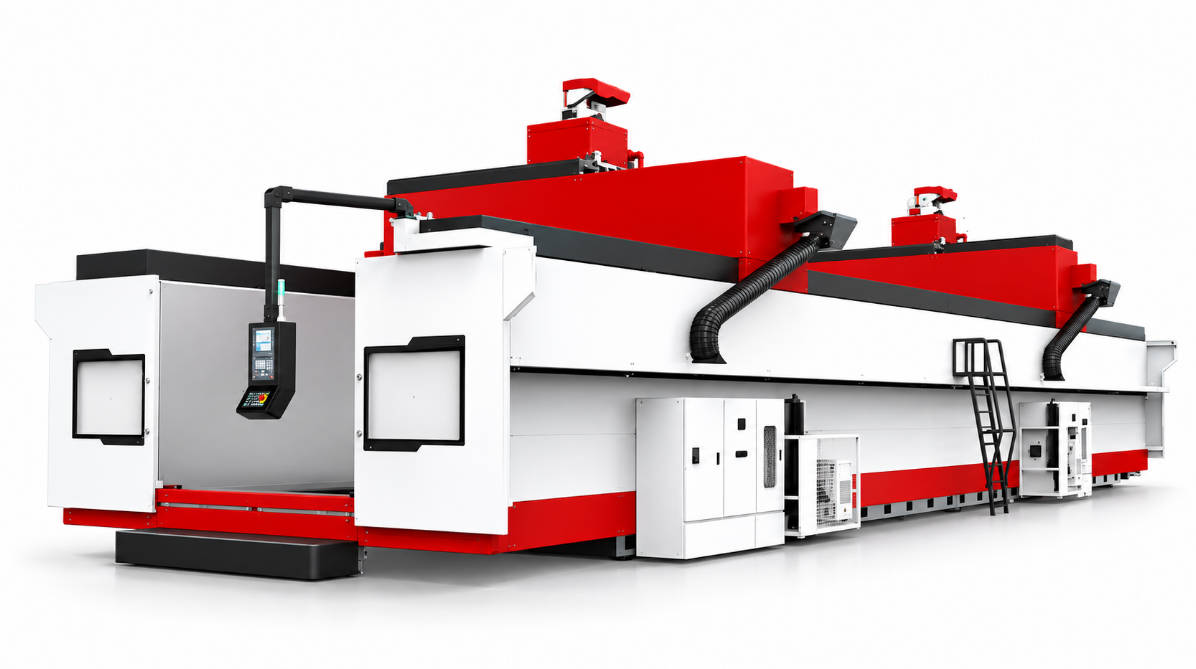
A gantry machining center improves large workpiece machining efficiency mainly by machining more faces in a single setup, supporting very long travels and high table loads while the part stays put, and reaching the work from overhead so the workpiece is never repositioned mid-job. Those three properties cut the non-cutting time — crane handling, clamp changes, and re-alignment — that usually dominates the cost of large-part work. On a multi-tonne mold base or structural frame, the hours saved outside the cut often outweigh the time saved inside it.
This article explains where those efficiency gains come from, how they show up on the shop floor, and what to specify so the advantage is real rather than theoretical. It is written for process and manufacturing engineers, and for buyers of heavy equipment, mold and die, aerospace, energy and construction components — including teams in Germany, Italy, Poland, the United Kingdom and Australia, where large-part contracts increasingly demand both throughput and traceable accuracy. For the capability background, our article on why CNC gantry machines are used for large workpiece machining covers the structural reasons in detail.
Why Large Workpiece Machining Is Inefficient on Conventional Machines
To see the gain, first see the waste. A vertical or horizontal machining center moves the part on a table whose travel and load are bounded. Once a workpiece exceeds those bounds — in length, mass, or the number of faces to be cut — the standard response is to reposition it: unclamp, crane or roll it, re-fixturing, re-indicate, recut. Each move adds non-cutting hours and a chance for error.
- Limited reach. A moving-table center stops at its own travel envelope, so long parts span multiple setups.
- Load ceiling. The table rating caps how heavy a part it can carry and still accelerate accurately.
- Crane dependency. Repositioning a multi-tonne workpiece needs lifting equipment, floor space and labor — all idle machine time.
- Error accumulation. Every re-clamp is a fresh chance to lose the datums that hold the part’s features in tolerance.
On large parts, the dominant cost is rarely the cutting itself; it is the handling, clamping and re-alignment around the cutting. A gantry layout attacks exactly that cost.
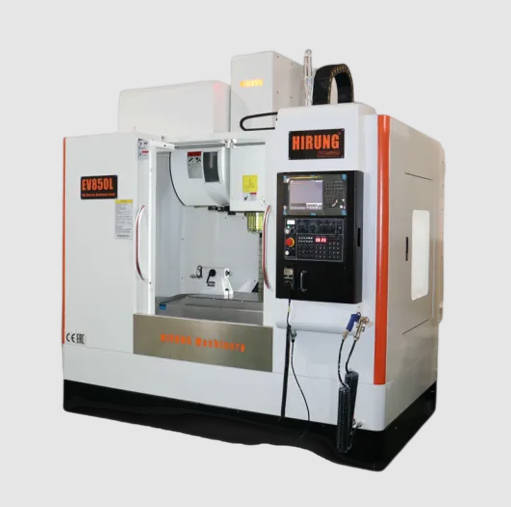
How the Gantry Layout Removes the Bottlenecks
A gantry carries the spindle on a bridge that moves overhead, leaving the work zone open on the sides and top. Two construction choices matter for efficiency:
- Moving-column (fixed table). The part sits on a stationary table while the column travels. HIRUNG’s HPG series uses this layout for extra-large and very heavy workpieces, with X-axis travels extending beyond 12,000 mm and effectively no hard table-load ceiling from the machine’s own rating.
- Moving-table (fixed bridge). The bridge is fixed for maximum rigidity while the table indexes the part beneath it. HIRUNG’s SP series takes this approach for finishing accuracy, with table loads rated up to 30,000 kg.
Both keep the workpiece from being shuttled between setups. That single design fact is the source of most of the efficiency advantage.
The Efficiency Gains That Matter on the Floor
Fewer setups mean less crane time and fewer errors
Large parts are frequently machined on five faces. On a conventional center that is four or five repositioning cycles; on a gantry with overhead and angle-head access it can be one. Collapsing four or five setups into one removes the majority of non-cutting time on a large part and eliminates the datum shifts that come with each re-clamp.
One-clamp, multi-face cutting
With the part fixed and the head able to reach top and sides, a single clamping carries roughing through finishing across multiple faces. The shop spends its time cutting, not handling — which is the definition of higher throughput.
Long travel and high load without moving the part
Travels beyond 12,000 mm and table loads into the tens of tonnes (the SP series reaches 30,000 kg) let a single machine own an entire large part. There is no intermediate transfer to another machine or another bay, so the part’s progress is continuous and easy to schedule.
Stability over long cycles
Efficiency is lost if a long cut drifts out of tolerance and must be repeated. HIRUNG gantry platforms are built on stress-relieved Mehanite cast iron with hand-scraped interfaces held within 0.01 mm per 1,000 mm, and active spindle oil cooling that holds thermal displacement below 0.005 mm. Every machine is verified with Renishaw laser interferometer and ballbar testing. The practical result: a long roughing-and-finishing run stays in spec the first time, which is itself an efficiency gain. The key factors that affect CNC gantry machine accuracy explain the build details behind this.
Automation for lights-out running
Because the part is stationary and the work zone is open, gantries suit pallet changers, rotary tables and probing that let long programs run unattended. For high-mix large-part shops, that is how a single machine delivers two shifts of output without two shifts of labor.
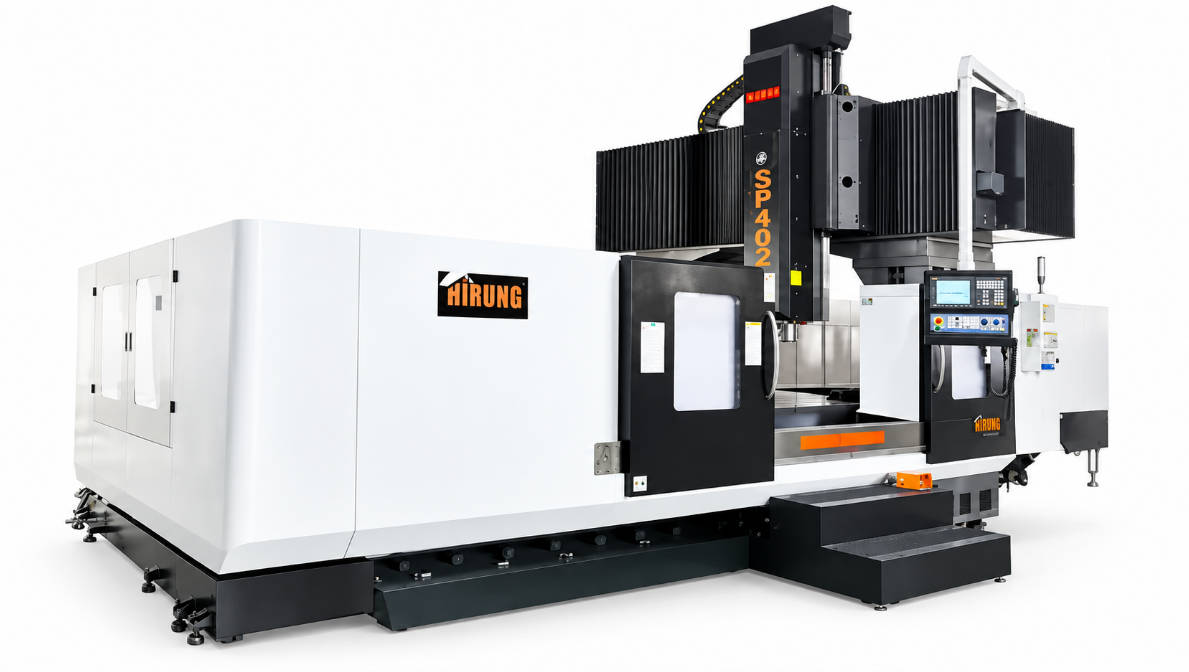
Gantry vs. VMC for Large Workpieces: The Efficiency View
| Efficiency factor | Vertical machining center | Gantry machining center |
|---|---|---|
| Setups for a 5-face large part | Multiple (part repositioned) | Typically one (overhead access) |
| Crane / handling time | High, repeated per setup | Low, part stays clamped |
| Max workpiece length | Limited to table travel | Long travels, often 12,000 mm and beyond |
| Max table load | Modest (table must move it) | Up to ~30,000 kg on table-moving designs |
| Datum risk across faces | Higher (re-clamping) | Lower (single datuming) |
| Best efficiency fit | Small–medium parts, high mix | Large, heavy, multi-face parts |
Where Gantry Efficiency Pays Off Most
The advantage is largest wherever parts are big, heavy, and cut on many faces — which is exactly the profile of the industries below. For a fuller sector breakdown, see our article on gantry machining center applications in heavy equipment manufacturing:
- Mold and die. Large mold bases and die-casting dies are clamped once and machined across the full envelope.
- Aerospace structures. Long ribs, spars and frames where one-clamp accuracy protects assembly fit.
- Energy sector. Casings and housings whose size and wall thickness demand stable, long-cycle cutting.
- Construction and agricultural machinery. Booms, frames and housings produced in volume benefit from continuous, transfer-free machining.
- Shipbuilding and rail. Very long structural members that simply cannot move between conventional tables.
In European and Australian supply chains, these parts frequently carry both productivity and documentation requirements — another reason a verifiable, single-setup process is valued over repeated manual handling.
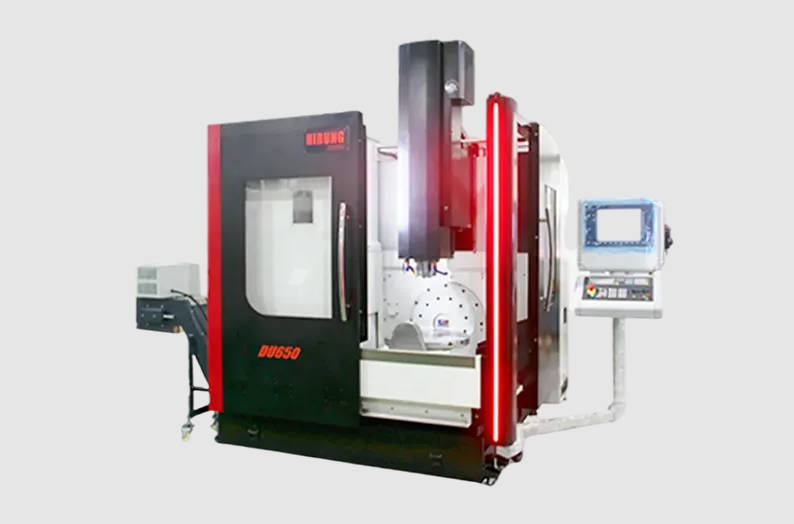
Common Mistakes That Erase the Efficiency Gain
| Mistake | What it costs you |
|---|---|
| Undersized foundation or poor leveling | Vibration and geometric drift that force slower feeds and rework |
| Weak fixturing for a one-clamp strategy | Forced to add setups anyway, losing the core advantage |
| Skipping warm-up on long cycles | Thermal growth errors on the first precision passes |
| Not planning automation | Machine sits idle between programs instead of running unattended |
| Choosing travel too tightly | Largest occasional part still needs a second machine or setup |
How to Choose a Gantry for Maximum Efficiency
Match the construction to the work. For parts that are mainly defined by their length and mass, a column-moving design (HIRUNG HPG) keeps the part on a fixed table and removes the load ceiling. For parts where finishing accuracy across a large surface is the priority, a table-moving design (HIRUNG SP) fixes the bridge for rigidity and supports table loads up to 30,000 kg. Our guide on how to choose a CNC gantry machine for heavy-duty machining walks through the selection trade-offs in more depth.
Specify the travel and load against your realistic largest part, not your average one, and confirm the verification method — laser interferometer and ballbar — so the accuracy you plan production around is the accuracy the machine actually holds.
Evaluating a Supplier for Large-Part Efficiency
The machine creates the opportunity; the supplier determines whether you capture it. Ask for the accuracy verification report, the recommended calibration interval, spare-parts lead times for the wear items, and the training provided for single-clamp and unattended operation. For buyers in Europe and Australia, response time and spare-parts logistics in your region are what turn a capable gantry into a dependable throughput asset. HIRUNG has supplied CNC machine tools to customers in more than 33 countries since 2015, with mold and die among its core applications.
Frequently Asked Questions
How do gantry machining centers improve efficiency for large parts?
Mostly by reducing non-cutting time: the overhead layout machines more faces in one setup, so the part is not crane-handled and re-aligned between operations. That removes the handling hours and datum errors that dominate large-part cost, while long travels and high table loads let a single machine own the whole workpiece.
Why is a gantry more efficient than a VMC for large workpieces?
A VMC must move the part on a bounded table, so large workpieces span several setups with repeated clamping and crane time. A gantry keeps the part stationary and reaches it from above, collapsing those setups into one and protecting accuracy across faces — which is where the efficiency gap comes from.
Can a gantry machining center reduce setup time on big molds?
Yes. Large mold bases and die-casting dies are typically machined across multiple faces; a gantry with overhead access can hold them in one clamping for roughing through finishing. Reducing four or five setups to one removes most of the non-cutting handling and the re-alignment risk that comes with each move.
What size workpiece needs a gantry machining center for efficiency?
A workpiece becomes a gantry candidate when its envelope, mass, or number of faces exceeds what a moving-table machining center can handle without repositioning. The practical trigger is repeated multi-setup handling: once a part needs crane moves between operations, a gantry usually wins on total throughput.
Does gantry machining improve accuracy as well as speed?
It helps both. Single-clamp machining avoids the datum shifts of repeated re-clamping, and stable gantry structures with thermal control and verified geometry keep long cycles in tolerance the first time. Accuracy and efficiency reinforce each other: a part cut right the first time is both faster and cheaper.
How can I maximize large workpiece machining throughput?
Choose the gantry construction that fits the part (column-moving for very large and heavy, table-moving for finishing accuracy), invest in strong single-clamp fixturing, plan for pallet or rotary automation, and confirm accuracy verification so long runs stay in spec. Together these convert the gantry’s layout advantage into real shop-floor throughput.
Conclusion: Efficiency Comes From What the Machine Avoids Doing
A gantry machining center does not beat a conventional center by cutting faster in isolation; it wins by avoiding the handling, clamping and re-alignment that surround the cut. Fewer setups, one-clamp multi-face machining, long travels, high load capacity and stable accuracy together compress the total time and cost of a large part. For shops where large workpieces define the backlog, that is the difference between a machine that is busy and a process that is efficient.
If your work is moving toward larger, heavier, multi-face parts, review HIRUNG’s HPG and SP gantry series and discuss verification reporting and regional support with the team. And if you are still weighing the capability case, our article on why CNC gantry machines are used for large workpiece machining is the natural next read.