A CNC machine for mold manufacturing is typically chosen from three equipment families: vertical machining centers (VMCs) for small and medium molds, 5-axis machining centers for complex contoured cavities and cores, and gantry (double-column) machining centers for large mold bases and heavy die work. The right choice depends on four variables — the size of the molds you cut, the hardness of the steel, the accuracy class you must hold, and your budget. Getting this match right matters more to your results than any single figure on a specification sheet.
This guide explains which machine types are used for mold making, the selection factors that actually influence outcomes, and how to evaluate equipment and suppliers before you invest. It is written for mold and die manufacturers, toolrooms, and procurement teams — particularly buyers across Europe and Australia, where demand for precision mold machining equipment continues to grow. HIRUNG has supplied CNC machine tools to customers in more than 33 countries since 2015, with mold and die listed among its core applications alongside aerospace and medical instruments. If you are still comparing machine categories at a general level, our CNC machining center buying guide covers the fundamentals first.
What Makes Mold Manufacturing Different from General CNC Machining?
Mold making places a specific combination of demands on a machine tool that general parts production does not. Understanding these demands is the fastest way to filter out machines that will not survive in a mold shop:
- Harder materials. Mold cavities and cores are commonly cut from pre-hardened and hardened tool steels — P20, H13, 1.2344 and similar grades — typically in the range of roughly 30 to 50 HRC depending on the steel and heat treatment. Cutting these materials requires spindle torque and structural damping that lighter machines cannot sustain.
- Deep cavities and pockets. Cooling channels, deep pockets and tall cores demand long tool overhangs, which magnify any vibration or geometric error in the machine.
- Fine surface finish. Many mold surfaces are hand-polished after machining. The closer the machined finish is to the final requirement, the less polishing labor — and the lower the risk of losing geometry during polishing.
- Long, heavy cutting cycles. A single large cavity may run for many hours or days. Accuracy must hold not only on day one, but across weeks of heavy roughing and long finishing passes on the same machine.
- High workpiece value. A mold blank often carries weeks of prior work and significant material cost before cutting even starts. Scrapping one is far more expensive than scrapping a batch of brackets.
Which Types of CNC Machines Are Used for Mold Making?
Four machine families cover nearly all mold manufacturing work. Each occupies a clear position in the workflow, and many growing shops eventually operate more than one.
Vertical Machining Centers (VMCs)
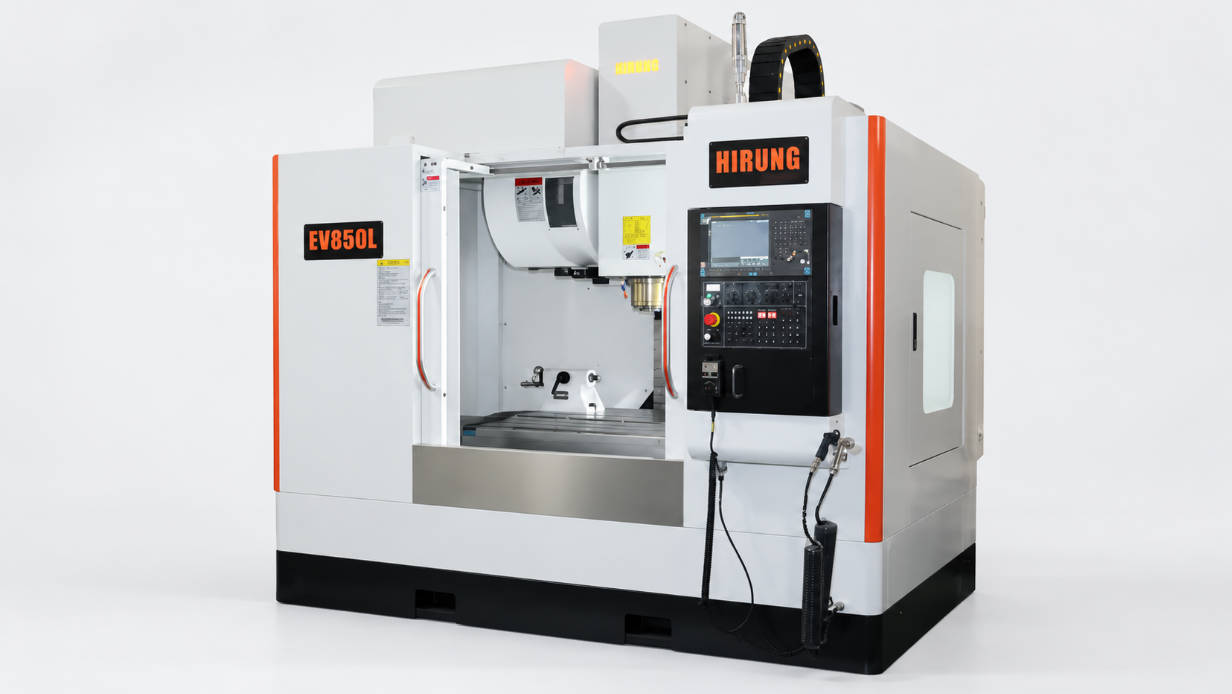
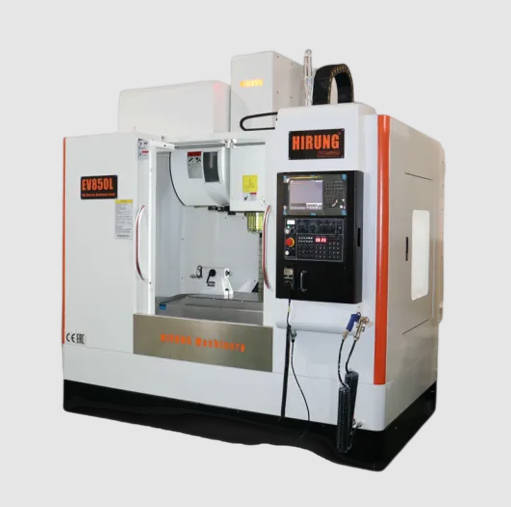
The VMC is the workhorse of small and medium mold manufacturing. Its vertical spindle suits mold plates, pockets, inserts, sliders, and complete injection molds up to the limit of its travel and table load. Mold work also consumes many tools — roughing end mills, ball-nose finishers, drills for cooling channels — so an adequately sized tool magazine keeps long cycles running without supervision.
HIRUNG’s EV series spans X-axis travels of roughly 600 to 1,800 mm with table loads from 350 to 2,000 kg, BT40/BT50 spindle tapers, spindle speeds of 6,000–12,000 rpm and power of 7.5–18.5 kW, and a 24-tool arm-type automatic tool changer (up to 32 tools on selected models). Controls offered across the series include FANUC OiMF, SIEMENS 828D and MITSUBISHI M80, and the EV specification table quotes positioning accuracy of ±0.005 mm and repeatability of ±0.002 mm (ISO 230-2).
5-Axis Machining Centers
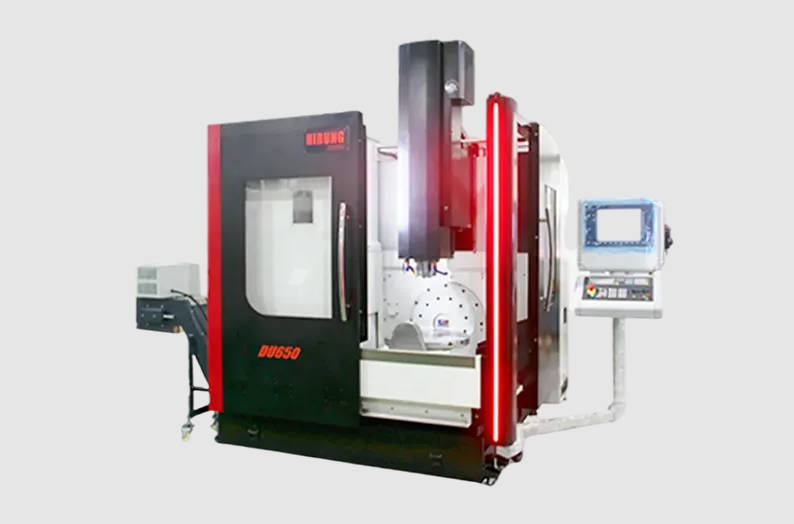
In many mold shops, 5-axis machines take over where three linear axes reach their limits: deep contoured cavities, complex parting lines, and cores with undercuts. The practical benefits are well established — the tool can approach the surface at an angle that keeps the cutting length short and the tool rigid, and multiple setups can be consolidated into one, which removes the re-clamping errors that accumulate across setups.
HIRUNG’s 5-axis lineup covers three constructions. The DU series uses German Meehanite FC30 castings, an HSK A63 built-in spindle, and a 32-tool chain magazine. The DV series targets larger, heavier parts with an integrated spindle and B-axis in a direct-drive design and a 24-tool arm-type magazine. The DC series moves the crossbeam on a gantry-type structure and carries a 30 kW built-in electric spindle with HSK A63 interface.
Gantry and Double-Column Machining Centers
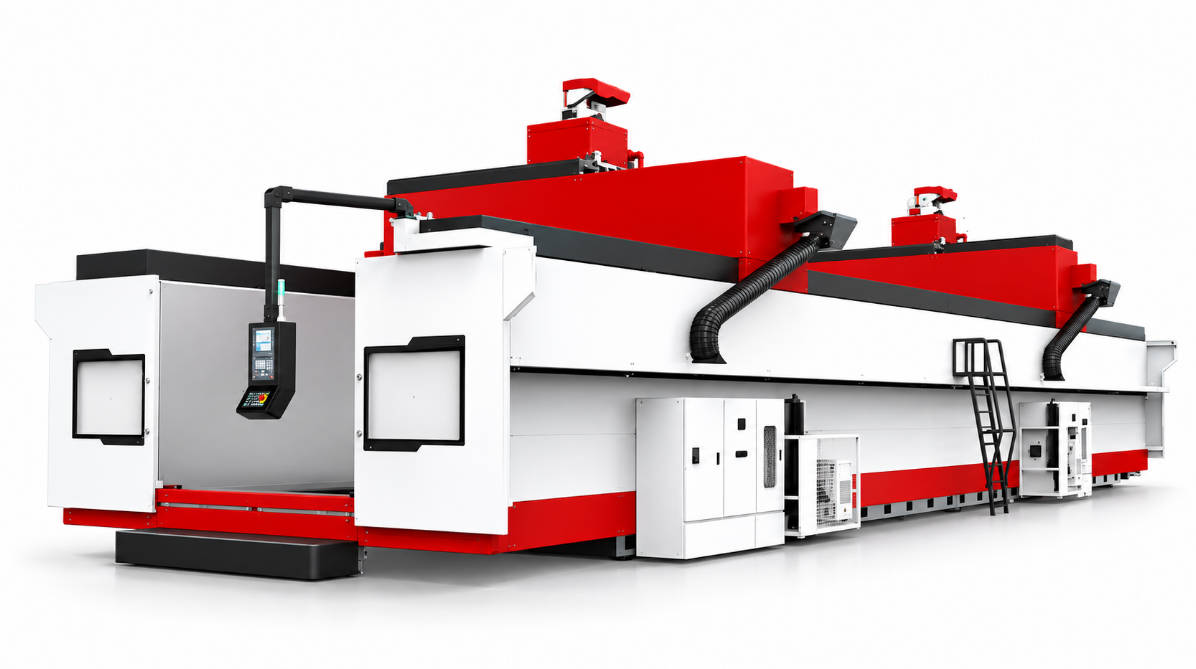
Once mold bases grow beyond what a column machine can comfortably swing — large automotive injection molds, die-casting dies, stamping die sets — a gantry (double-column) machining center becomes the natural choice. The supported bridge carries the spindle across a wide table with far greater rigidity than a single column can offer.
HIRUNG builds two gantry constructions for different jobs. The HPG series moves the column over a fixed table, which suits extra-large and exceptionally heavy workpieces — travels extend beyond 12,000 mm and table load is effectively unlimited by the machine’s own rating. The SP series moves the table under a fixed bridge, maximizing rigidity where finishing accuracy is the priority, with table loads rated up to 30,000 kg. Both approaches are explained further in our article on how gantry machines are applied in mold, aerospace and machinery manufacturing, and the current CNC gantry machine lineup is on the product page.
The Supporting Role of CNC Lathes
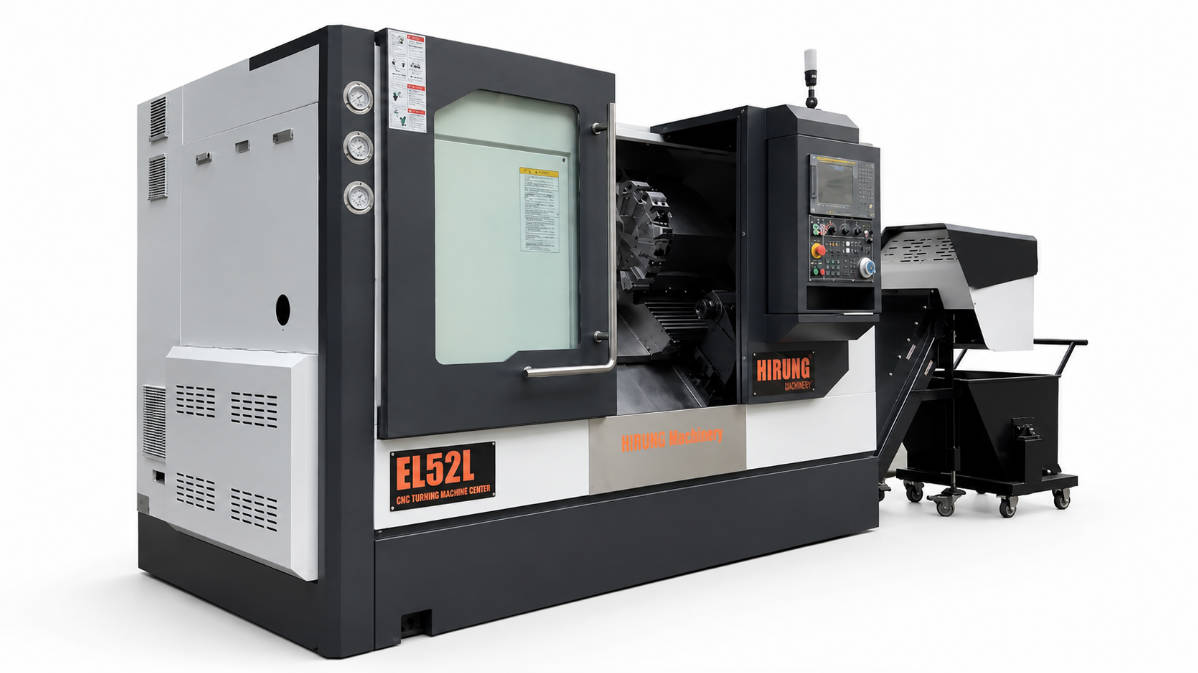
Although molds are milled, a shop that machines its own mold components in-house also produces round parts: guide pillars and bushes, sprue bushes, ejector components, and round inserts. A CNC lathe covers this work economically, which is why some mold shops add one alongside their milling capacity rather than outsourcing these components.
Key Factors When Choosing a CNC Machine for Mold Manufacturing
With the machine families clear, the next step is comparing machines within a class. These are the factors that separate a machine that holds up in mold production from one that only looks good on paper.
Travel, Table Size and Load Capacity
Start from your largest realistic mold, not your average one. The work envelope must accommodate the mold block plus tool clearance, and the table load rating must carry the mold plus fixture with margin. As a practical rule, many mold shops size the machine around the 80th-percentile mold they expect to cut, then handle the rare oversized job with an outsourced partner — buying travel you rarely use ties up budget, floor space, and power.
Accuracy, Repeatability and Thermal Stability
Positioning and repeatability figures are only meaningful alongside a measurement standard and a verification method. HIRUNG’s gantry platforms specify positioning accuracy of ≤ 0.010 mm over full travel with repeatability of ± 0.003 mm, and every machine is verified with Renishaw laser interferometer and ballbar testing before shipment. Structural alignment between critical interfaces is hand-scraped and held within 0.01 mm per 1,000 mm.
Thermal stability is what separates mold machines from general-purpose machines: spindle oil cooling that holds thermal displacement below 0.005 mm protects finishing accuracy through the long cycles typical of cavity work. When comparing suppliers, ask how each figure was measured and under what standard.
Rigidity and Damping
Structure and bearings determine how the machine behaves when a large cutter bites into hardened steel. HIRUNG machines use high-grade Mehanite cast iron (FC300 / GC-275 class) bases that are heat-treated and stress-relieved, with Class C3 double-nut ball screws and premium roller guides. For heavy roughing, box ways hardened to HRC 50+ provide the damping that absorbs cutting shock; for shops prioritizing rapid traverse — up to roughly 20 m/min on gantry platforms — premium linear guideways are the alternative. For mold work, rigidity and thermal control usually determine surface finish and tool life more than maximum rapid feed rates do.
Spindle Power, Torque and Speed
Hardened mold steels demand torque at low and medium speeds for productive roughing; aluminum and pre-hardened steels reward higher spindle speeds for finishing. Match the spindle taper to your tooling strategy — BT40 suits lighter, faster work, while BT50 and HSK A63 interfaces carry the heavier cutting typical of die and large mold work. A spindle that is powerful but thermally unstable will still cost you finishing time, which is why the cooling system deserves as much attention as the power rating.
Control System and CAM Workflow
The control must fit your programmers, not the other way around. HIRUNG offers FANUC, SIEMENS and MITSUBISHI controls across its machining centers, so most shops can standardize on the platform their CAM post-processors and operators already know. Before ordering, confirm that your CAM system’s post-processor for the chosen control is available and tested, and budget for operator training on any new platform.
Tool Magazine Capacity and Automation
A typical mold program moves through roughing, semi-finishing and finishing stages with different tools at each stage. A 24-tool arm-type magazine — expandable to 32 on selected EV models, with 32-tool chain magazines on the DU series — allows most complete programs to run unattended. For shops planning to grow into lights-out operation, magazine capacity and chip management are worth specifying early rather than retrofitting later.
Machine Classes for Mold Work at a Glance
| Machine class | Best-suited mold work | Typical strengths | Points to verify before buying |
|---|---|---|---|
| VMC | Small–medium injection molds, mold plates, inserts, sliders | Strong capability per unit of budget; simple setup; broad CAM support | Travel vs your largest mold; table load; tool magazine size; thermal stability |
| 5-axis machining center | Cavities, cores and inserts with complex 3D contours | Short, rigid tools in deep cavities; fewer setups; finer finish on curved surfaces | Spindle interface (HSK A63); CAM post-processor; programmer skill level |
| Gantry / double-column | Large mold bases, automotive injection molds, die-casting and stamping dies | Long travel; very high table load; rigidity for heavy cutting | Floor space and foundation; power supply; transport and installation access |
| CNC lathe (support role) | Guide pillars and bushes, sprue bushes, ejector parts, round inserts | Fast, accurate turning of round mold components in-house | Only worthwhile if you machine these parts yourself |
Matching Machine Class to Your Mold Types
The table below maps common mold categories to the machine class most shops use for them. Treat it as a starting point — your specific sizes and steels can shift the answer up or down one class.
| Mold type | Typical characteristics | Commonly recommended machine class |
|---|---|---|
| Small–medium injection molds (consumer, packaging, medical disposables) | Tool steels around 30–45 HRC; cavities from tens to several hundred mm | VMC; 5-axis where cavities are contoured |
| Large injection molds (automotive, appliance, logistics) | Heavy mold bases; multi-meter dimensions | Gantry — SP series where finishing accuracy dominates, HPG for extra-large workpieces |
| Die-casting dies | Hardened tool steel; deep pockets; repeated thermal cycling | Gantry or large rigid VMC with box-way construction |
| Stamping dies | Large flat plates; heavy intermittent cutting | Gantry or large VMC with high-damping construction |
| Prototype and aluminum molds | Soft materials; fast removal; speed matters more than torque | VMC with a higher-speed spindle |
| Blow molds, hot-runner and fixture plates | Often aluminum; large footprint but lighter | VMC or gantry depending on size |
Common Mistakes When Buying a CNC Machine for Mold Making
- Buying travel you will not use. Every extra metre of travel adds cost, floor space, foundation work and power demand. Size to your realistic mold range, not a worst case that may never arrive.
- Trusting spec sheets without asking how values were measured. Positioning accuracy quoted without a standard (such as ISO 230-2) or a verification method (laser interferometer, ballbar) is a marketing number.
- Ignoring thermal behavior. Two machines with identical static accuracy can differ sharply after two hours of cutting. Spindle cooling design and structural thermal management deserve direct questions.
- Choosing an unfamiliar control platform. An attractive machine price loses its appeal when post-processors, macros and operator habits all need rebuilding.
- Underestimating installation. Large machines need foundation planning, three-phase power, transport access and rigging — a 10-tonne class gantry is not delivered like a desktop device.
- Comparing purchase price alone. Tooling, fixtures, CAM licenses, training and spare-parts availability all shape the real cost of the first year.
How to Evaluate a CNC Machine Supplier for Mold Work
Equipment capability and supplier capability are two different assessments. On the equipment side, ask to see accuracy verification results for the actual machine you are buying — HIRUNG, for example, verifies every machine with Renishaw laser interferometer and ballbar testing before shipment, a level of documentation worth expecting from any supplier you shortlist. On the structural side, ask how castings are stress-relieved and how mating surfaces are finished; hand-scraped interfaces are a reliable indicator of a builder’s commitment to long-term geometric stability.
For buyers in Europe and Australia, add the practical questions early: how commissioning and acceptance testing will be handled in your region, what spare-parts lead times look like, and whether remote diagnostics are available. Export experience matters too — a supplier shipping to more than 33 countries will have settled answers on packaging and shipping arrangements. Finally, ask for a factory visit or a live video inspection of assembly and testing; a confident manufacturer will offer one without hesitation.
Frequently Asked Questions
What type of CNC machine is used for injection mold manufacturing?
Small and medium injection molds are most commonly machined on vertical machining centers, while molds with complex contoured cavities benefit from 5-axis machines and large mold bases — automotive, appliance and logistics tooling — are typically machined on gantry (double-column) machining centers. Many mold shops operate a VMC plus one larger machine rather than a single do-everything purchase.
Is a 5-axis CNC machine necessary for mold making?
Not always, but it is valuable in specific situations: deep contoured cavities, complex parting lines, and cores with geometries that force long tool overhangs on a 3-axis machine. Shops producing prismatic or relatively simple molds can hold their accuracy targets on a well-built VMC and invest the difference elsewhere.
What accuracy should a CNC machine for mold manufacturing achieve?
Requirements vary with the mold. As reference points, HIRUNG’s gantry platforms specify positioning accuracy of ≤ 0.010 mm with ± 0.003 mm repeatability, and the EV vertical machining center series quotes ± 0.005 mm positioning and ± 0.002 mm repeatability (ISO 230-2). What matters more than the individual number is that the figure is measured against a recognized standard and verified on your machine before delivery.
How much does a CNC machine for mold making cost?
Prices vary widely with size, configuration and country of manufacture — a compact VMC and a 12,000 mm gantry occupy entirely different price bands. Rather than quoting figures that date quickly, our article on what affects CNC machine price explains the cost drivers that matter for mold work: travel, table load, spindle taper and power, control platform, and accuracy verification.
Which machine class suits large automotive mold bases?
Large automotive injection mold bases are the classic application for gantry machining centers. Where the work is dominated by heavy roughing of very large blocks, a column-moving (HPG-style) design with a fixed table is the common choice; where finishing accuracy across a large surface is the priority, a table-moving (SP-style) machine under a fixed bridge maximizes rigidity — table loads on this class reach up to 30,000 kg.
Should a growing mold shop buy a VMC or a gantry machine first?
Most shops build around a capable VMC first, because it covers the widest share of small and medium work per unit of budget, then add a gantry when mold sizes and volumes justify it. The exception is a shop whose business model is specifically large tooling from day one — in that case, the gantry is the primary machine and the VMC comes later for inserts and secondary components.
Choose the Machine Around the Molds, Not the Other Way Round
Selecting the right CNC machine for mold manufacturing comes down to a short chain of questions: How large and how heavy are the molds you will cut? What steels and hardness levels will you machine? What accuracy class must you hold, and how will it be verified? Which control platform do your programmers already know? Answer those four, and the machine family — VMC, 5-axis, or gantry — usually selects itself.
If your roadmap includes large mold bases or heavy die work, start with the HIRUNG CNC gantry machine range, where the column-moving HPG and table-moving SP series cover travels beyond 12,000 mm and table loads up to 30,000 kg. For smaller and medium molds, the EV vertical machining center and DU/DV/DC 5-axis series extend the same build principles into compact footprints. Compare the machines against your mold list, and contact the HIRUNG team to discuss the configuration that fits your production.